
Blog
Insights on AI transformation, the strategy-execution gap, and what it takes to close the loop between intelligence and action.

“We do not measure success by the number of messages exchanged.” The UAE’s new agentic AI design guide defines what an AI assistant is for — to finish, not to answer. Five tests any business can run on itself.

295,000 Dubai companies have two years to adopt agentic AI. The risk isn't moving too slowly — it's ticking the box without moving a number that matters. A framework for AI and Innovation leaders.
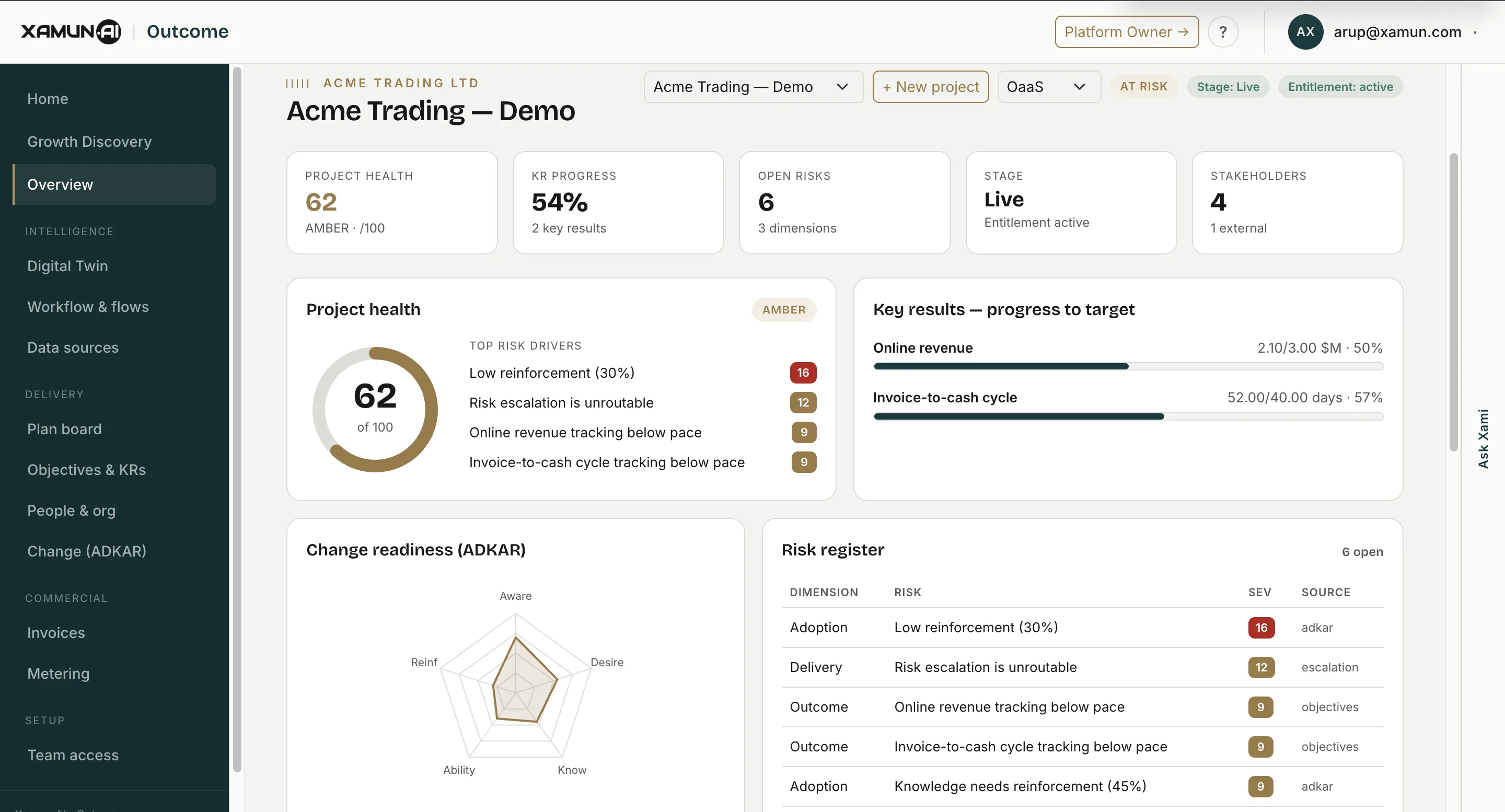
Transformations fail on follow-through, not technology. Outcome makes the diagnosis, the change management, and the accountability impossible to skip — and bills only as the growth lands.

Dubai's mandate requires every private-sector company to adopt autonomous AI agents within two years. What it requires — and how mid-market companies turn the deadline into growth.
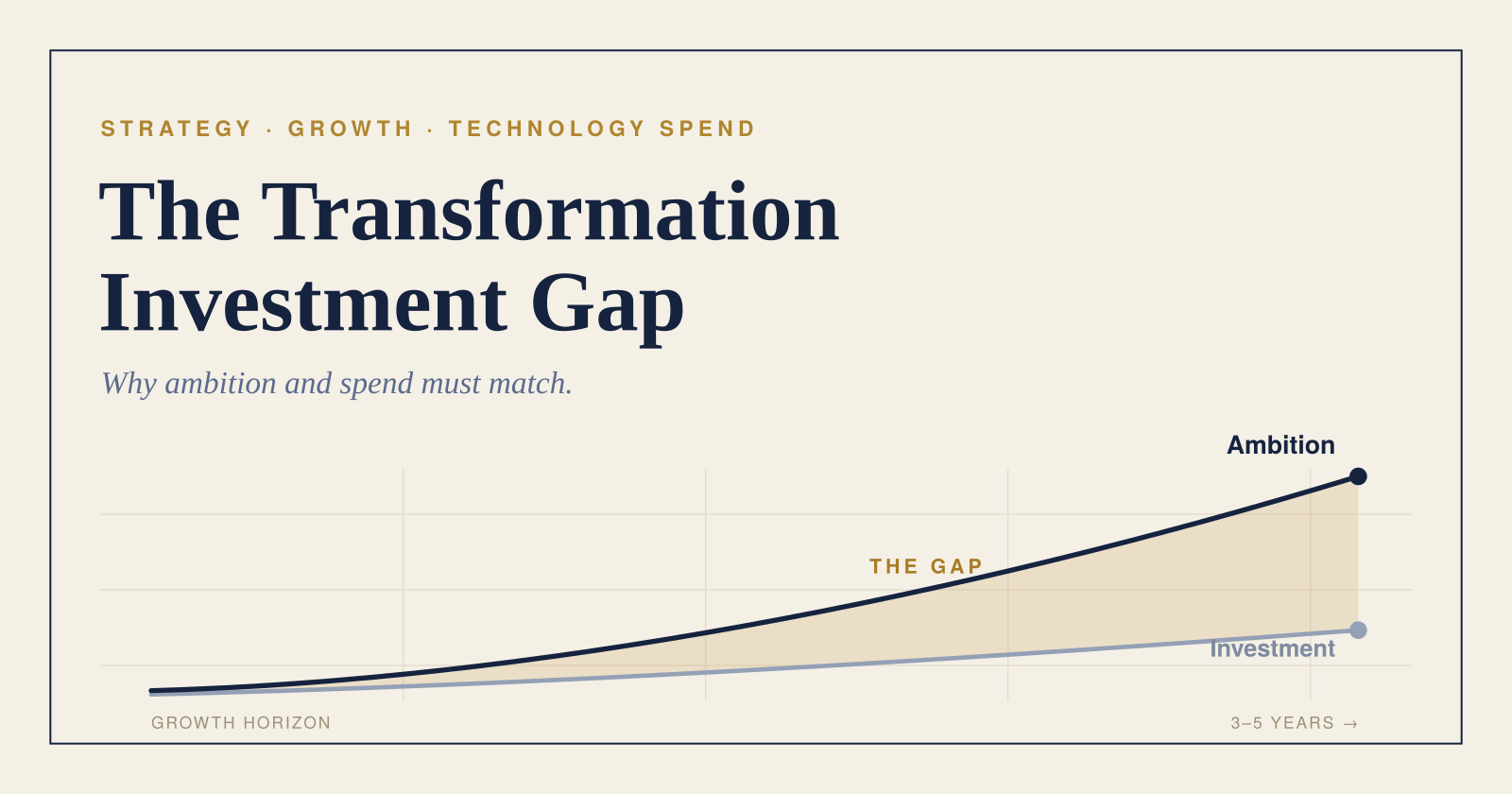
Most mid-market companies don't know what they actually spend on technology — or what their ambition requires them to spend.

A practical step-by-step guide for mid-market CEOs. Assess your starting point, prioritise AI use cases by ROI, and structure a 90-day plan — no $2M engagement required.

Bolting AI tools onto existing processes makes broken processes faster. Here's the difference between AI adoption and AI transformation — and how to tell which one your business is actually doing.

Most leaders use these terms interchangeably. They're not the same. Digital transformation digitised your workflows. AI transformation creates systems that learn, decide, and govern continuously.

70% of AI projects fail before they scale. Here are the three root causes — and a practical framework mid-market leaders can act on today.

Traditional development takes 6–18 months. AI-native delivery takes 21 days to working software. Here's what drives the difference — and how to evaluate any vendor's timeline claim.

Typical budget ranges, where the money goes, how to calculate ROI before committing — and why most mid-market companies already have the budget hiding in SaaS spend they've outgrown.

A system quoted at $500K and 12 months in 2022 can now be delivered in 21 days. Here's what changed — explained for C-suite leaders, not developers.

BI tells you what happened. Decision intelligence tells you what to do. AI decision intelligence tells you what's happening right now — and acts on it. Here's the full distinction.

Most business intelligence platforms answer questions. Xamun Intelligence asks them — monitoring market signals, competitor moves, and operational data 24/7 before you think to look.

An Opportunity Map is a prioritised list of AI interventions ranked by ROI and feasibility — generated from a diagnostic interview, not a six-month consulting engagement. Here's how it works.

Most strategy doesn't fail because it was wrong. It fails because nobody was watching it closely enough between quarterly reviews. Here's what always-on governance changes.

Organisations rarely fail catastrophically. They drift incrementally — initiative by initiative, week by week — until the drift becomes the strategy. Here's how to catch it before it compounds.

The judgment that built your business is now its ceiling. Every mid-market CEO carries a governance system in their head that no one else can access. Here's what externalising it actually means.

Most leaders say they want to be data-driven and proactive. The always-on enterprise is the operational definition of that aspiration. Here's what it looks like in practice.

Most leaders can diagnose what's wrong. Very few have a system that ensures the fix is implemented and tracked to completion. Here's why closing the governance gap is the real transformation challenge.

Mid-market businesses are too big for simple SaaS and too small for enterprise platforms. The gap is filled with spreadsheets — and the cost is higher than most leaders realise.

Most software projects fail not because the code is bad but because the specification was incomplete. Spec-first development fixes this — and it matters even more when AI is writing the code.

Most software projects go wrong before development begins. A good brief isn't a list of features — it's a precise description of the problem, the outcome, and the constraints. Here's what to include.

Off-the-shelf AI tools are built for average businesses. If your competitive advantage lives in how you operate, a generic tool can't protect it. Here's the build vs buy framework.

Generic software for specialist workflows doesn't just underperform. It creates costs that never appear on the software budget — in headcount, errors, and margin that silently leaks.

AI transformation is not a project with an end date. Every intelligence signal reveals a workflow to build. Every governance gap reveals a capability to deploy. The business that wins builds continuously.

AI hasn't just made software development faster. It has changed what building software fundamentally means. Here's the full definition — and why the cost and time equation has permanently shifted.

71% of US hospitals now deploy AI. Mid-sized clinics and hospital groups are falling behind — not for lack of intent, but for lack of a starting point. Here's the practical roadmap.

An EHR 18 months over schedule. A patient portal nobody used. A compliance system that created more admin than it replaced. Three real patterns — and what went wrong each time.

Healthcare AI is not a chatbot on your website. The applications that genuinely transform clinical outcomes are in operations — intake, workflows, reimbursement, staffing. Here's what they look like.

Patient throughput. Clinical admin hours. Compliance cost. Staff utilisation. These are the metrics that make the healthcare AI business case — not "efficiency gains." Here's how to build it.

Before building, assess. Data infrastructure, workflow documentation, governance capacity, change readiness — four dimensions that determine whether your AI investment will succeed or stall.

HIPAA. GDPR. NHS Digital standards. Compliance uncertainty stops more healthcare AI projects than budget constraints do. Here's what to resolve — and what isn't actually a blocker.

Compliance automation, credit decisioning, fraud signal monitoring. The highest-ROI AI applications in financial services are operational — not customer-facing. Here's the roadmap.

A core banking migration that took four years. A compliance platform that didn't connect to reporting. A robo-advisory that confused more clients than it helped. Three real failure patterns.

Financial services AI is not a chatbot that answers account balance questions. The applications that transform margins are in regulatory reporting, loan decisioning, fraud detection, and operations.

Stop guessing whether AI is working. Here's how financial services CEOs measure real ROI across compliance, decisioning, fraud, and onboarding — with a worked example showing £570K annual return.

AI can reduce compliance workload by 60–75% — but only if the architecture decisions are right. Here's how mid-market financial services CEOs approach AI compliance automation safely, with FCA, PCI-DSS, and GDPR in mind.

Neobanks approve loans in 23 minutes. Traditional lenders take 6 days. The gap isn't talent — it's architecture. Here's how mid-market financial services firms close the speed gap without regulatory risk.

Last-mile delivery costs eat 50% of your logistics budget. Route planning wastes 2+ dispatcher hours a day. Here's where mid-market logistics operators start with AI — and how to measure the return.

A £1.2M TMS that drivers ignored. A tracking portal that customers never opened. A warehouse management system that made picking slower. Three cautionary tales from logistics digital transformation — and the structural reasons behind each failure.

The AI that matters in logistics isn't a chatbot. It's the system that cuts fuel costs by 20%, reduces customer status calls by 65%, and gets invoices out the same day as delivery. Here's what operational AI actually looks like.

Fuel savings. Status call reduction. Fleet availability. Invoice cycle time. Four ROI metrics every logistics CEO should track before and after AI — with a worked example showing £330K annual return on a £95K investment.

EU carbon tracking, customs documentation, driver hours regulations — logistics compliance is growing more complex and more manual. Here's how AI handles the administrative burden while keeping you on the right side of every obligation.

Your professionals spend 28% of their time on non-billable admin. Utilisation sits at 68% against an 80% target. Client reporting takes 5 hours per client per month. Here's where professional services firms start with AI — and what to measure.

A £95K practice management system nobody used after six months. A client portal with 4% adoption. An AI proposal tool that made proposals longer and slower. Three professional services technology failures — and the structural reasons behind each one.

The AI that transforms professional services isn't a chatbot or a generic writing tool. It's the system that monitors project margin in real time, surfaces the right person for the right brief, and produces client reports in 10 minutes instead of 5 hours. Here's what it actually looks like.

Billable utilisation. Admin overhead. Project margin. Client reporting. Four metrics every professional services CEO should measure before and after AI — with a worked example showing £679K annual return on a £95K investment.

AI will automate 40–60% of traditional BPO work within five years. But the threat is not to Filipino talent — it is to the delivery model that has defined the industry. Here's what BPO leaders need to understand and act on now.

Client confidentiality, GDPR, professional regulatory bodies, conflict of interest — professional services AI compliance is distinctive. Here's how mid-market consulting, legal, and accountancy firms navigate it without stalling progress.

PE and Family Office returns depend on turnaround execution that no PMO spreadsheet can sustain. How Xamun Intelligence becomes the always-on AI copilot for the value-creation plan.

Procurement was designed to protect buyers from bad vendors. In the AI era, it protects them from speed. How transparent estimation and story-point engagement break the deadlock.

Most corporate strategies don't fail at the boardroom. They die in the long, quiet stretch between approval and execution — when conditions shift and good work continues in the wrong direction.

Strategy firm. Engineering firm. Change firm. Three vendors, three contracts, three sets of incentives — and a single business outcome that no one signed up to be responsible for.

CEOs hear "AI Operating System" and reach for infrastructure, chatbots, or agent runtimes. Three different things, three different vendors — none of them what mid-market actually needs.
SaaS sold access to a tool — the customer was responsible for the outcome. OaaS inverts the contract. Why now? AI economics finally make outcome accountability viable.

BCG-popularised: transformation is 10% algorithm, 20% technology, 70% people and process. Most AI strategy inverts the ratio — and pays for it.

Twelve diagnostic questions for CIOs and CEOs evaluating AI Transformation vendors. The checklist that separates structural fit from sales theatre.

Two letters reordered. The whole vendor-customer contract inverted. Why AI economics finally make Service-as-a-Software a sustainable business model.

Volatility, uncertainty, complexity, ambiguity isn't a periodic crisis — it's the steady state. If the market moves weekly and your strategy reviews are quarterly, you're running a postmortem.

Consulting firms start from zero and take weeks to learn your business. Xamun Intelligence has already read your filings, competitors, and market signals before you sit down with it.

Quarterly reporting is a record. Continuous governance is a nervous system. How the Objective Governance Dashboard scores every annual goal in real time.

Intelligence without execution is a presentation. The Xamun Software Factory closes that gap — specification first, working software in 21 days, continuous sprints thereafter.

Most mid-sized businesses don't have a strategy problem — they have a translation problem. Here's what AI Decision Intelligence means for the mid-market.

An NHS patient waits 31 days for a new appointment. A patient in Manila waits 35-40 days with acute physician shortages. Yet AI is solving both problems differently.

In London, a borrower waits 5-7 days for a loan decision. In Manila, AI-driven platforms approve loans in under 24 hours using transaction history.

UPS processes 1+ billion data points daily and has spent $1 billion on AI route optimization. Yet neither UPS nor Amazon has solved last-mile delivery where it matters most.

The consulting industry has a $500 billion open secret: the majority of AI strategy engagements end with a presentation that never becomes operational reality.

Palantir AIP is genuinely world-class intelligence. But for mid-market companies, it's $1M/year and doesn't build the software.

What does $2M in consulting actually buy? A strategy deck. Here's what $182,500 buys: working software and continuous intelligence.
AI is making the billable-hour model obsolete. The IT services giants are pivoting to consulting. Here's what that means for buyers.
A week-by-week plan to go from AI assessment to deployed, outcome-tracked software in 90 days. No $2M consulting engagement required.
See it in action
See how Xamun Intelligence closes the loop — then book a Discovery for your business.