
You buy the result.
This is the machine that delivers it.
Outcome-as-a-Service is the what: you buy the business result — diagnosed, built, deployed and measured. This page is the how — what actually happens, in what order, on what cadence, and who is accountable for the metric moving.
Not a tool to make work. A result we're on the hook for.
The mechanics below only make sense once you see what changes hands. With software, you take delivery of a tool and the outcome stays your problem. Under Outcome-as-a-Service, the outcome is ours.
You take delivery of a tool.
- — You pay up front, per seat
- — You configure, integrate, operate it
- — You retrofit measurement later, if ever
- — The vendor is paid whether you grow or not
You take delivery of the metric, moved.
- ✓ No upfront CAPEX — we invest alongside you
- ✓ We diagnose, build, run and tune the system
- ✓ Measurement is built in from Day 1
- ✓ Paid when the number moves — never for hours
Three steps. One bottleneck at a time.
We measure before we build, and we're paid after it works — so you never pay for something that hasn't.
Discovery
A short diagnostic finds the one operation that's capping your growth. Not "improve productivity," but a number: fuel cost per shipment, time-to-onboard, capacity utilisation. We name the bottleneck, measure what it costs you today, agree the number that means it's solved, and say which door it goes through. Not sure which operation it is? Discovery starts with the constraint inventory below.
Build and launch
The Software Factory builds the software that unlocks it — spec-first via xDD, typically live within weeks — instrumented to the number from day one, so the first day of operation produces measurable data. What the solution turns out to be is our problem; you never see a change request.
Done — and held
Done is when the number holds unattended for the agreed period, with a person only at a real judgement fork. The Objective Governance Dashboard tracks it weekly. For three years after done, if the number slips, we re-engineer whatever it takes to bring it back — free, whatever the cause. No questions.
And if it slips, we keep building. No questions. Not bug versus change, not your data versus our code. It's proof the incentive is the outcome, not the hours.
Constraint inventory.
If you don't know which operation to start with, Discovery starts here. We list the operations that run your business, and score each on four tests: is the output countable, is it the constraint on the next stage, is the change reversible, and does one person own it. Most businesses have three or four that pass. We pick one, measure it, and put a number on it. The rest of the list is yours to keep — it is not a plan we invoice, it is the order we'd go in.
The four tests come from our position paper Your AI strategy is a list of tools. It should be a list of operations. →
After the first bottleneck.
Most clients don't stop at one. When the first number holds, the new capacity moves the constraint somewhere else — that's the point. We run the inventory again, name the next operation, agree its number, and start the meter on that one separately.
Each operation is measured, priced and held on its own. There is no programme fee, no transformation retainer, no plan we invoice. Strategy, for us, is the list of operations we're willing to put a number on. Why that list, and not a list of tools, is the strategy: the position paper →
Three commitments, made up front and governed continuously.
"We'll work on it" isn't a contract. An OaaS engagement commits to three things, in writing, from the start.
A defined metric
The business metric is named in Discovery — a specific number with a current baseline and a target. The engagement is tied to that number, not to a deliverables list or a feature backlog.
Instrumentation from Day 1
Measurement is built at launch, not bolted on in v2. The moment the system goes live, it is already producing the data that proves whether the metric is moving.
Continuous governance
The Objective Governance Dashboard tracks the number weekly. If it isn't moving, Xamun Intelligence surfaces why and we change the build — before the quarterly review, not after, and never as a change request.
The metric is reviewed against baseline and target every week — continuous, not quarterly.
The system that moves the number ships in short increments, instrumented from the first day it runs.
Usage: a small fee per transaction, starting the day the operation runs through the system. Licence: one capital fee, final payment at done.
One accountable system — not three firms.
Most transformations split the work across a strategy consultancy, an IT firm and a change team — and nobody owns the gap between them. Xamun runs the loop as one: forward-deployed experts who carry the result, Xamun Intelligence that guards the direction, and the Software Factory that builds it.
Senior Xamun people sit inside your operation and carry the number — 25+ years of building and running global software behind them. They set strategic direction, not just execution, and they don't hand the outcome off to anyone. Your success is their target.
Meet the people behind the loop →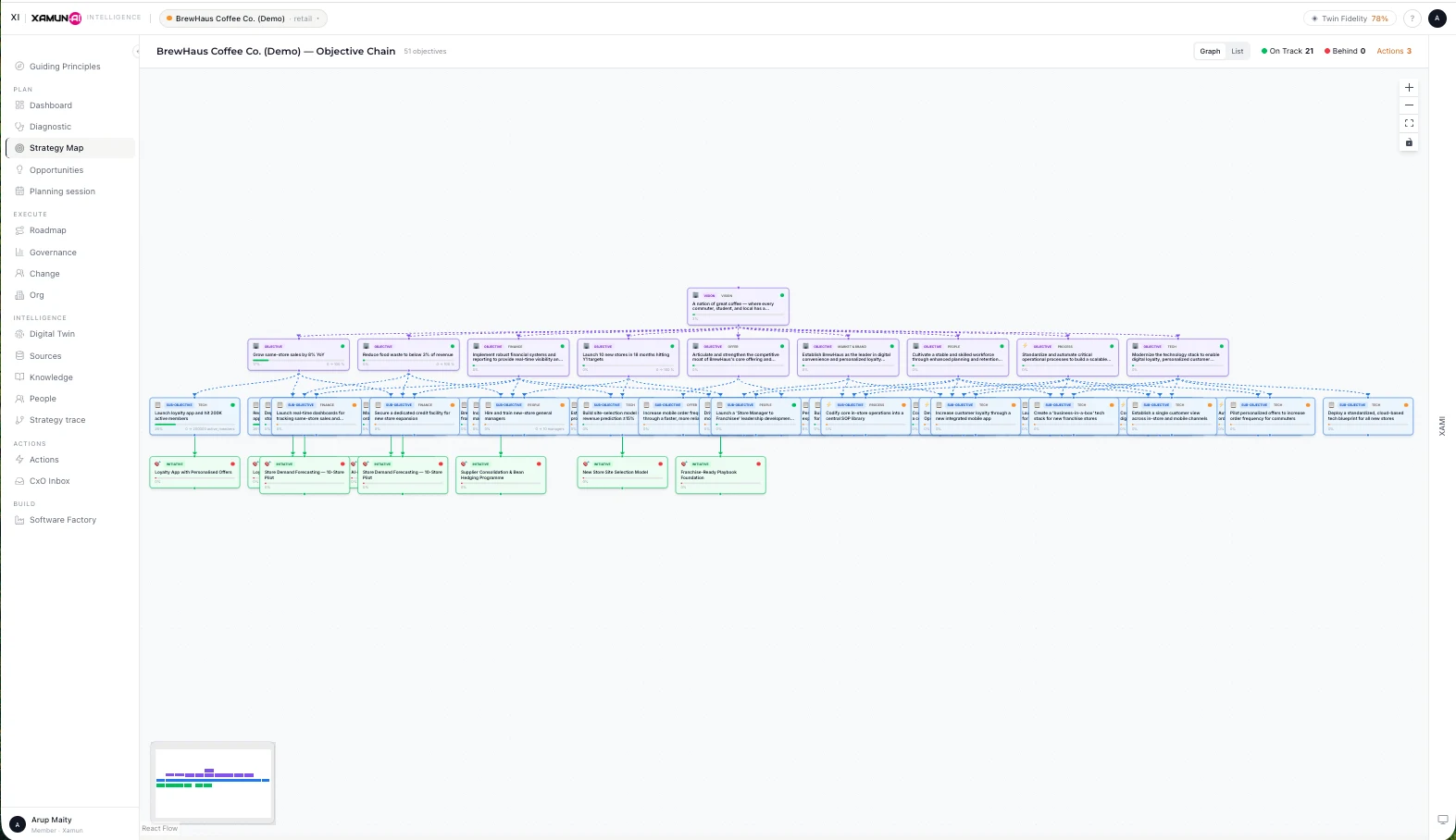
XI reads your operation during Discovery, derives what needs to be built to move the number, and watches the result after launch. When the number stalls, it surfaces why and proposes the next move — so governance is a nervous system, not a quarterly report.
Read more about Xamun Intelligence →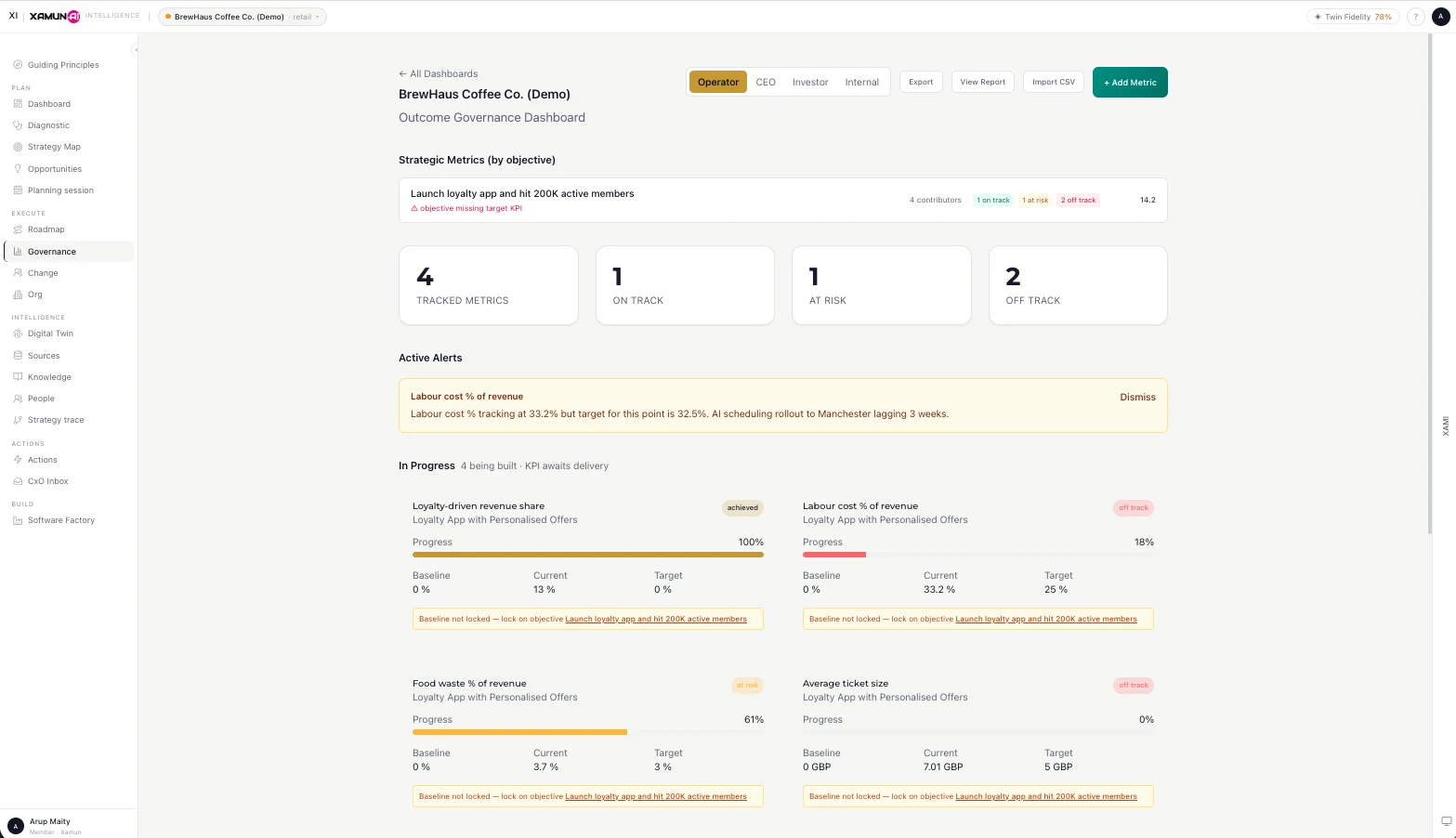
The Factory builds the system that moves the metric — spec-first via xDD, AI handling 95%+ of the build, expert engineers confirming the rest, instrumented from launch. Coding tools make one developer faster. The Factory redesigns the whole lifecycle around AI and delivers the outcome, end to end.
Read more about the Software Factory →Our principals ship your software.
Most software vendors separate the people who understand your business from the people who build the software. Requirements pass through account managers, analysts, project managers and delivery teams, and something is lost at every handoff. Xamun inverts this. The principals who sit with you — the most senior people in the firm — are the ones who translate the problem and ship the solution. Everyone and everything else at Xamun, including the Software Factory, exists to make those principals faster and their output enterprise-grade.
Because the person who scoped the outcome is the person delivering it, we can sell the outcome itself: no hourly rates, no FTE contracts, no change-request economics. You pay for a working system, delivered in weeks, owned by you.
| Model | What you get | Where it breaks | Xamun |
|---|---|---|---|
| Global integrator or consultancy | Senior people in the room when the work is sold. | Delivery moves to a larger, more junior team. Billing by the hour means scope growth is revenue. | The principal in the room is the one delivering. Billing by outcome means scope growth is our cost, not your invoice. |
| Offshore development shop | Capacity at a low unit cost. | You supply the understanding, and you carry the risk that it survives translation. | Understanding is the product. The Software Factory supplies the capacity. |
| Boutique agency | Senior attention throughout. | Output is hand-built, so throughput is capped by headcount. | Senior attention at factory speed, because the Software Factory does the building. |
| Packaged SaaS | Fast to start and predictable to budget. | You adapt your operation to fit the software. | Built to fit your operation, at comparable speed, and you own the code. |
These are delivery models, not named firms. Any individual firm may work differently.
What if the principal is busy, or leaves?
The specification, the build history and the domain context live in the Software Factory, not in one person's head. Another Xamun principal can pick the engagement up without putting you through Discovery again.
What month six looks like.
Tuesday, 8:40am: our forward-deployed lead messages your COO — "utilisation dipped on three routes last week; here's what we think it is, and what we'd change." Thursday: we're in your ops review, on your agenda, with your numbers. End of month: an invoice that shows its math — count × rate — for the transactions the system actually ran.
That's the difference between a vendor and a colleague: a vendor waits for tickets; a colleague speaks up first.
The machinery behind that behaviour — the escalation ladder, the weekly sponsor digest, invoices that ship with their basis of computation — runs on Outcome, our operating platform.
What's on the dashboard — and what isn't.
Velocity is vanity. Sprint completion, feature counts and a busy activity feed tell you the team was working — not whether the company moved. So those aren't what the Objective Governance Dashboard reports against.
What it reports is the one number named in Discovery, tracked weekly against its baseline and target. Fuel cost per shipment, down. Onboarding, from 8 days to 2 hours. Capacity utilisation, 65% to 82%. If the metric the CEO cared about isn't on the dashboard, the dashboard is theatre.
What the loop looks like — in three sectors.
Same mechanics, different binding metric. Each is defined in Discovery and tracked from launch.
Illustrative of how the loop is scoped per sector. The binding metric and targets are set in your Discovery. See outcomes by industry →
How the engagement runs — answered.
Name the bottleneck. Then watch the number move.
A short Discovery names the bottleneck, measures the number, and tells you which door it goes through — and you'll meet the people who'll be inside your operation.