
The Transformation Investment Gap: Why Ambition and Spend Must Match
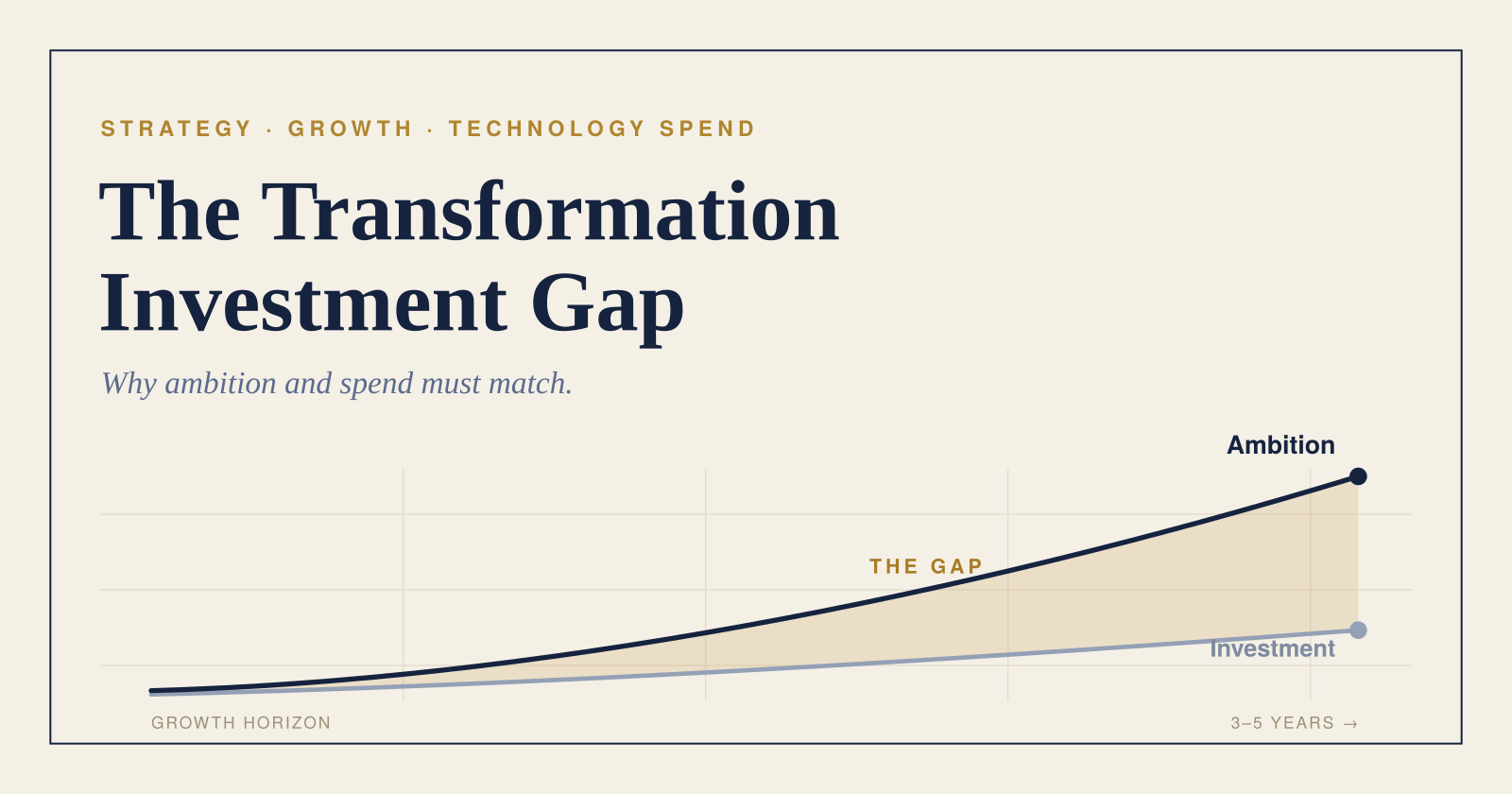
Two identically sized companies with different growth ambitions should not spend the same on technology — yet benchmarks quietly push them to. This is the transformation investment gap: the distance between what your ambition requires and what you actually spend. Most leaders can't even see it, because they don't know their true technology spend to begin with. Here is how to find the real number, size it to your posture, and fund the move — often without new budget at all.
There is a gap inside most mid-market companies that never shows up on a balance sheet. It is the distance between what a company's ambition requires it to invest in technology, and what it actually spends. Leaders rarely see it, because they are missing the two numbers that define it: what they truly spend today, and what their ambition would cost to fund.
Close that gap and transformation becomes a budgeting decision rather than a leap of faith. Leave it open and the symptoms arrive quietly — competitors moving faster, initiatives that never quite land, a strategy that outpaces the means assigned to it.
The Number You Don't Actually Know
Before deciding what to spend, you have to know what you already spend — and most organisations don't. The honest figure is not the IT line in the budget. It is engineering teams, outside consultants, outsourced development, every SaaS subscription across every department, cloud services, and the long tail of tools bought on someone's card and never reviewed.
That last category is larger than almost anyone expects. Research has found that organisations underestimate their SaaS spending by more than 300%. If you don't know the real denominator, every conversation about "how much should we invest?" is built on sand. The first move in closing the investment gap is not spending more — it is seeing clearly what you already spend.
The Benchmark, and the Trap Inside It
Once you know your real number, the natural next step is to compare it to peers. Technology spend varies enormously by sector: banking runs north of 7% of revenue, while construction sits below 2%. Mid-market companies typically land somewhere between 5% and 8%.
Benchmarks are useful, but they hide a trap. They tell you what your peers spend — not what your ambition requires. Two competitors of identical size, one defending a comfortable position and one trying to double in three years, should not be spending the same percentage. The average is a description of the past, not a prescription for where you are trying to go. Anchoring to it quietly caps your ambition at the median of your industry.
The Variable the Benchmarks Ignore: Posture
The missing variable is business posture — whether you are playing offence, defence, or simply keeping the lights on. Posture, not sector average, should drive the investment decision.
The most useful frame here comes from research by Bansi Nagji and Geoff Tuff, who studied how companies allocate innovation investment. The firms that outperformed put roughly 70% into their core, 20% into adjacent opportunities, and 10% into genuinely transformational bets. The striking part is the return: that small transformational slice generated something close to 70% of long-term innovation returns — while routinely being the first thing starved of funding.
The lesson for a mid-market CEO is uncomfortable but clarifying. The work most likely to change your trajectory is the work least likely to be funded by a budget built on last year's averages. Posture is how you correct for that — you decide, deliberately, how much of your spend is defending today versus building tomorrow, and you fund accordingly.
The Three Dials That Make It Specific
Posture is the philosophy; three dials make it a number.
Industry baseline. Where does your sector actually sit — the 2% world or the 7% world? This sets the floor.
Gross-margin affordability. Technology investment has to be paid for out of margin, so the right ceiling is expressed as a share of gross margin, not revenue. A high-margin software business can sustain a very different number from a thin-margin distributor of the same size.
Growth ambition. This is the dial benchmarks omit entirely. The more aggressive the goal, the further above the sector baseline you should sit.
For most mid-market companies, those three dials resolve to roughly 10–16% of gross margin in steady state — a figure precise enough to defend in a boardroom and flexible enough to flex with ambition. It is a far more honest answer than "the industry average is 6%, so let's do 6%."
What Underspending Actually Costs
Underspending against your ambition does not announce itself with a crisis. There is no single quarter where the gap shows up as a number. Instead it compounds silently: a competitor ships the thing you were planning, the roadmap slips another two quarters, the transformational 10% gets quietly reallocated to keep the lights on. The cost is the return you never earned — the 70% of long-term value that lived in the work you didn't fund.
That is what makes the investment gap dangerous. It is invisible until it is structural.
Spend More — But Don't Bet Blind
None of this is an argument for simply spending more. Roughly 70% of digital transformation initiatives fail to meet their objectives, and writing a bigger cheque does not change those odds — it raises the stakes on them.
Closing the gap responsibly requires two controls running alongside the spend. The first is continuous measurement of investment against results, so you find out a programme is drifting in weeks, not at the post-mortem. The second is governance built around the things that actually decide transformation outcomes: adoption and culture. Both McKinsey and BCG keep finding the same thing — the dominant obstacles are rarely technical. They are whether people use what was built. (Why most AI implementations fail and the governance gap both come back to exactly this.)
This is also why the 10-20-70 rule matters as much for budgeting as for delivery: if 70% of the work is people and process, a budget that funds only software and infrastructure has mispriced the whole programme.
You May Not Need New Budget at All
Here is the part that changes the CFO conversation. Somewhere between 40% and 50% of purchased SaaS licences sit unused, draining money every month for value no one receives. For most mid-market companies, a meaningful share of the transformation they want is already funded — it is just being spent as waste.
This is the analysis we run as part of every Discovery: a structured review of where spend is duplicated, underused, or pointed at a problem a purpose-built system would solve better. We call what it surfaces the Found Budget. It rarely covers an entire transformation, but the Found Budget we identify often offsets a meaningful share of the investment — which reframes the decision from "approve new spend" to "redirect existing spend toward the roadmap." (The same diagnostic produces the Opportunity Map: where the money should go once it's freed.)
The Discipline: Spend to the Outcome, Not to the Average
Pulling it together, a transformation budget done well has four properties. It is sized to posture — set by ambition and margin, not by the sector median. It is funded first from reallocated waste, so new budget is the last resort rather than the first ask. It is governed by feedback loops that measure spend against outcomes continuously. And it is anchored in change management, because that is where most of the return — and most of the risk — actually lives.
The companies that pull away are not the ones with the biggest technology budgets. They are the ones whose spend matches their ambition, and whose ambition is honest about what it costs. Everyone else is living inside the gap — paying for it quietly, in the returns they never see.
Related reading: The AI Transformation Budget for Mid-Market → The 10-20-70 Rule: Why Technology Alone Doesn't Transform Businesses → The Governance Gap →