
Point Xamun at an existing codebase and its reverse-engineering agents map the whole system into a living knowledge graph and a regenerated specification. From there, refactor and stabilise what you have — or replatform it onto a modern stack entirely. At the same speed and efficiency as a new build. Legacy modernization runs through either door: as an outcome we carry end-to-end, or as a Turnkey build under your team’s direction.
No multi-year rewrite. No rip-and-replace risk. You own the code.
Legacy platforms accumulate technical debt with every patch. The people who understood them have moved on. Documentation is stale or gone. Every change is slow, risky and expensive — and the longer it runs, the more it costs to touch.
The usual options are both bad: keep paying the operational tax forever, or commit to a multi-year, multi-million rewrite that may never land. Xamun gives you a third path — and it moves at the speed of the factory.
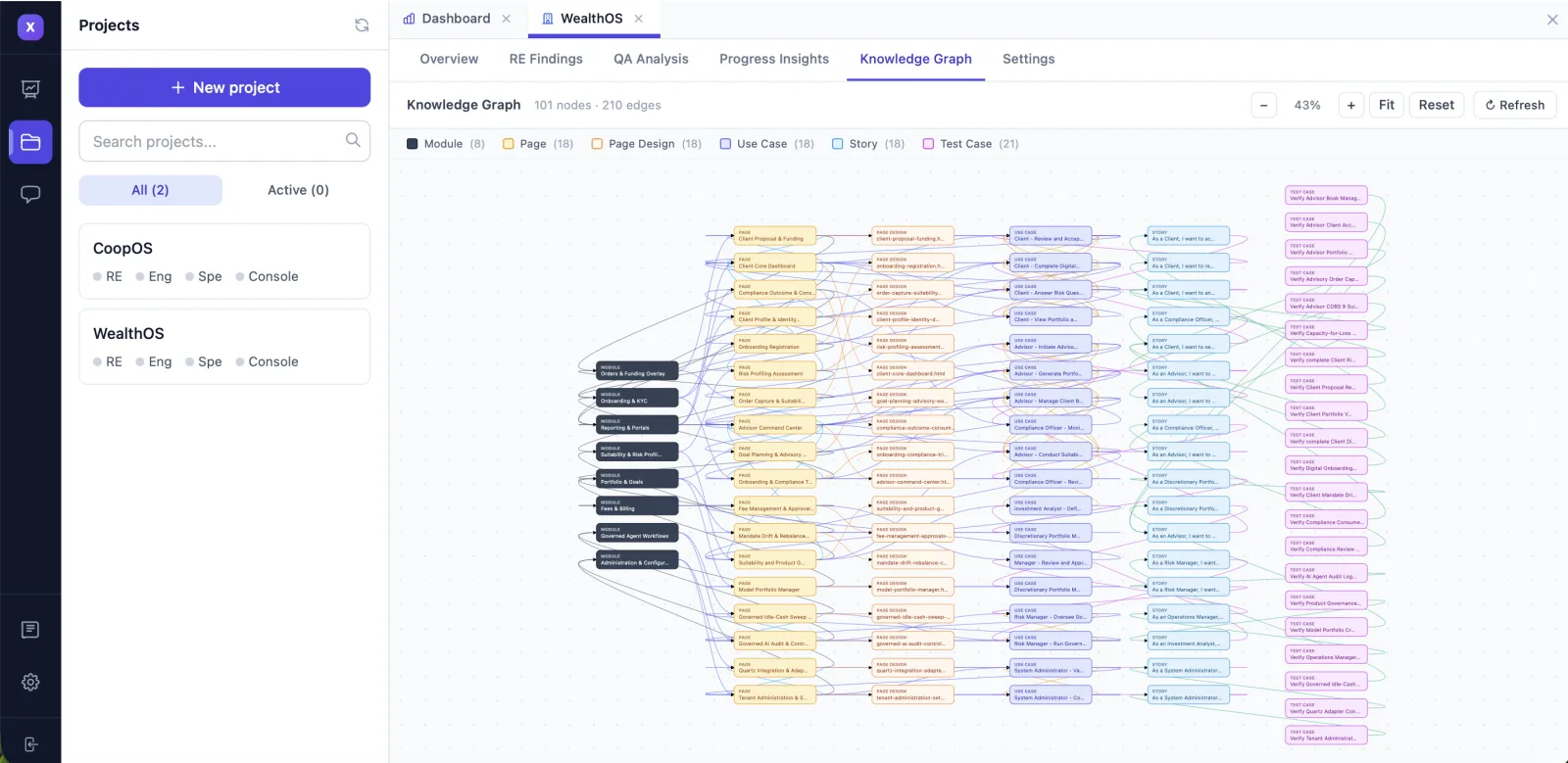
XamunForge runs the same agentic pipeline in reverse — turning an opaque codebase into a specification you can read, govern and rebuild from.
Register the existing system with read-only access. Reverse-engineer plugins go to work: graphify for knowledge-graph extraction, dep-scan for the dependency catalogue, api-extract for OpenAPI spec inference.
Input: Your codebaseAgents reconstruct modules, pages, business processes, use cases, user stories and data into a connected, navigable knowledge graph — the system's real behaviour, made legible.
Output: System knowledge graphFrom the graph, XamunForge regenerates a full SRS — business processes, catalog entities and page designs synced into Xamun Core — the same spec format every Xamun build runs on.
Output: Regenerated specWith a clean spec in hand, the factory rebuilds at AI speed — stabilise the current stack, or generate a modern one from scratch. Tests, quality gates, UAT, handover. You own the code.
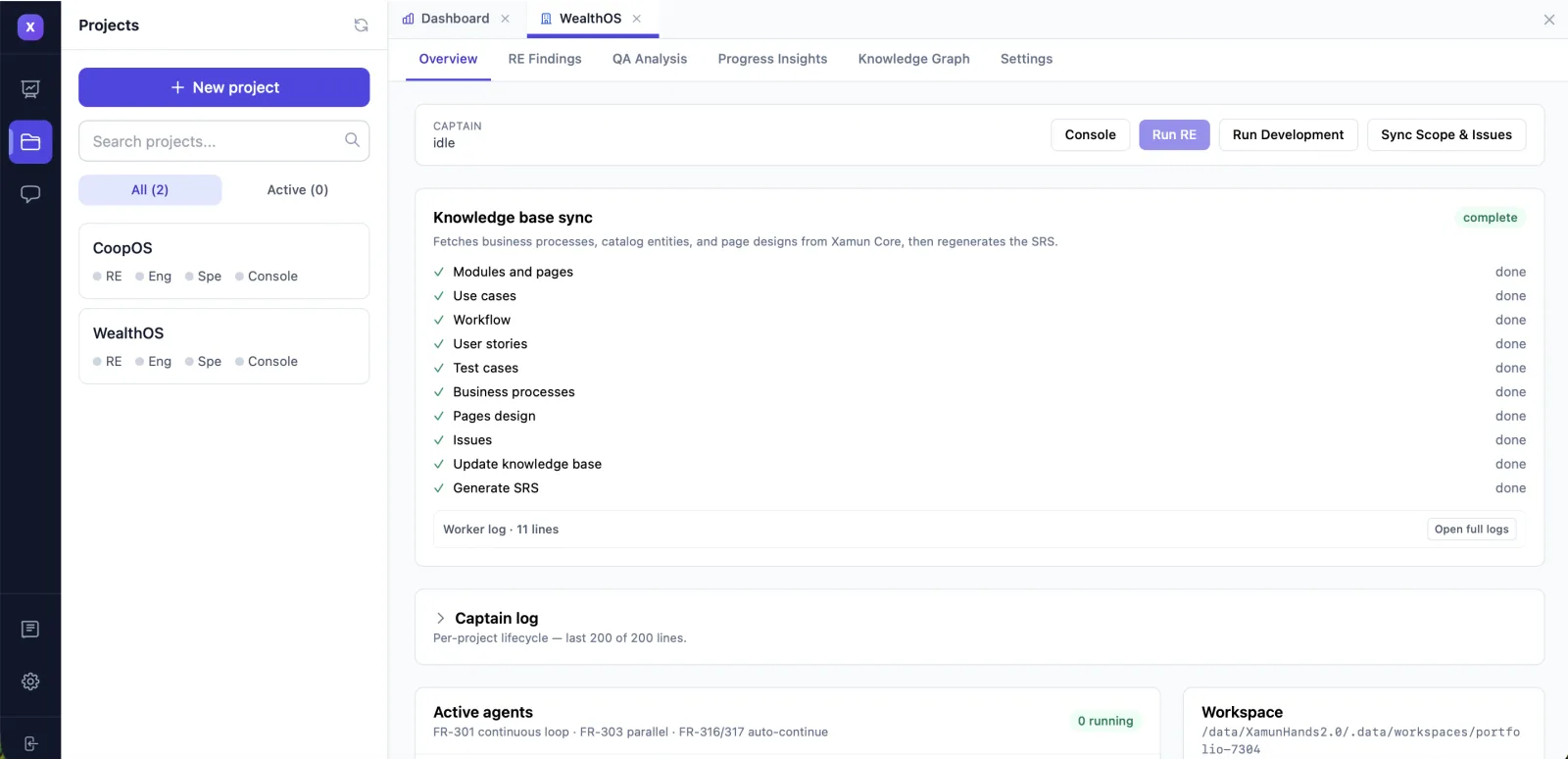
Output: Modern systemXamunForge fetches business processes, catalog entities and page designs from the running system and regenerates the SRS against them — modules, use cases, workflow, user stories, test cases, all reconciled. The result is a specification that matches what the system actually does, ready to refactor or rebuild from with full governance.
You don't have to bet the business on a big-bang rewrite. Once the system is mapped, choose the path that fits — per module if you like.
Keep the stack, kill the debt. Untangle the spaghetti, restore test coverage, document the behaviour, and patch the structural risks — guided by the knowledge graph so nothing breaks silently.
Regenerate the whole system onto a modern, supported stack from the recovered spec — preserving the business logic, shedding the legacy runtime, framework and infrastructure constraints. At new-build speed.
The same factory that builds greenfield systems in under a day runs the rebuild — so legacy modernization stops being a decade-defining gamble.
The rebuild is an AI step measured in hours, not quarters. Re-run it on every change, the same way the factory ships new software.
Trade an opaque, undocumented codebase for a clean spec, a knowledge graph and a modern stack you can actually maintain.
The graph captures behaviour even the original team forgot. Business logic is preserved; the runtime is what changes.
Deployed to your infrastructure, no lock-in. Take it to any team. Same ownership terms as every Xamun build.
Book an assessment. We'll reverse-engineer a slice of your system and show you the knowledge graph and the rebuild options — before you commit to anything.