
Distribution and wholesale in the UAE — order to cash, e-invoice ready.
A UAE distributor sells from several depots through an order desk and field reps, and from 2027 every B2B invoice it issues has to travel as a PINT AE e-invoice through an Accredited Service Provider. Xamun builds and runs the order-to-invoice system that gets both right: the order is taken once, stock is reserved where it ships from, VAT is fixed on every line, and the e-invoice is built from that record. SalesOrderOS by Xamun is the built version for building materials; FMCG, industrial supplies, auto parts and electrical share the same order-to-invoice shape.
Three things cost a UAE distributor money today
They look like three separate problems. They have one cause: the order is captured in one place, the stock is known in another, and the invoice is written in a third.
Freight from the wrong depot
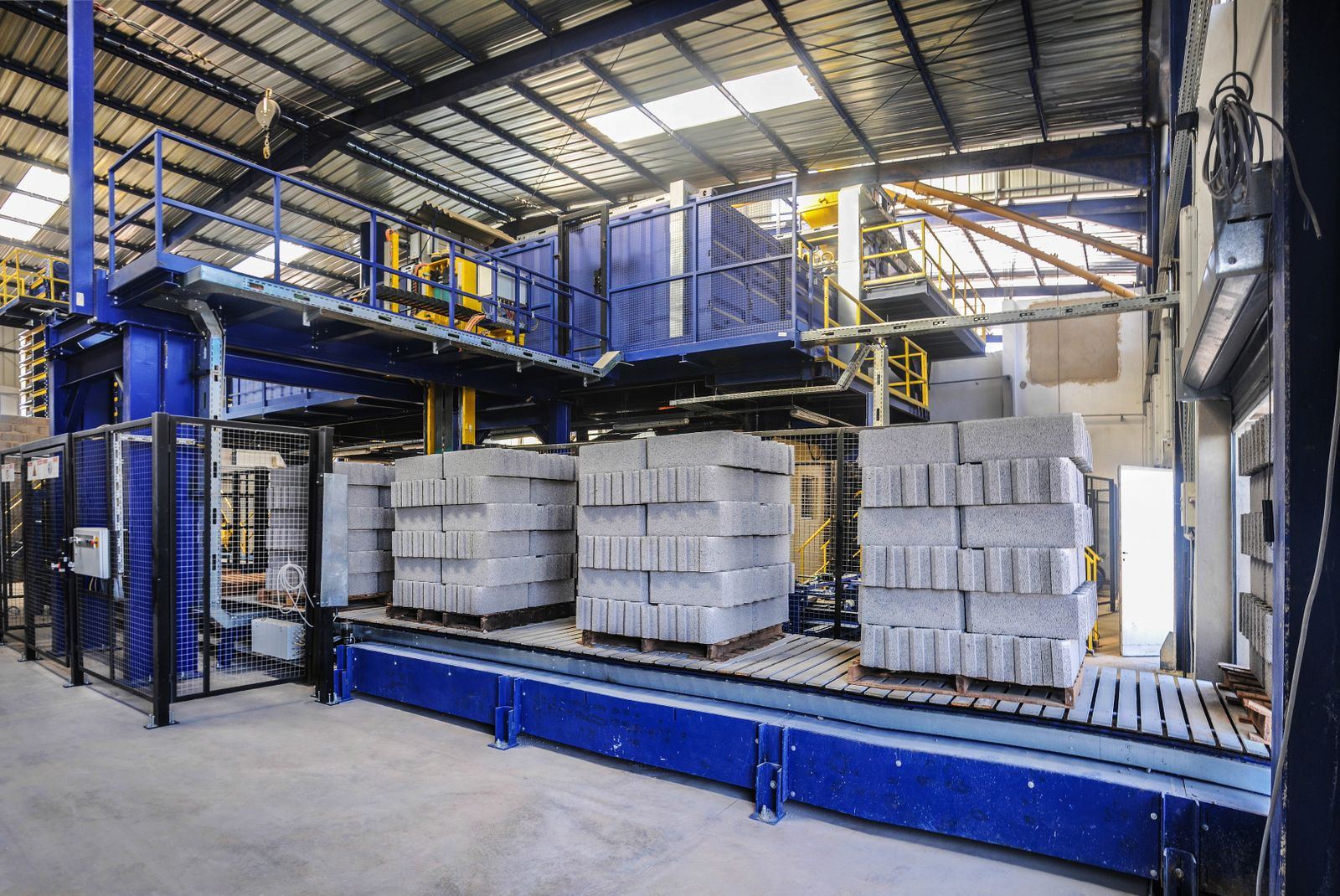
Heavy goods are quoted from whichever depot the desk has in mind, not the one nearest the site. On blocks, cement, pipe or drums the freight difference is the margin. Stock also gets sold twice when two users see the same last pallets.
Field orders re-keyed later
A rep takes the order on site in a notebook, a call or a WhatsApp message and someone re-keys it in the evening against stock nobody checked. Prices drift from the price list, the TRN is missing, and the customer finds out at delivery.
An e-invoicing deadline that will not move
Large taxpayers appoint an Accredited Service Provider by 30 October 2026 and go live on 1 January 2027; everyone else follows by 1 July 2027. The provider carries the invoice. It does not fix a missing TRN, a wrong VAT category or a price that does not match the order.
What the UAE e-invoicing mandate requires of a distributor or wholesaler — and when
From 2027 a UAE business can no longer send a B2B tax invoice as a PDF or on paper. Every invoice and credit note in scope must travel as a structured e-invoice in the PINT AE format, through an Accredited Service Provider (ASP) the business appoints. The UAE uses a five-corner model: your ASP validates the invoice, delivers it to the buyer’s ASP and reports the tax data to the Federal Tax Authority. The legal basis is Federal Decree-Law No. 16 of 2024, which amended the VAT law so e-invoices count as tax invoices, and Federal Decree-Law No. 17 of 2024, which amended the tax procedures law to create the e-invoicing system. Ministerial Decisions No. 243 and 244 of 2025 set the system and its phases.
| Date | What happens |
|---|---|
| 1 July 2026 | Pilot and voluntary adoption An invited taxpayer working group pilots the system; any business may adopt voluntarily. |
| 30 October 2026 | Large taxpayers appoint an ASP Businesses with revenue of AED 50 million or more. Moved from 31 July 2026 by Ministerial Decision No. 66 of 2026. |
| 1 January 2027 | Large taxpayers go live B2B and B2G invoices and credit notes must be issued as e-invoices. |
| 31 March 2027 | Everyone else appoints an ASP Businesses below AED 50 million; government entities also appoint by this date. |
| 1 July 2027 | Everyone else goes live Government entities follow on 1 October 2027. |
Dates as published by the UAE Ministry of Finance, checked 24 September 2026. B2B and B2G are in scope; B2C is excluded until a further ministerial decision. Confirm your own dates with your tax adviser.
The ASP carries the invoice; it does not fix it. If the order system cannot produce the data the e-invoice needs — a validated buyer TRN, a VAT category on every line, the right treatment for a free-zone or export sale, prices that match what was ordered — the ASP rejects the invoice, or accepts one that is wrong. Cabinet Decision No. 106 of 2025 prices the gap: AED 5,000 a month for failing to implement or appoint an ASP, and AED 100 for each invoice or credit note not issued electronically, capped at AED 5,000 a month.
The built system: SalesOrderOS by Xamun
Built for UAE building-materials distributors — blocks, pavers, tiles, cement and aggregates — selling from several depots and factories through an order desk and field reps. It is live, with a public demo on fictional UAE data.
SalesOrderOS
Order to e-invoice, built for the UAE.
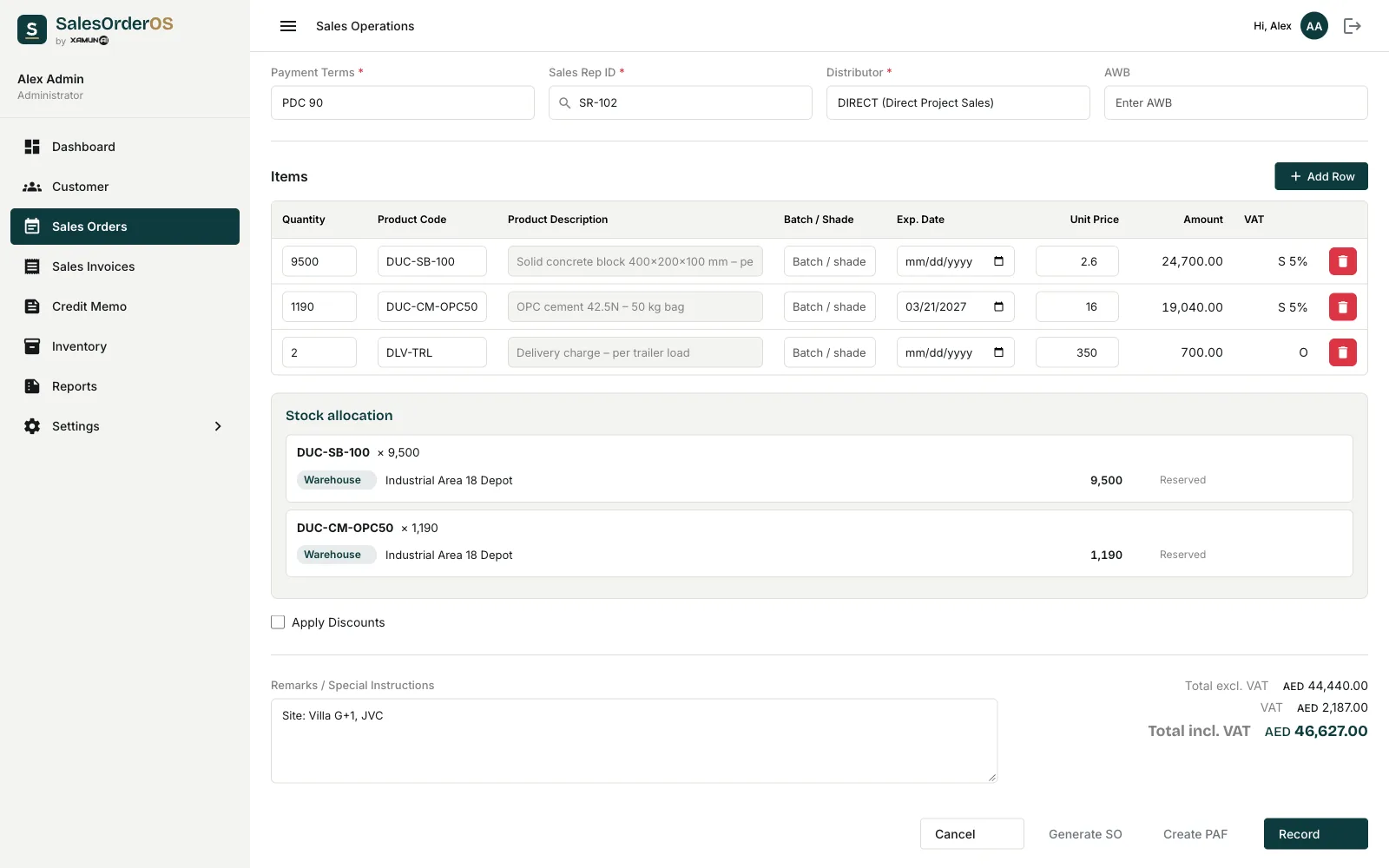
- One order, taken once. Typed at the desk, taken on a rep’s phone against live stock, or said in one sentence to the AI assistant in English or Arabic. Stock is reserved at the nearest depot on confirm.
- An invoice that is right first time. VAT is frozen on every line, the buyer TRN is validated, and the bilingual tax invoice is built from the shipped order, not from a month-end batch.
- PINT AE through the ASP you appoint. The e-invoice file is built from the frozen invoice and sent through whichever Accredited Service Provider you choose; each provider is a single connector.
The same order-to-invoice shape applies to FMCG, industrial supplies, auto parts and electrical wholesale: several depots or a central warehouse, a field-sales or van-sales team, a price list with customer-specific terms, and B2B invoices in scope for e-invoicing. Those are configured from the same system in a Discovery, not claimed as built.
Also relevant
LogiOS →
Bin-level warehouse control, marketplace orders, multi-courier booking and cash-on-delivery remittance — for distributors whose volume is parcels rather than pallets.
MarshaOS →
Marine-services operations for the Gulf, with a deterministic billing engine where every AED on the invoice traces to a rule — the same VAT discipline SalesOrderOS applies to goods.
Is your order data ready for e-invoicing?
Pull last quarter’s invoices and run the eight checks — TRN coverage, VAT category per line, free-zone and export treatment, price drift from the order, credit-note linkage, delivery-charge treatment, bilingual fields and provider independence. It takes an afternoon and tells you whether the problem is the provider or the order.
Two ways to buy. No rate card.
Discovery names the order bottleneck, measures the baseline and agrees what solved means. The build and launch follow, at Xamun’s cost. Then you choose the door.
A fee per order, from go-live
No upfront capex. From go-live you pay a small fee per order processed — no orders, nothing owed. Xamun runs it with your team for three years, and if order throughput slips we re-engineer it free, whatever the cause.
Your own deployment, bought out
You get a separate instance, in the cloud or on your own infrastructure, configured to your product range and depots, and the source code is yours. Buy it out at the start, or after running on usage.
See it on your own orders
A 30-minute walkthrough on the live demo, then a look at last quarter’s invoices against the eight checks. We are in DIFC, Dubai; the reply comes from a person, not a form.