
SalesOrderOS — Order to e-invoice, built for the UAE.
Sales orders, depot stock, field reps, UAE VAT and PINT AE e-invoicing in one system for building-materials distributors. An order — typed into the form, or said in one sentence to the AI assistant in English or Arabic, at the desk or on a rep’s phone — reserves stock at the nearest depot, the invoice freezes VAT on every line, and the e-invoice is built from that frozen invoice and sent through whichever Accredited Service Provider you appoint.
What is SalesOrderOS?
Sales orders, depot stock, field reps, UAE VAT and PINT AE e-invoicing in one system for building-materials distributors. An order — typed into the form, or said in one sentence to the AI assistant in English or Arabic, at the desk or on a rep’s phone — reserves stock at the nearest depot, the invoice freezes VAT on every line, and the e-invoice is built from that frozen invoice and sent through whichever Accredited Service Provider you appoint.
Who is SalesOrderOS for?
UAE distributors of building materials — blocks, pavers, tiles, cement and aggregates — selling from several depots and factories through an order desk and field reps. Three things cost them money today: heavy goods quoted from the wrong depot, where the freight eats the margin; orders taken on site and re-keyed later against stock nobody checked; and an e-invoicing deadline that will not move.
What the UAE e-invoicing mandate requires of a distributor — and when
From 2027 a UAE business can no longer send a B2B tax invoice as a PDF or on paper. Every invoice and credit note in scope must travel as a structured e-invoice in the PINT AE format, through an Accredited Service Provider (ASP) the business appoints. The UAE uses a five-corner model: your ASP validates the invoice, delivers it to the buyer’s ASP and reports the tax data to the Federal Tax Authority. The legal basis is Federal Decree-Law No. 16 of 2024, which amended the VAT law so e-invoices count as tax invoices, and Federal Decree-Law No. 17 of 2024, which amended the tax procedures law to create the e-invoicing system. Ministerial Decisions No. 243 and 244 of 2025 set the system and its phases.
| Date | What happens |
|---|---|
| 1 July 2026 | Pilot and voluntary adoption An invited taxpayer working group pilots the system; any business may adopt voluntarily. |
| 30 October 2026 | Large taxpayers appoint an ASP Businesses with revenue of AED 50 million or more. Moved from 31 July 2026 by Ministerial Decision No. 66 of 2026. |
| 1 January 2027 | Large taxpayers go live B2B and B2G invoices and credit notes must be issued as e-invoices. |
| 31 March 2027 | Everyone else appoints an ASP Businesses below AED 50 million; government entities also appoint by this date. |
| 1 July 2027 | Everyone else goes live Government entities follow on 1 October 2027. |
Dates as published by the UAE Ministry of Finance, checked 24 September 2026. B2B and B2G are in scope; B2C is excluded until a further ministerial decision. Confirm your own dates with your tax adviser.
The ASP carries the invoice; it does not fix it. If the order system cannot produce the data the e-invoice needs — a validated buyer TRN, a VAT category on every line, the right treatment for a free-zone or export sale, prices that match what was ordered — the ASP rejects the invoice, or accepts one that is wrong. Cabinet Decision No. 106 of 2025 prices the gap: AED 5,000 a month for failing to implement or appoint an ASP, and AED 100 for each invoice or credit note not issued electronically, capped at AED 5,000 a month.
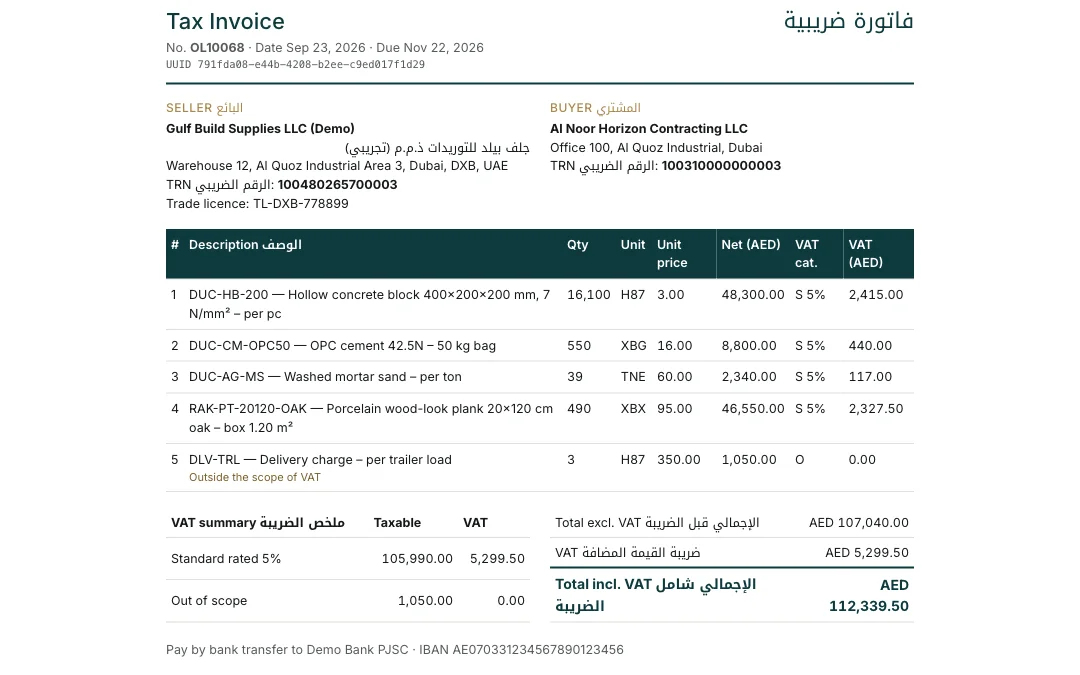
That is why SalesOrderOS starts at the order, not the invoice. The order captures the customer, the delivery site and the VAT treatment; the invoice freezes price, description and VAT on every line; “Mark ready” refuses an invoice with a missing mandatory field; and the PINT AE file is built from that frozen record, so the e-invoice step never guesses or recalculates. Once the ASP accepts it, the invoice locks, and any change is a credit note.
What regulation does SalesOrderOS handle?
UAE VAT at 5% under Federal Decree-Law No. 8 of 2017, with standard, zero-rated, exempt and out-of-scope lines; the tax-invoice fields of Article 59 of the VAT Executive Regulation; and the e-invoicing system set by Ministerial Decisions No. 243 and 244 of 2025, as amended by No. 66 of 2026 — enforced in the workflow rather than documented beside it.
- Ministerial Decision No. 243 of 2025 (Electronic Invoicing System)
- Ministerial Decision No. 244 of 2025 (implementation phases)
- Ministerial Decision No. 66 of 2026
- Cabinet Decision No. 106 of 2025 (e-invoicing penalties)
- UAE VAT — Federal Decree-Law No. 8 of 2017
- Federal Decree-Laws No. 16 and 17 of 2024
- Tax invoice fields — Art. 59, Cabinet Decision No. 52 of 2017
- PINT AE (Peppol)
- TRN validation
One flow from order to accepted e-invoice
One system, one record. The order reserves stock, the invoice ships it and freezes the VAT, and the e-invoice is built from the frozen invoice. The first four steps run today in the live demo, and orders can be typed into the form or said to the AI assistant; the dashed step is on the roadmap.
Order
Typed, or said to the AI assistant, at the desk or on a phone
Reserve
Stock held at the nearest depot
Invoice
UAE VAT frozen on every line
E-invoice
PINT AE sent through your ASP
ERP sync
SAP Business One — next
Three ways to comply. Only one pays you back.
Every UAE business in scope has to change how it invoices. Where you make that change decides whether you get compliance and nothing else, or compliance plus a better-run operation — and with Xamun, the better route is also the one with no upfront cost.
| Route | What it does to your invoices | What you get | What it costs up front |
|---|---|---|---|
| Keep Excel or PDF, key it into an ASP portal | Meets the format. Every invoice is typed twice, and every data error surfaces as a rejection or a credit note. | Compliance only | Portal fees, plus staff time on every invoice |
| Bolt a converter onto the invoicing tool | Automates the sending. Whatever was wrong in the invoice — TRN, VAT category, price — is converted faithfully and sent. | Compliance only | An integration project you fund |
| Fix it at the sales order | The invoice is built from an order that captured the right customer, price, depot and VAT treatment, so it is right before it reaches the ASP. | Compliance, plus margin, speed and cash | Zero capex with Xamun — a fee per order from go-live |
What fixing it at the order returns, beyond compliance
The data the mandate forces you to get right — customer, price, depot, VAT treatment — is the same data that runs the business.
Freight margin kept
Heavy goods are allocated to the nearest depot to the delivery site, not whichever depot someone checked first.
Orders captured once
Reps order on site against live stock; nothing is re-keyed from a notebook, a call or a WhatsApp message.
No overselling
Stock is reserved when the order is confirmed, so two people can never sell the same last units.
Discounts and credit held to policy
Field discounts are capped and new prospects are held until the trade licence arrives.
Billing without a month-end batch
The invoice is built from the shipped order, so it can go out when the goods do.
Adoption without retraining
Staff can type or say an order the way they would text it, in English or Arabic, and the assistant fills the form. A new system is easier to adopt when nobody has to learn it first.
Zero capex. Discovery and the build are at Xamun’s cost. You start paying at go-live, a small fee per order processed — no orders, nothing owed. The mandate’s deadline, the operation’s payback, and no capital request to raise first. How you buy it →
One project, two agendas
E-invoicing is compulsory. Agentic AI is not — but Dubai is funding its private sector to adopt it within two years, through Dubai Chamber business councils, incubators and dedicated funds. A distributor can meet the first and make a real start on the second with the same project: fix order-to-invoice for the Federal Tax Authority, and put a working AI assistant in front of the order desk and the reps to do it.
Not a pilot running beside the business. The assistant sits in the system the orders actually go through, takes an order as one sentence in English or Arabic, checks stock, and leaves every order for a person to confirm.
What Dubai’s agentic-AI push actually asks of the private sector →
What can SalesOrderOS do?
Not a generic ERP with an e-invoicing plug-in. Every module is shaped around how a UAE building-materials distributor actually sells: heavy goods, many depots, reps on site.
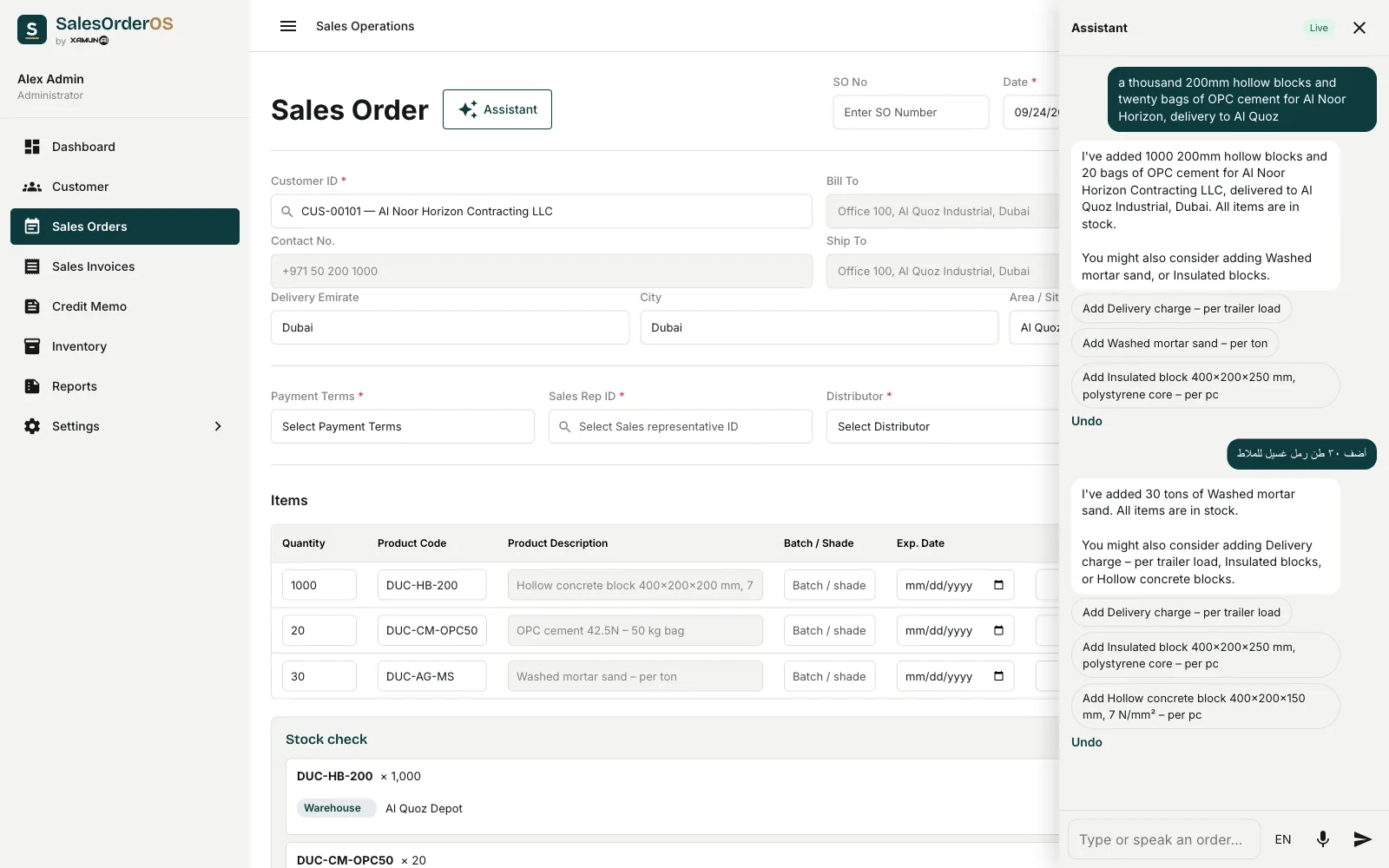
AI order entry, in English or Arabic
Type or speak the order as one sentence — “a thousand 200 mm hollow blocks and twenty bags of OPC cement for Al Noor, delivery to Al Quoz” — and the assistant fills the customer, site and lines, checks stock and suggests what usually goes with it. Every step can be undone, and nothing is recorded until a person confirms.
Nearest-depot stock split
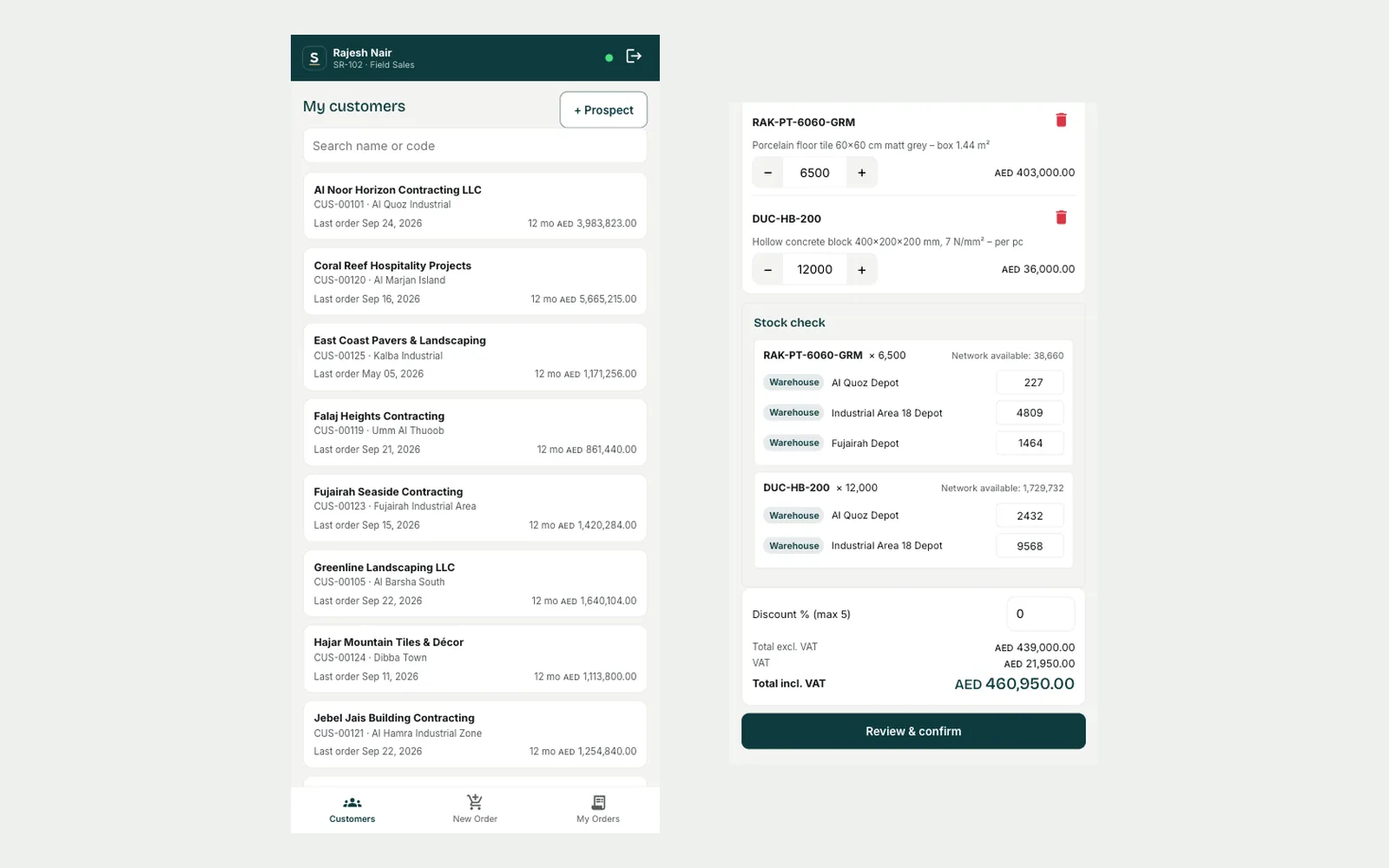
Each order line gets a proposed split from the nearest warehouses first, then factories, measured from the delivery site rather than the customer’s head office. If one depot can’t cover a line, the system splits it across depots and the user confirms or adjusts.
Reserve on confirm
Confirming an order reserves the stock; cancelling releases it; invoicing ships it. Two users can never take the same last units, and every receipt, reservation and shipment sits in one ledger.
A field-sales app with no app store
Reps install it from the browser on any phone and see only their own customers, enforced on the server. Drafts save offline and stock is re-checked when signal returns. Discounts are capped at 5%, and new prospects are held until the trade licence arrives.
UAE VAT, frozen on every line
Standard-rated, zero-rated, exempt and out-of-scope lines, including free zones and exports. Price, description and VAT are snapshotted per line, so a later price or rate change never rewrites an issued invoice.
Bilingual tax invoices that are right first time
English and Arabic print with seller and buyer TRN, a VAT category on every line and a VAT summary; save as PDF. TRNs are validated, and “Mark ready” lists exactly which mandatory field is still missing.
PINT AE, through the ASP you choose
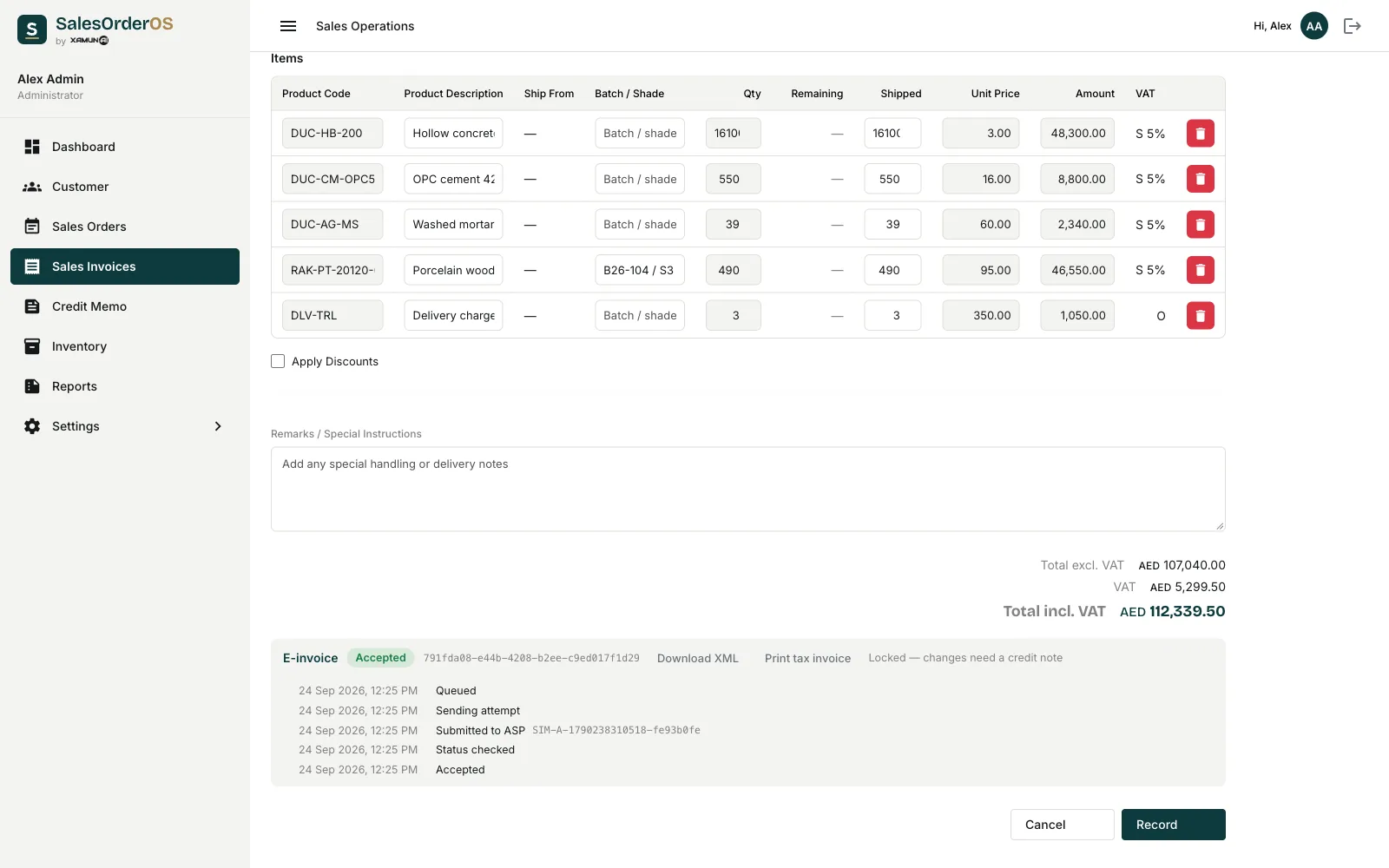
The e-invoice XML is built from the frozen invoice, so it never guesses or recalculates, and you can download the exact file sent. Each Accredited Service Provider is one connector. A background queue retries with backoff when the provider is down; rejections come back with readable error codes to fix and resend; once accepted, the invoice locks and changes need a credit note.
Fast at ten years of orders
Every list pages on the server with indexed, date-windowed queries — no screen loads a whole table. Monthly partitions and archiving keep live data lean. Role-based access, and provider secrets encrypted with a key kept out of the app image.
What does SalesOrderOS look like?
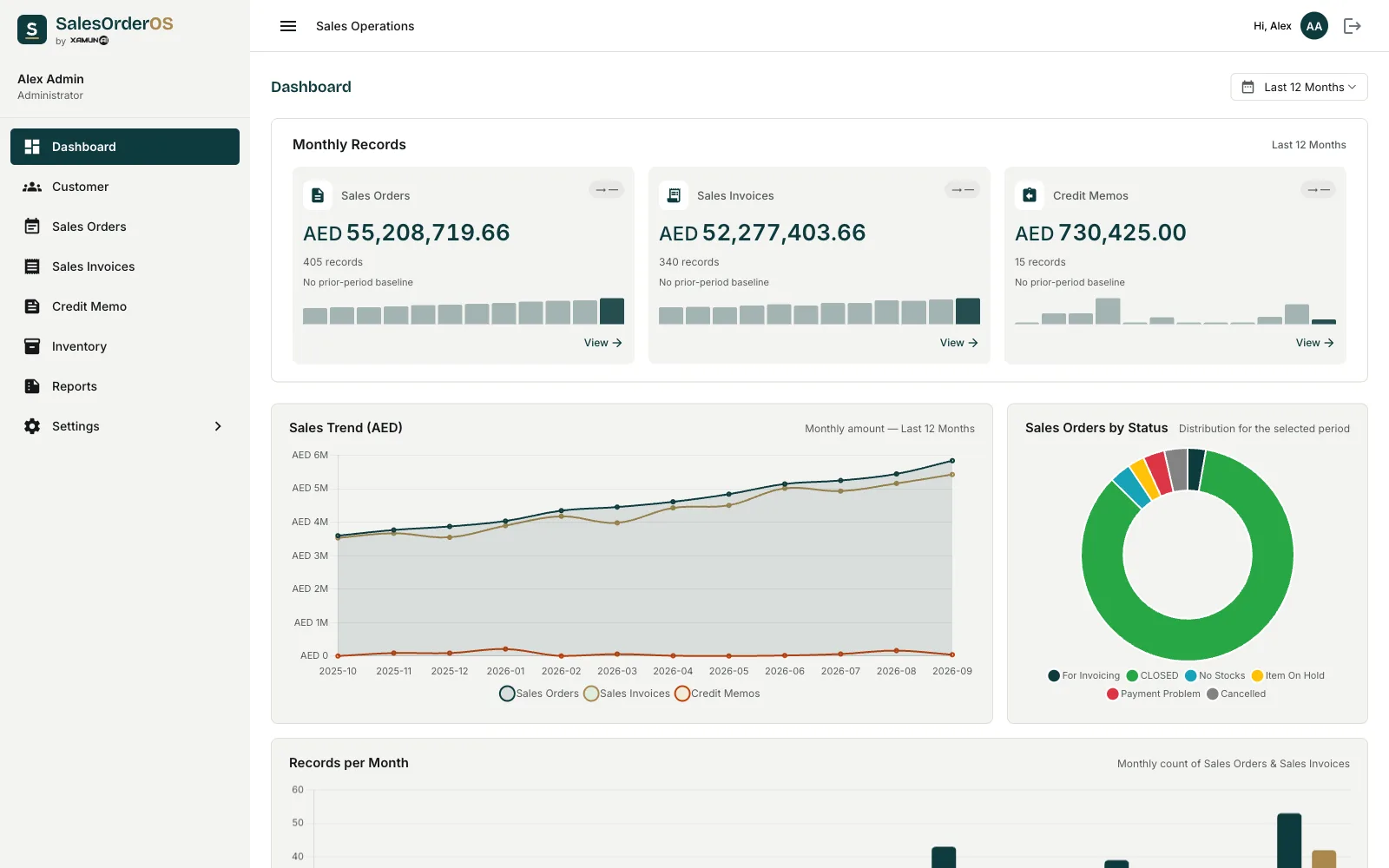
Real screens from the live demo you can open above, on fictional UAE seed data. The demo has one-click accounts for admin, sales manager, order desk, billing and two field reps. Your own deployment is a separate instance, configured to your product range and depots.
What is live, and what is next?
Five parts are built and running in the demo: stock and fulfilment, the field-sales app, UAE tax invoices, PINT AE e-invoicing through any accredited provider, and the AI order assistant — say “a thousand 200 mm hollow blocks and twenty bags of cement for Al Noor” in English or Arabic and the order form fills itself, with nothing recorded until a person confirms. One is next: a SAP Business One connector to keep orders, stock and invoices in sync with the ERP.
Questions distributors ask about UAE e-invoicing
When does UAE e-invoicing become mandatory?
For large taxpayers — revenue of AED 50 million or more — on 1 January 2027, with an Accredited Service Provider appointed by 30 October 2026. Everyone else appoints an ASP by 31 March 2027 and goes live on 1 July 2027; government entities go live on 1 October 2027. The phases are set by Ministerial Decision No. 244 of 2025, and the large-taxpayer ASP date was moved from 31 July to 30 October 2026 by Ministerial Decision No. 66 of 2026.
What is PINT AE?
PINT AE is the UAE specialisation of the Peppol International invoice format — the structured XML e-invoice the UAE system exchanges. Under the UAE’s five-corner model the supplier’s Accredited Service Provider validates the invoice, delivers it to the buyer’s ASP and reports the tax data to the Federal Tax Authority. SalesOrderOS builds the PINT AE file from the frozen tax invoice and hands it to your ASP.
Does SalesOrderOS replace my Accredited Service Provider?
No. The law requires you to appoint an ASP; SalesOrderOS connects to whichever one you choose. Each provider is a single connector, so the queue, screens and data model stay the same whichever ASP you pick. The public demo uses a simulated ASP.
What are the penalties for not complying with UAE e-invoicing?
Cabinet Decision No. 106 of 2025 sets AED 5,000 per month for failing to implement the system or appoint an ASP, AED 100 per e-invoice or credit note not issued electronically (capped at AED 5,000 a month), and AED 1,000 per day for failing to notify a system failure or a change in registered data.
Is B2C in scope?
Not yet. B2B and B2G transactions are in scope; B2C is excluded until the Minister issues a decision bringing it in.
Who is SalesOrderOS for?
UAE distributors of building materials — blocks, pavers, tiles, cement and aggregates — selling from several depots and factories through an order desk and field reps. Heavy goods make the depot a line ships from matter as much as the stock count.
Can I comply with UAE e-invoicing by keeping Excel or PDF invoicing?
Partly. Some providers accept an Excel upload or let staff key invoices into a portal, and that can meet the format. But the data problems stay where they were: a missing TRN, a wrong VAT category or a price that drifted from the order becomes a rejection to fix, or a credit note the Federal Tax Authority also sees. Fixing the data at the sales order means the invoice is right before it reaches the provider.
What does SalesOrderOS do beyond e-invoicing compliance?
The same data the mandate forces you to get right also runs the business. Stock is reserved at the nearest depot, which protects freight margin on heavy goods; reps take orders on site against live stock instead of re-keying them later; two users can never sell the same last units; discounts are capped; new prospects are held until the trade licence arrives; and invoices are built from the shipped order, so billing does not wait for a month-end batch. And it is zero capex: Xamun funds the build and you pay a fee per order processed from go-live.
Does it work with SAP Business One?
SAP Business One sync is the next part of the programme and is not in the live demo. Orders, stock and invoices will be kept in sync with the ERP.
Can staff enter an order by typing or speaking a sentence?
Yes. The AI assistant on the order screen takes an order as one sentence, typed or spoken, in English or Arabic, and fills the customer, delivery site and lines, checking stock as it goes. Every step can be undone and nothing is recorded until a person confirms. It speeds up order entry and makes the system easier to adopt, because staff describe the order the way they already would instead of learning the form first.
Is SalesOrderOS relevant to Dubai’s agentic-AI programme?
Dubai’s May 2026 announcement is a funded programme to move the private sector to agentic AI within two years, not an obligation on companies. E-invoicing, by contrast, is compulsory. SalesOrderOS lets a distributor act on both with one project: it meets the e-invoicing requirement, and its AI order assistant is a working AI system in daily operations rather than a pilot beside them. Whether a given project qualifies for any programme support is for the programme to decide.
How do you buy SalesOrderOS?
Under Outcome-as-a-Service, with no upfront CAPEX. Discovery and the build are at Xamun’s cost; from go-live you pay a small fee per order processed — no orders, nothing owed. You get your own deployment, in the cloud or on your own infrastructure, and for three years after done, if order throughput slips, Xamun re-engineers it free.
How do you buy SalesOrderOS?
Under Outcome-as-a-Service, with no upfront CAPEX. Discovery names the order bottleneck, measures the baseline and agrees what solved means; the build and launch follow, instrumented to that number from day one. Both are at Xamun’s cost. From go-live you pay a small fee per order processed — no orders, nothing owed. For three years after done, if order throughput slips, we re-engineer it free, whatever the cause. We run it for three years, or you buy it out.
Start a pilot before the mandate
A live walkthrough on your product range and depots, then a pilot with your SKUs, depots and reps loaded and your ASP’s sandbox connected — so compliant e-invoices are flowing ahead of your deadline.