
LandOS — From first mention to a developer-ready pack — India & the UAE.
The land-sourcing workbench for India and the UAE — field & chat capture, registry adjudication, deterministic requirement-to-parcel matching and tokenized property-pack delivery in one workspace. It speaks each market in its own terms: acres, khata and survey numbers in Karnataka; square feet, tenure and plot numbers in Dubai. Same product, same code, market switched at sign-in. Every claim is grounded in the public record, and it is built never to assert what it cannot actually verify.
What is LandOS?
The land-sourcing workbench for India and the UAE — field & chat capture, registry adjudication, deterministic requirement-to-parcel matching and tokenized property-pack delivery in one workspace. It speaks each market in its own terms: acres, khata and survey numbers in Karnataka; square feet, tenure and plot numbers in Dubai. Same product, same code, market switched at sign-in. Every claim is grounded in the public record, and it is built never to assert what it cannot actually verify.
Who is LandOS for?
LandOS is built for land sourcing teams in real estate, across the UAE. It is delivered under Outcome-as-a-Service: Xamun invests the build, deploys it on your infrastructure, and you pay per transaction the system processes.
What regulation does LandOS handle?
LandOS carries the following regulatory and compliance surface, enforced in the workflow rather than documented beside it. The GraphIQ compliance layer keeps these rules current as they change.
- Kaveri
- Bhoomi
- Dubai Land Department
What can LandOS do?
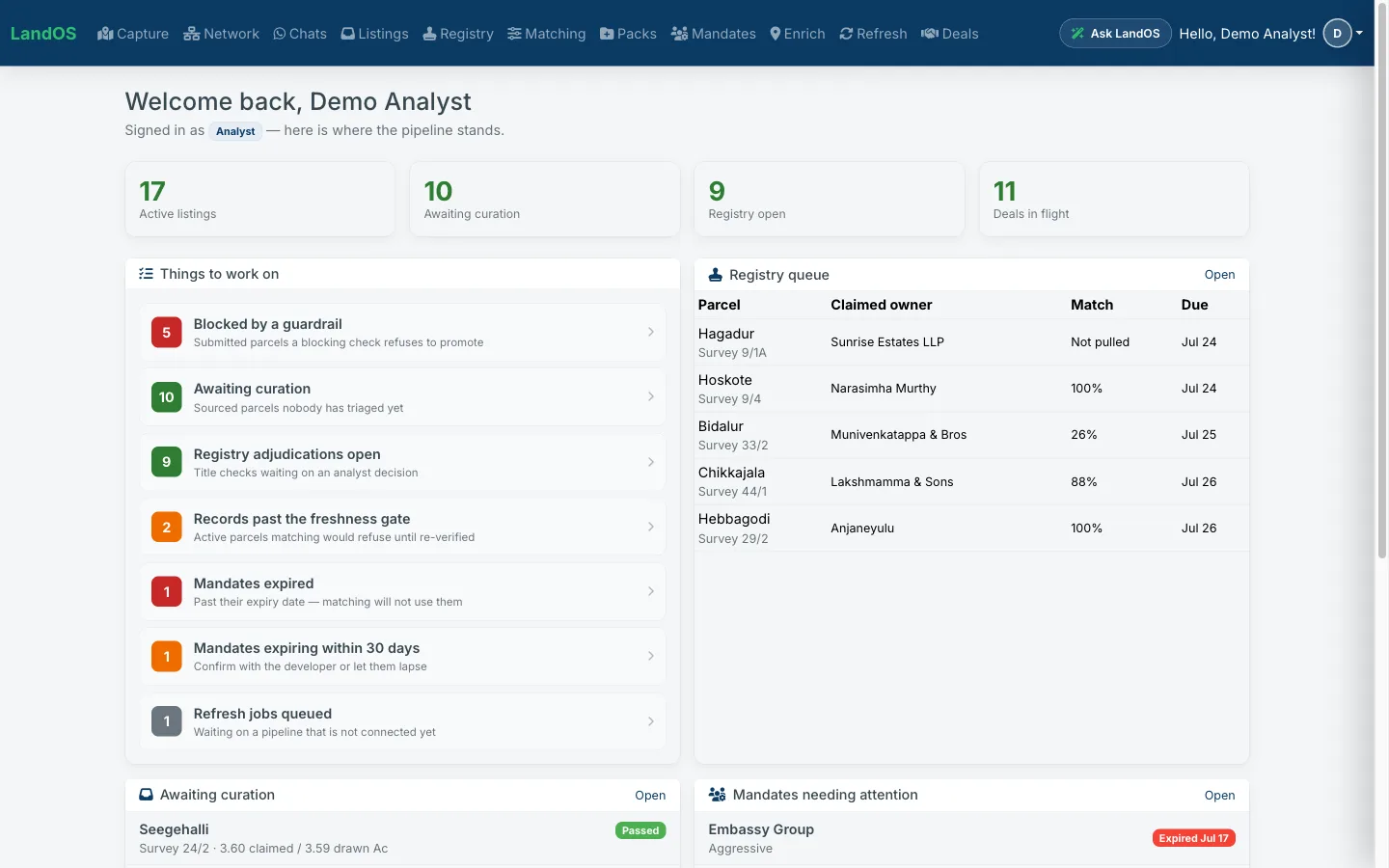
Not a generic CRM with a map bolted on. Every module is shaped around how land is actually sourced, verified and traded — and every vocabulary, unit and registry comes from the market you are signed in to.
Field & chat capture
Pin a parcel on the map or turn a WhatsApp thread into a structured listing — with claimed area checked against drawn area on the spot.
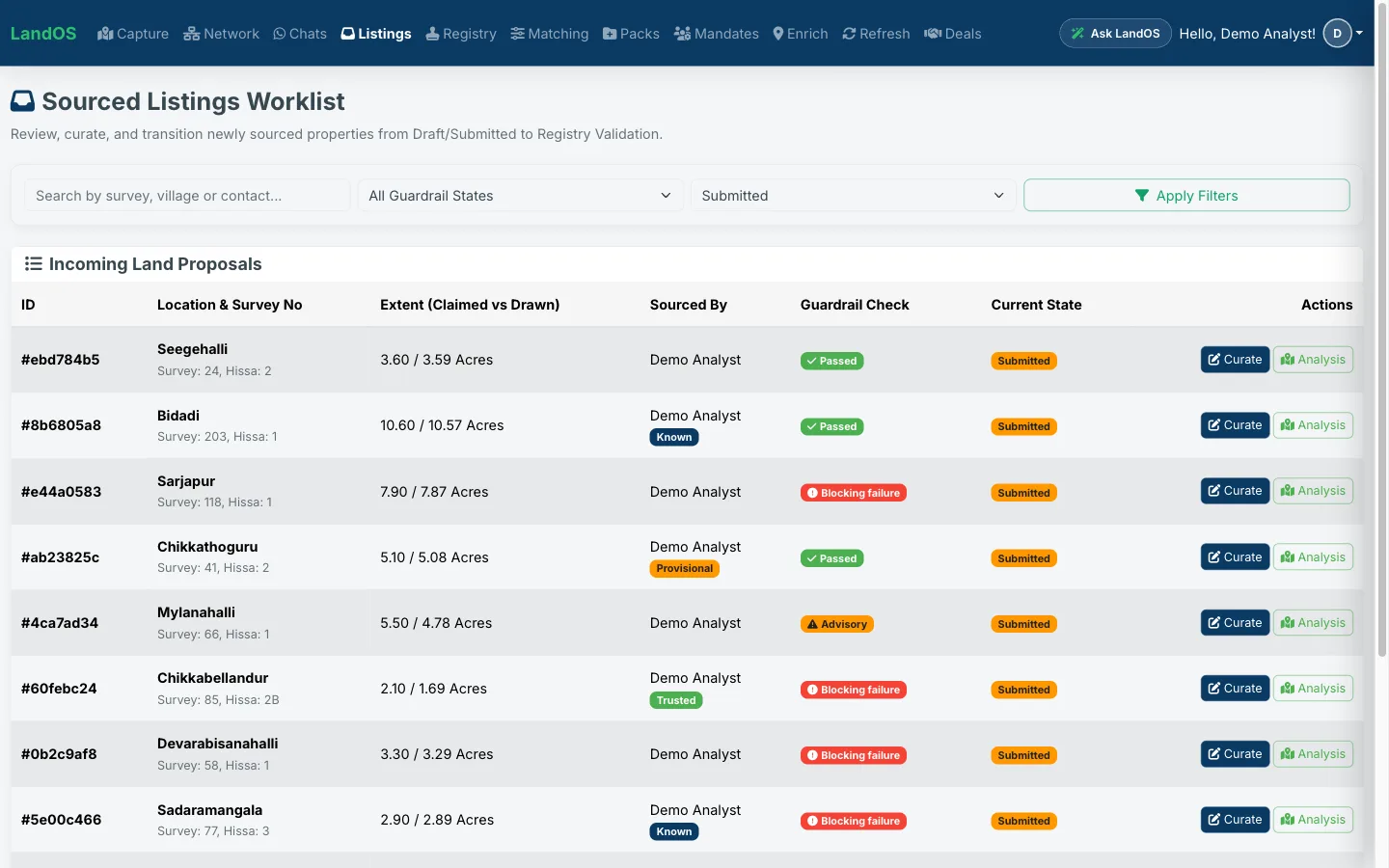
Sourced-listings worklist
Every incoming parcel triaged, with a sourcer-trust badge and guardrail checks, before anything is allowed to move downstream.
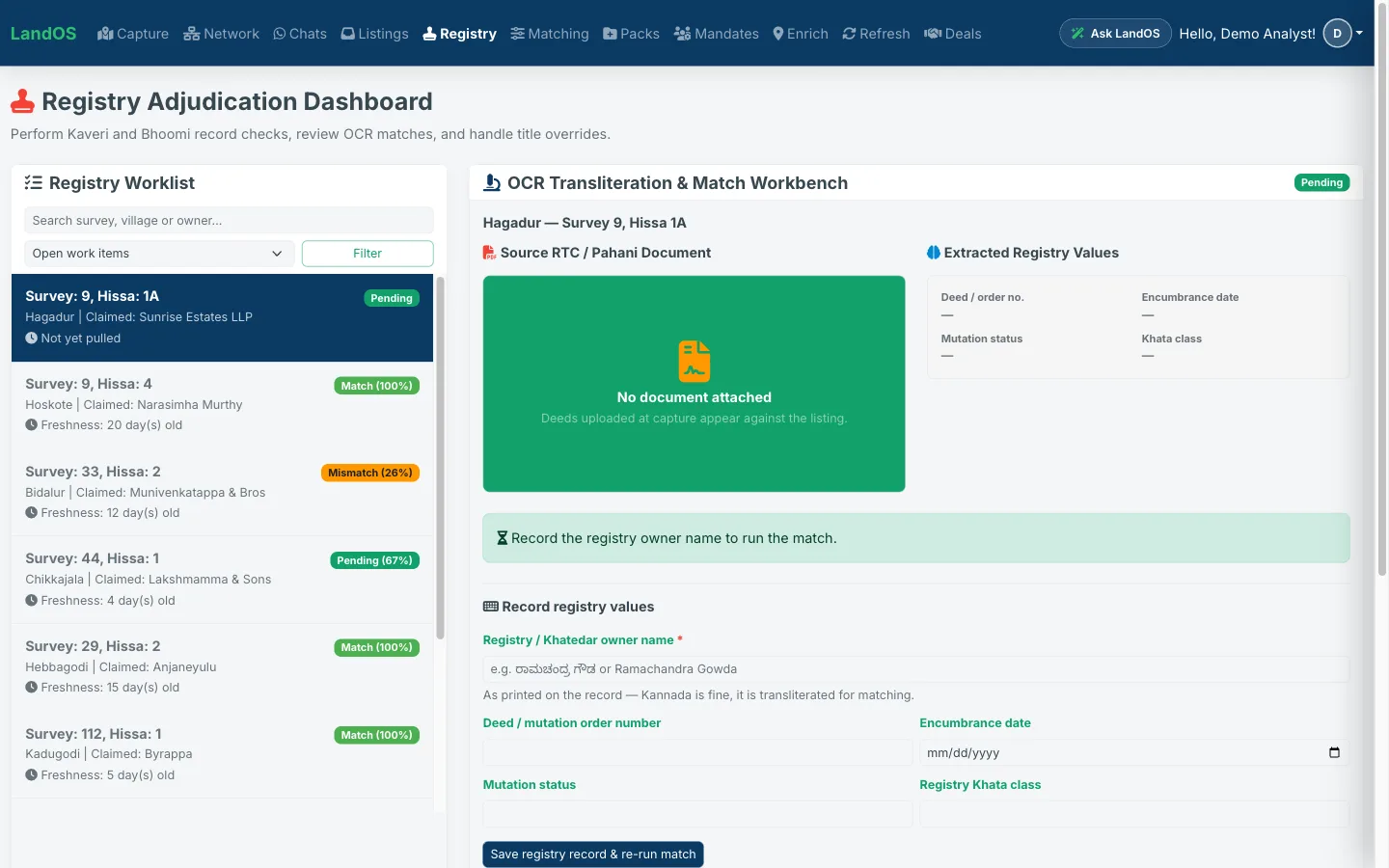
Registry adjudication
Kaveri and Bhoomi in India, the Dubai Land Department in the UAE — with Kannada and Arabic name matching against the claimed owner. Each decision scored and logged.
Location & access scoring
Score a parcel 0–100 on amenity access, road connectivity and zoning fit — colour-coded across the surrounding micro-market.
Deterministic matching
Rank active parcels against a developer's mandate on location, price and title quality — weights you control, and a score you can decompose.
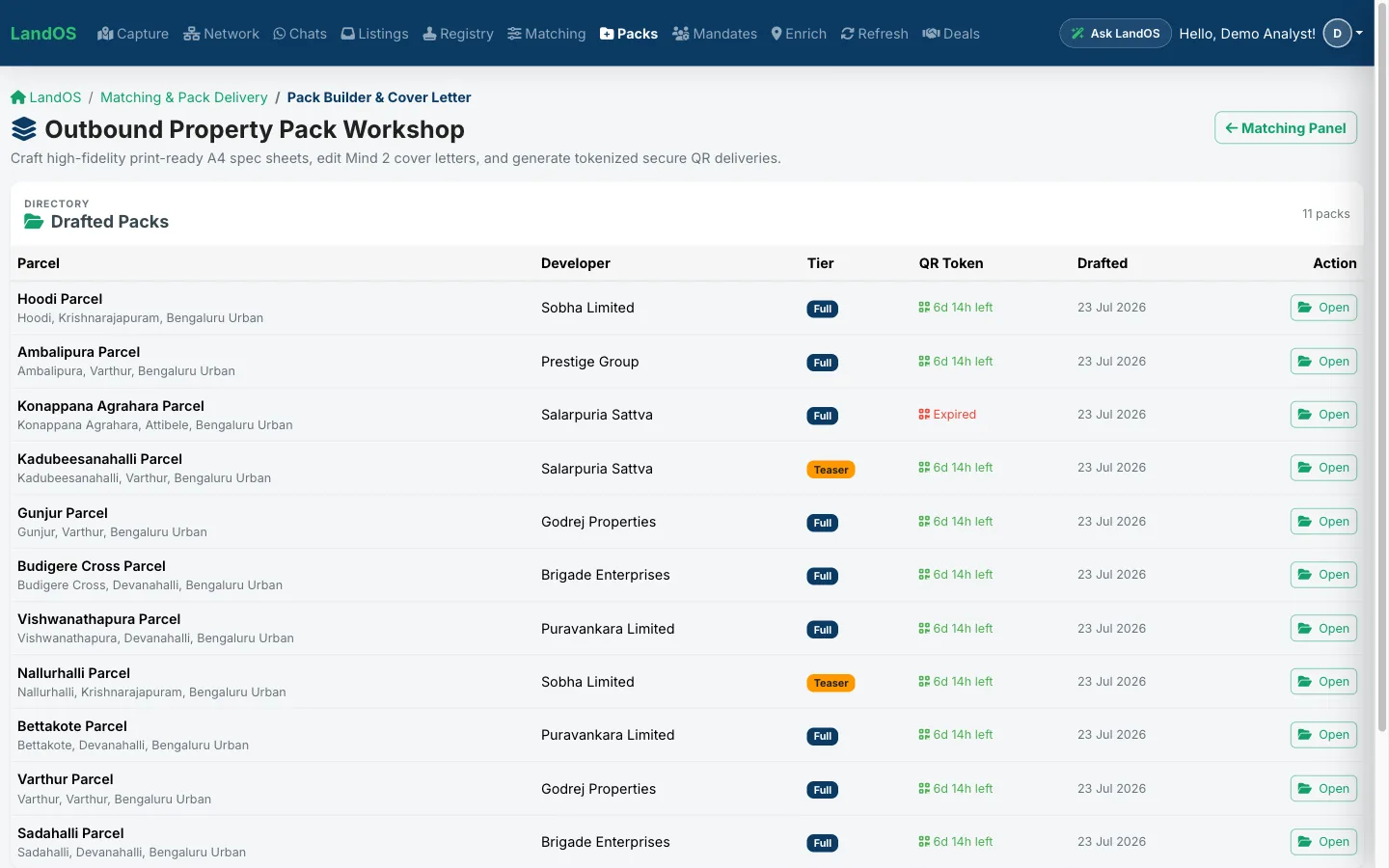
Property packs & QR delivery
Print-ready spec sheets and cover letters, delivered to developers through tokenized, expiring QR links — as a full brief or a teaser.
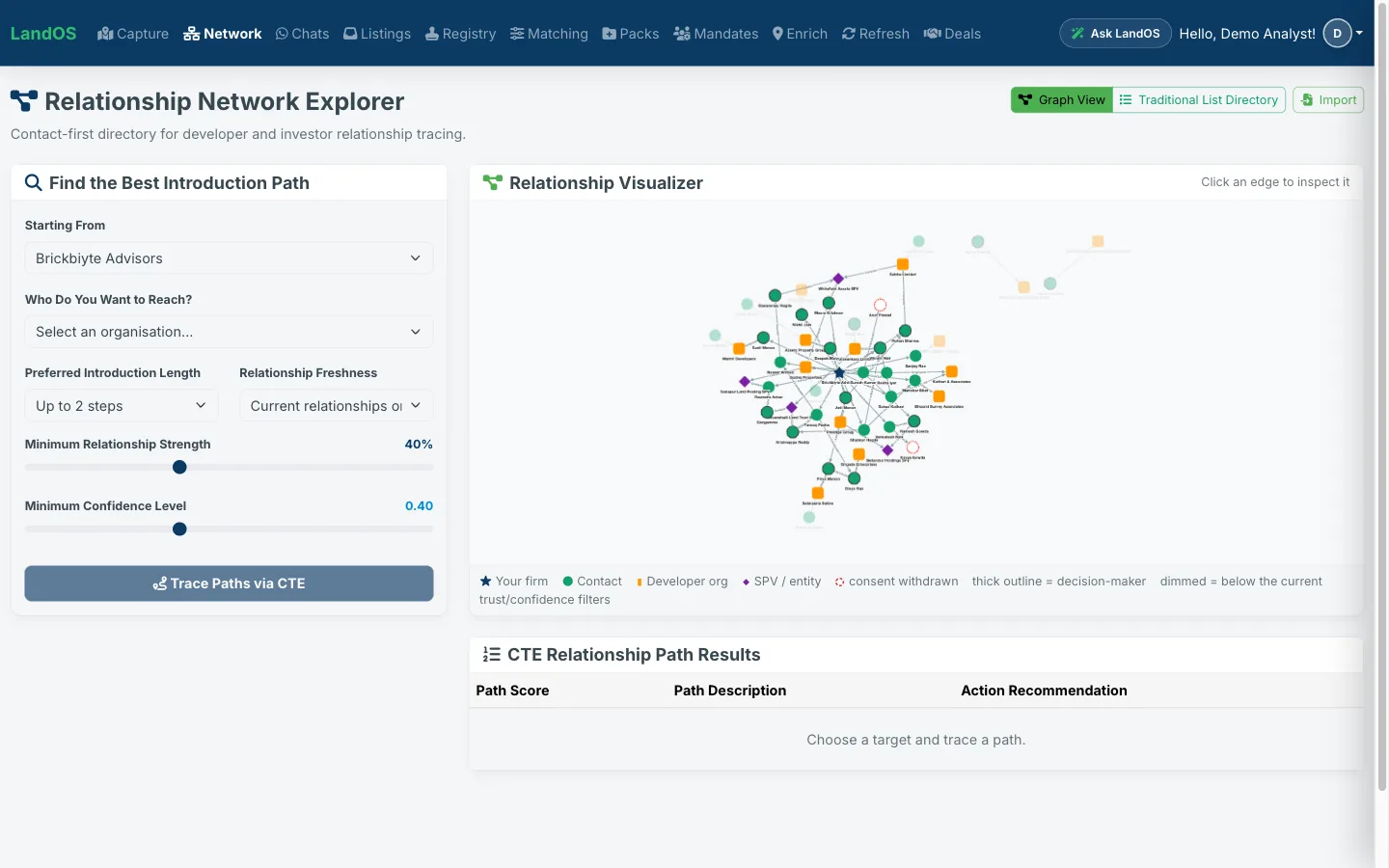
Relationship network
Trace the warmest introduction path to any developer or investor through the contacts you already have — filtered by strength and freshness.
Deal pipeline
Track every parcel from first contact to closed — sent, interest, LOI, due diligence, site visit — so a promising site never stalls in silence.
Grounded copilot
Ask about your pipeline in plain words. Answers are read-only, role-scoped and cited to the records you can already see — it never changes a thing.
One product, many markets
A market's units, vocabulary, documents, registry and legal checks live in one small config — so India speaks acres, khata and survey numbers while Dubai speaks square feet, tenure and plot numbers, from the same code. A third market is a config file, not a rebuild.
What does LandOS look like?
Real screens from the live demo you can open above. Your own deployment is a separate instance, branded and configured to your operation.
The winning balance of rigour and reach
Stacked against the ways a land-sourcing team runs today.
| Capability | LandOS Purpose-built for land | GIS / mapping platform(survey-grade suites) | Generic CRM(horizontal SaaS) | WhatsApp & spreadsheets |
|---|---|---|---|---|
| Second market without a rebuild | ● Config, not code | ✕ New rollout | ✕ New instance | ✕ New spreadsheet |
| Local registry record checks | ● Built-in | ✕ Not localized | ✕ None | ✕ Manual |
| Non-Latin name transliteration & match | ● Native | ✕ No | ✕ No | ✕ Manual |
| Claimed-vs-drawn area guardrails | ● On capture | ◑ Measure only | ✕ No | ✕ Eyeball |
| Freshness gate on verified records | ● Enforced | ✕ No | ✕ No | ✕ None |
| Deterministic, explainable matching | ● Decomposable | ✕ No | ◑ Rules only | ✕ Gut feel |
| Tokenized QR pack delivery | ● Built-in | ✕ No | ◑ Attachments | ✕ Email PDF |
| Relationship / intro-path tracing | ● Graph-based | ✕ No | ◑ Contact list | ✕ In your head |
| Grounded, read-only copilot | ● Cited answers | ✕ No | ◑ Generic AI | ✕ None |
| Role-scoped workspaces | ● Analyst / Principal / Admin | ◑ Seat-based | ◑ Configurable | ✕ Shared file |
| Time to go live | ● Weeks | ✕ Months | ◑ Months | ● Immediate* |
| Source code ownership & white-label | ● You own & rebrand it | ✕ Vendor-locked | ✕ Vendor's product | ◑ Files only |
| Hosting & data residency control | ● Your infra, any region | ◑ Vendor-defined | ✕ Vendor cloud only | ◑ Your device |
How do you buy LandOS?
Under Outcome-as-a-Service, with no upfront CAPEX. What you open above is a demo instance; what you buy is your own separate deployment — on your infrastructure, under your brand, source-available, and configured to how your operation actually works. Xamun invests the build, and you pay a per-transaction fee on what the system processes. A slow month is a small invoice; if it does not run, you do not pay.
Where LandOS fits
See LandOS on your own numbers
Bring us one workflow and we will show you LandOS running it.