
PlanIQ — The feasibility study that shows its working.
Land feasibility underwriting between a title deed and a funding decision. A consultant gives you one answer and a spreadsheet gives you no defence; PlanIQ gives you both — a four-gate highest-and-best-use assessment, a residual land value pro-forma and a Monte Carlo risk frontier, each traceable to the evidence it rests on. Every evaluation runs against a versioned, effective-dated jurisdiction rule pack and is pinned by hash, so a land price can be defended later on the rules that actually applied at the time.
What is PlanIQ?
Land feasibility underwriting between a title deed and a funding decision. A consultant gives you one answer and a spreadsheet gives you no defence; PlanIQ gives you both — a four-gate highest-and-best-use assessment, a residual land value pro-forma and a Monte Carlo risk frontier, each traceable to the evidence it rests on. Every evaluation runs against a versioned, effective-dated jurisdiction rule pack and is pinned by hash, so a land price can be defended later on the rules that actually applied at the time.
Who is PlanIQ for?
PlanIQ is built for land feasibility underwriting teams in real estate, across the UAE. It is delivered under Outcome-as-a-Service: Xamun invests the build, deploys it on your infrastructure, and you pay per transaction the system processes.
What regulation does PlanIQ handle?
PlanIQ underwrites land against a versioned, effective-dated jurisdiction rule pack rather than a consultant's memory of it. The Dubai pack (AE-DXB) carries zoning, plot-ratio and density rules, Dubai Land Department title and encumbrance records, and the Oqood and escrow obligations a development will meet later under Law No. (13) of 2008 and Law No. (8) of 2007 — so a feasibility that passes the four gates is one that can be financed and registered. Every evaluation is pinned to the pack version it ran against, and the GraphIQ compliance layer keeps the pack current as rules change.
- AE-DXB jurisdiction pack
- Dubai Land Department records
- Law No. 13 of 2008 (Oqood)
- Law No. 8 of 2007 (escrow)
What can PlanIQ do?
Not a GIS viewer with a spreadsheet bolted on. Every module is shaped around how land actually gets underwritten.
Gate 1 — physical feasibility, measured
Cadastral boundaries, flood, slope, soil and road networks resolve to a net buildable footprint using real geometry operations — hazards that overlap are dissolved and deducted once, not double-counted. Areas are computed in the local projected CRS, never in degrees.
Four-gate highest-and-best-use
Every candidate use is screened against the site's own measured constraints, then its zoning, then its economics, then ranked by productivity. Each rejection carries a coded reason and the threshold that produced it.
Pro-forma & residual land value
A period-by-period cash flow with escrow release, debt drawdown capped at the binding constraint, interest capitalised to practical completion and expensed after. The residual is a stated formulation, not a rule of thumb — and it exports to CSV.
Monte Carlo risk frontier
Price, cost, absorption and interest sampled across thousands of iterations to produce P10/P50/P90 returns and a hurdle-clearing probability — then an efficient frontier across scheme configurations, tested for Pareto dominance rather than labelled by hand.
Use-mix & density optimiser
Blend the surviving uses into phased configurations bounded by real catchment demand, with a cap status that refuses to propose more of a use than the trade area can absorb.
Validate mode — vision versus benchmark
Measure a sponsor's proposed scheme against the optimiser's own benchmark, parameter by parameter, with a fragility rating and a written mitigation for each gap. It answers "why is our scheme worth less than it could be" in a table.
Jurisdiction rule packs
Planning regimes are versioned and effective-dated, with forward schedules for rules that have been published but not yet commenced. A pinned verdict always names the exact regime it was decided under.
Evidence feeds & entity resolution
Public registry spine, operational exhaust, municipal master plans and commissioned field research ingest continuously. The same unit listed on four portals collapses into one canonical record, with confidence that rises as independent sources agree.
Deliverables studio
Screening memo, investment-committee paper, lender study or master-developer brief — compiled from the pinned baseline rather than retyped, stamped with the study version and carrying a confidence level that cannot be suppressed.
What does PlanIQ look like?
Real screens from the live demo you can open above. Your own deployment is a separate instance, branded and configured to your operation.
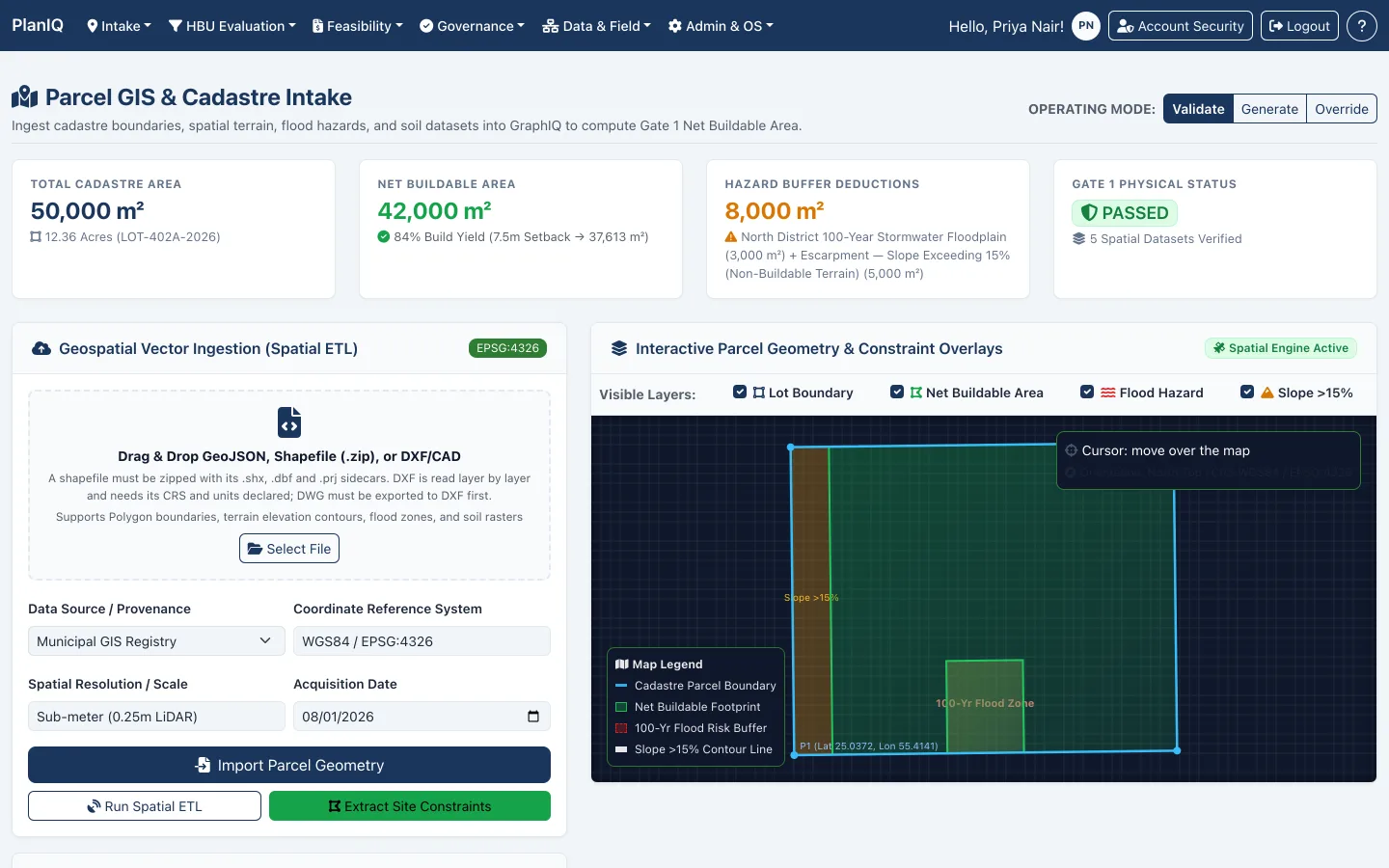
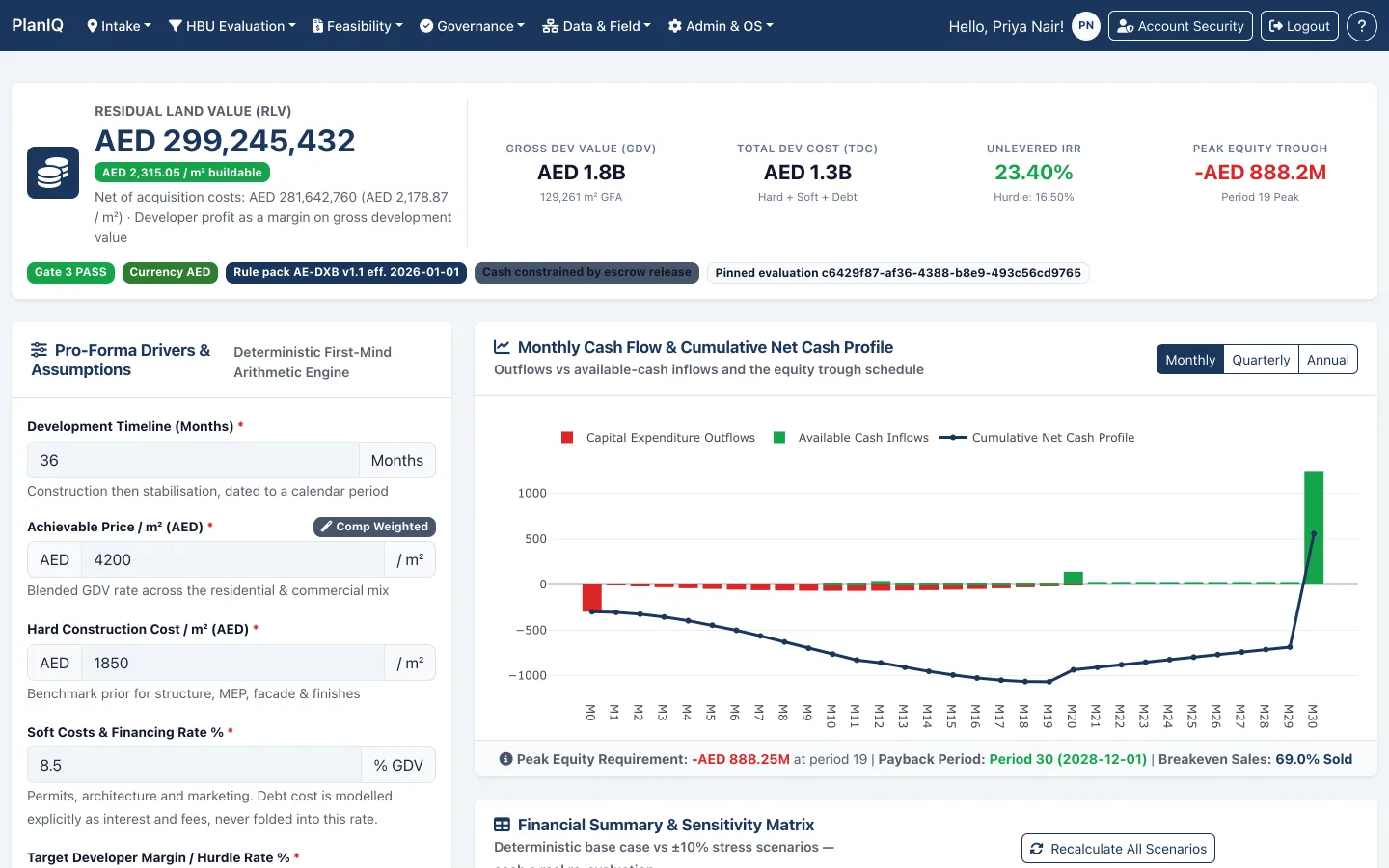
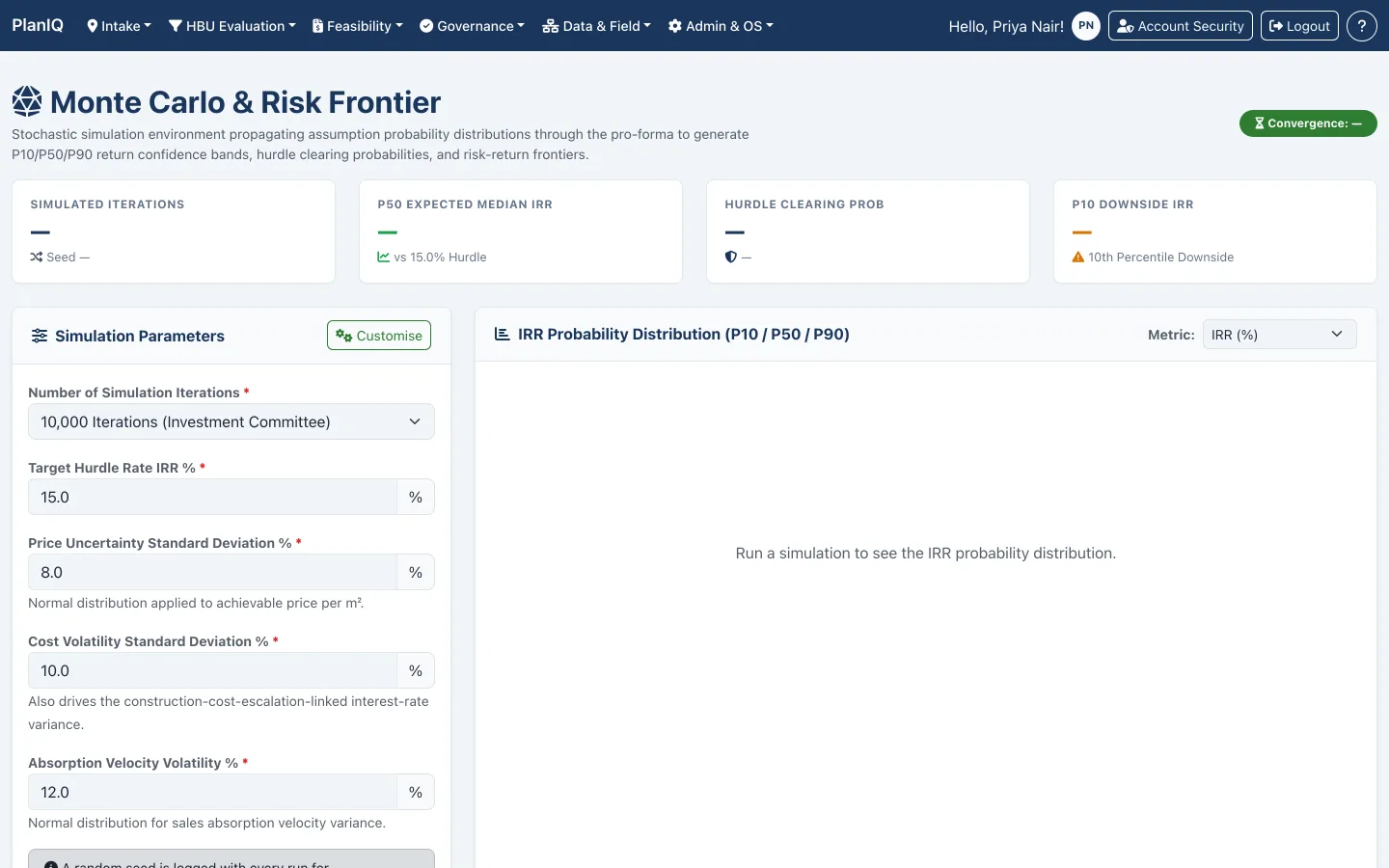
It is worth more in year three than on the day you install it
Most underwriting tools are static: they compute what you tell them and forget. PlanIQ closes the loop. Two flywheels turn — one on your own delivered projects, one on the open market — and both feed the same place: how widely the model is willing to bet.
The model learns which of your forecasts were wrong, and by how much
When a study's baseline is locked for underwriting, PlanIQ writes an immutable prediction snapshot — the input assumptions, the model parameters, the confidence interval, and the predicted gross development value, IRR, absorption velocity and residual. It is never edited; it is the record of what you believed, and when.
Public evidence compounds into confidence
Alongside your own history, PlanIQ ingests the open market continuously across four distinct layers — the public registry spine (transactions and cadastre), operational exhaust (broker and MLS activity), the municipal master plan (permits and planned infrastructure) and commissioned field research. Each layer carries its own trust weighting; none is treated as ground truth simply because it arrived.
PlanIQ versus the manual process
There is no like-for-like product to line up against, so this compares PlanIQ to what land actually gets underwritten with today: a commissioned consultant study, or the workbook someone built in-house.
| Capability | PlanIQ | Consultant-led study | In-house spreadsheet |
|---|---|---|---|
| Turnaround for a new site | ● Same day | ✕ 4–8 weeks | ◑ Days, if the model fits |
| Cost of testing one more scheme | ● Marginal | ✕ A new engagement | ◑ Rebuild by hand |
| Buildable area from real geometry | ● Spatially measured | ◑ Manual GIS pass | ✕ Estimated |
| Candidate uses actually screened | ● 25 per site | ◑ The two or three discussed | ✕ The one modelled |
| Reason recorded for each rejection | ● Coded, per gate | ◑ Narrative | ✕ None |
| Risk expressed as a distribution | ● P10 / P50 / P90 + clearing probability | ◑ A sensitivity table | ✕ A single number |
| Efficient frontier across configurations | ● Pareto-tested | ✕ Not attempted | ✕ Not attempted |
| Planning rules versioned & effective-dated | ● Rule packs, with forward schedules | ◑ In the consultant's head | ✕ Hard-coded |
| Provenance on every input | ● Source, as-of & confidence | ◑ Footnotes | ✕ None |
| Forecast accuracy measured after delivery | ● Bias, RMSE & MAPE per source | ✕ Rarely revisited | ✕ Never |
| Model tightens as evidence accumulates | ● Variance adjusts from measured error | ◑ Consultant's judgement | ✕ Static |
| Audit trail an examiner can follow | ● Immutable, content-hashed | ◑ The document itself | ✕ Last edited by… |
| Source code ownership & white-label | ● You own & rebrand it | ✕ Not applicable | ◑ A file on a laptop |
| Hosting & data residency control | ● Your infra, any region | ✕ The consultant's systems | ◑ Wherever the file went |
How do you buy PlanIQ?
Under Outcome-as-a-Service, with no upfront CAPEX. What you open above is a demo instance; what you buy is your own separate deployment — on your infrastructure, under your brand, source-available, and configured to how your operation actually works. Xamun invests the build, and you pay a per-transaction fee on what the system processes. A slow month is a small invoice; if it does not run, you do not pay.
Where PlanIQ fits
See PlanIQ on your own numbers
Bring us one workflow and we will show you PlanIQ running it.