
You rent a frontier mind for every decision.
Most were never a frontier problem.
Agentic systems run on thousands of small, bounded decisions a day, and most enterprises send every one to a frontier model. A $92 training run and a new class of decision model show that this is a choice, not a necessity — and that the decision layer belongs to the enterprise.
Arup Maity, Founder and CEO, Xamun Technologies. The decisions — the ninth paper in the series, following Paper No. 8, You hired a coder. You needed an owner. The full argument is on this page; the PDF is the formatted paper.
Summary of the argument
Most of what an enterprise AI system does is not reasoning. It is a long run of small, bounded decisions: which queue a request belongs to, how urgent it is, whether a submission is complete, whether the next action is safe to take. In most stacks today, every one of those decisions is a call to a frontier model — billed per token, hosted elsewhere, and changed on someone else’s schedule.
Two developments in 2025 and 2026 make that habit optional. Andrej Karpathy’s public work showed that a working chat model can be trained end to end for about ninety-two dollars on a single node, which turns could we own a model? from a research question into a line item. And TypeSafe’s Jev showed that a model can be built to return only typed decisions with calibrated confidence, never free text.
This paper argues that every governed system should have a decision layer: one interface per decision, with several minds behind it. Rules decide first. A small model the enterprise owns handles the routine decisions inside its own network. A System One model is an optional adapter where data residency allows. The frontier model is kept for language, judgement and the cases the cheaper minds are unsure about, and a person sees only the genuine forks.
The result is a cost that stays flat as volume grows, decisions that behave the same way twice, and data that stays where the regulator wants it. The paper sets out the source of the argument, the three kinds of mind, how they fit together, what it takes in practice, the economics, where it works and where it does not, and a phased path to adoption.
Rules decide first and act last. Everything in between is a question of which mind is cheapest and still confident.
1 · The source, and what it proves
This paper starts from Small Language Model Engineering 2026, an independent study note that synthesises Andrej Karpathy’s open-source repositories, discussion threads and public posts. The note is not written, reviewed or endorsed by Karpathy, and neither is this paper. The figures below are as Karpathy published them in his nanochat discussions, reached through that note. We credit both and claim neither.
The central result is nanochat, released in October 2025: one readable repository that takes raw text all the way to a chat model through four named stages — pretraining, midtraining, supervised finetuning and optional reinforcement learning. A January 2026 miniseries extended it into a ladder of model sizes, each set by a single dial, with a published cost for each rung.
| Run | Size | Time on 8×H100 | Cost | Benchmark (CORE) |
|---|---|---|---|---|
| Depth 17 | GPT-3 Small grade | ~26 minutes | ~$10 | 0.148 |
| Depth 20, the speedrun | ~561M parameters | 3 h 51 m | $92.40 | 0.222 |
| Depth 32 | Above GPT-2 | ~33 hours | ~$1,000 | 0.31 |
| Depth 181, extrapolated | GPT-3 175B grade | ~1,869 days | ~$1.07M | 0.427 |
Three lessons carry over directly to enterprise systems.
- Ownership has a price, and it is small at the bottom. A model that beats the 2019 state of the art costs about a thousand dollars to train. General capability is what becomes expensive; narrow jobs sit on the cheap rungs of the ladder.
- Small models are poor generalists. The $92 model scores close to chance on a broad knowledge test and solves roughly one grade-school maths problem in twenty. Nobody should mistake it for an assistant.
- Method beats model. One dial instead of a hyperparameter sweep, staged training where each stage has a named job, and measurement against something you did not train yourself. Those disciplines transfer even where the model itself does not.
The question “could we just train one?” has stopped being rhetorical. It is now a number you can put next to the invoice you already pay.
2 · The decision economy
An agent loop is mostly decisions, not thought. Before an AI worker drafts a single reply it has already asked a series of short questions: what is this, how urgent is it, which tool applies, is the input complete, is the next action safe, was the last output acceptable. Each answer is short, and each is drawn from a fixed set of options.
Those decisions dominate volume. A single customer request triggers several of them, and in most stacks a frontier model answers every one. The bill grows with traffic, the latency stacks up step by step, and two runs on the same input can disagree with each other — which is exactly what an auditor does not want to hear about a decision that moved money or touched a customer.
The dividing line
What can move off the frontier model follows a simple rule.
- If the answer is a function of the input, a small model can learn it. Routing, triage, classification, completeness checks, risk gating, format validation.
- If the answer needs knowledge that is not in the input, it cannot. Explaining a regulation, drafting a letter, weighing a credit case, planning a piece of work.
The second kind stays with the frontier model — or, better, with a model that looks the facts up rather than remembering them. That is Karpathy’s own picture of where small models are heading: a compact “cognitive core” that sacrifices encyclopaedic recall for capability and consults the world for facts. Most of the first kind was never a frontier problem at all.
3 · Three minds for decisions
Three kinds of model can now make a routine decision. They differ less in what they can do than in what the enterprise ends up holding.
| Frontier model | System One model (Jev) | Owned small model | |
|---|---|---|---|
| What it returns | Text, which the system must parse | A typed choice, score or yes/no, with probabilities | Whatever it is trained for: a label from a fixed set |
| Confidence | Self-reported, usually overconfident | Trained to be calibrated | Must be calibrated on the enterprise’s own held-out data |
| Speed | Seconds per decision | 70–500 ms, as published by the vendor | Milliseconds on local hardware |
| Cost shape | Per token; grows with traffic | Per input token; very low early-access pricing | Flat: the server, whatever the volume |
| Where it runs | Vendor cloud | Vendor cloud, US-hosted at launch | The enterprise’s network or an in-region host |
| Changes under you | Yes, on the vendor’s schedule | Yes, by vendor version | No: the same weights until you retrain |
| Best at | Language, judgement, open questions | Instant atomic judgements on data it may be sent | High-volume decisions on the enterprise’s own traffic |
Jev, launched in early access by TypeSafe AI in September 2026, is the first public “System One” model, named for Kahneman’s fast, intuitive mode of thought. It gives up text generation entirely: the system defines the answer space and the model returns a probability distribution over it. That is why it cannot invent an option, though it can still choose the wrong one. Its real contribution is the interface: typed answers, honest confidence, and decisions decomposed into atomic questions recombined in deterministic code.
The owned small model is what Karpathy’s work makes affordable. It has none of Jev’s built-in calibration, and it must be trained, served and watched. But it has the one property neither rented option can offer: it never leaves the enterprise’s control.
4 · How they come together
The three minds are not rivals; they are rungs. Each decision starts at the cheapest mind that might answer it and climbs only when that mind is unsure. Above them all sits a deterministic layer that has the final say: whatever tier answers, rules check the answer, execute it and record it.
Figure 1 · The decision cascade
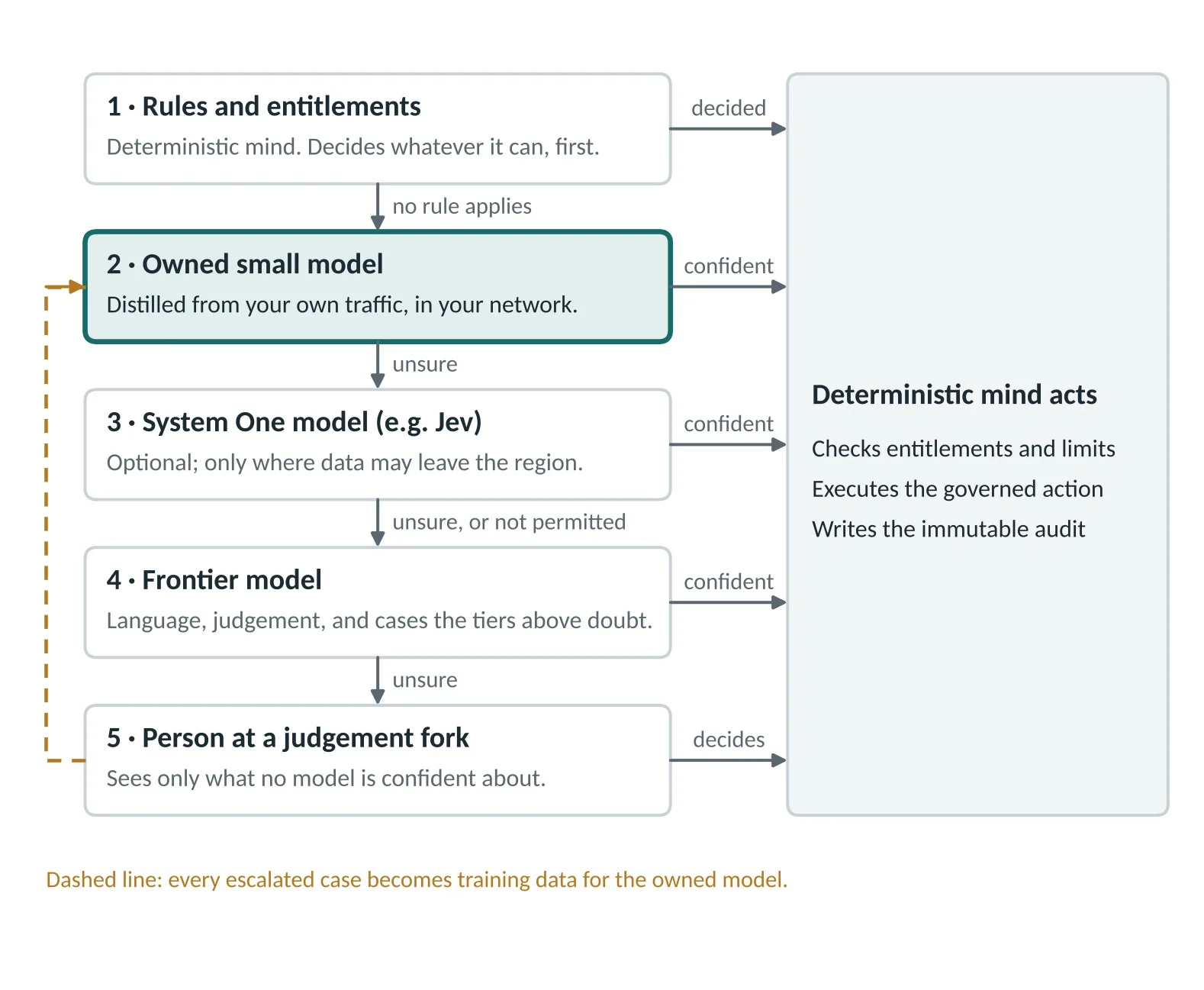
- Rules and entitlementsDeterministic mind. Decides whatever it can, first. If no rule applies, the decision moves down.
- Owned small modelDistilled from your own traffic, in your network. Answers when confident; passes on when unsure.
- System One model (e.g. Jev)Optional; only where data may leave the region. Passes on when unsure, or when not permitted.
- Frontier modelLanguage, judgement, and cases the tiers above doubt. Passes on when unsure.
- Person at a judgement forkSees only what no model is confident about, and decides.
- Deterministic mind actsWhichever tier answers, it checks entitlements and limits, executes the governed action and writes the immutable audit. Every escalated case becomes training data for the owned model.
Three properties of the cascade matter to a regulated buyer.
- One contract, swappable minds. Each decision is defined once: its input, its allowed answers, its confidence threshold and its escalation rule. The minds behind it are adapters. Changing a model does not change the system.
- Residency is a routing rule. For data that may not leave the region, the System One tier is simply skipped and the owned model hands straight to the frontier tier, which can itself be an in-region deployment.
- The system improves where it is uncertain. Every case escalated past the owned model becomes training data for its next release. The frontier model’s share of decisions falls as the owned model learns, and the person at the top sees genuine forks only.
This sits naturally inside an architecture that already separates a deterministic mind from a governed language mind, as earlier papers in this series have described (the Two Minds architecture; Paper Seven). The decision layer is not a new product category. It is a socket that a well-governed system already has room for.
Rules decide first and act last. Everything in between is a question of which mind is cheapest and still confident.
5 · What it actually takes
Almost nobody should train from scratch. The study note sets out four routes to a small model that does one job, in rising order of effort. The right one is the cheapest that clears the bar.
| Route | When it fits | Effort |
|---|---|---|
| Prompt an open small model off the shelf | The task is generic | Hours |
| Finetune that model on labelled examples | A few thousand labels exist | Days; tens of dollars |
| Distil from the frontier model on real traffic | The decision already runs in production | One to two weeks; hundreds of dollars |
| Train from scratch, nanochat-style | The data looks like nothing on the shelf | Weeks; $100–$1,000 of compute |
For an enterprise already running AI, distillation is the right default, because the training data already exists in its logs.
Figure 2 · The distillation loop
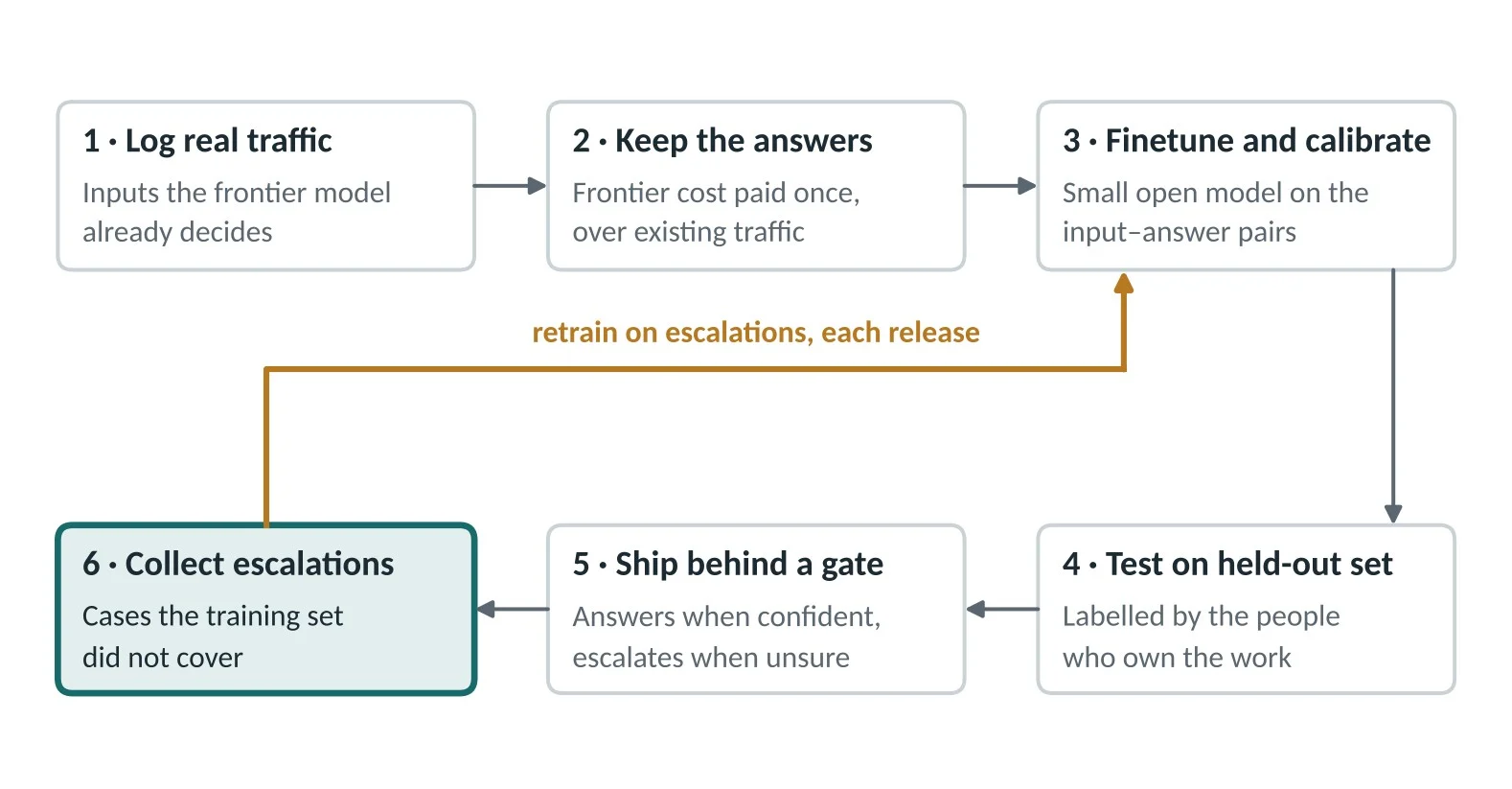
- Log real trafficInputs the frontier model already decides.
- Keep the answersFrontier cost paid once, over existing traffic.
- Finetune and calibrateSmall open model on the input–answer pairs.
- Test on held-out setLabelled by the people who own the work.
- Ship behind a gateAnswers when confident, escalates when unsure.
- Collect escalationsCases the training set did not cover. Retrain on them, each release, from step 3.
Two engineering facts decide whether it works
- Calibration is not free. A finetuned small model’s raw scores are not honest probabilities. Constrain it to a fixed label set, then calibrate its scores against a held-out set before setting the gate threshold. Jev is trained for this; an owned model has to be tuned for it.
- Size decides where it runs. Weight memory is roughly parameters multiplied by bytes per parameter. A three-billion-parameter model needs about 6 GB at 16-bit precision and about 1.5 GB at 4-bit, which fits a single modest GPU in the enterprise’s own data centre. The accuracy lost to compression must be measured on the enterprise’s own task, not on a public benchmark.
6 · The economics
At volume, the frontier bill is the one that scales; the other two barely move. Figure 3 works through a single routine classification decision of about 800 input and 20 output tokens.
Figure 3 · Monthly cost of one routine decision, by daily volume
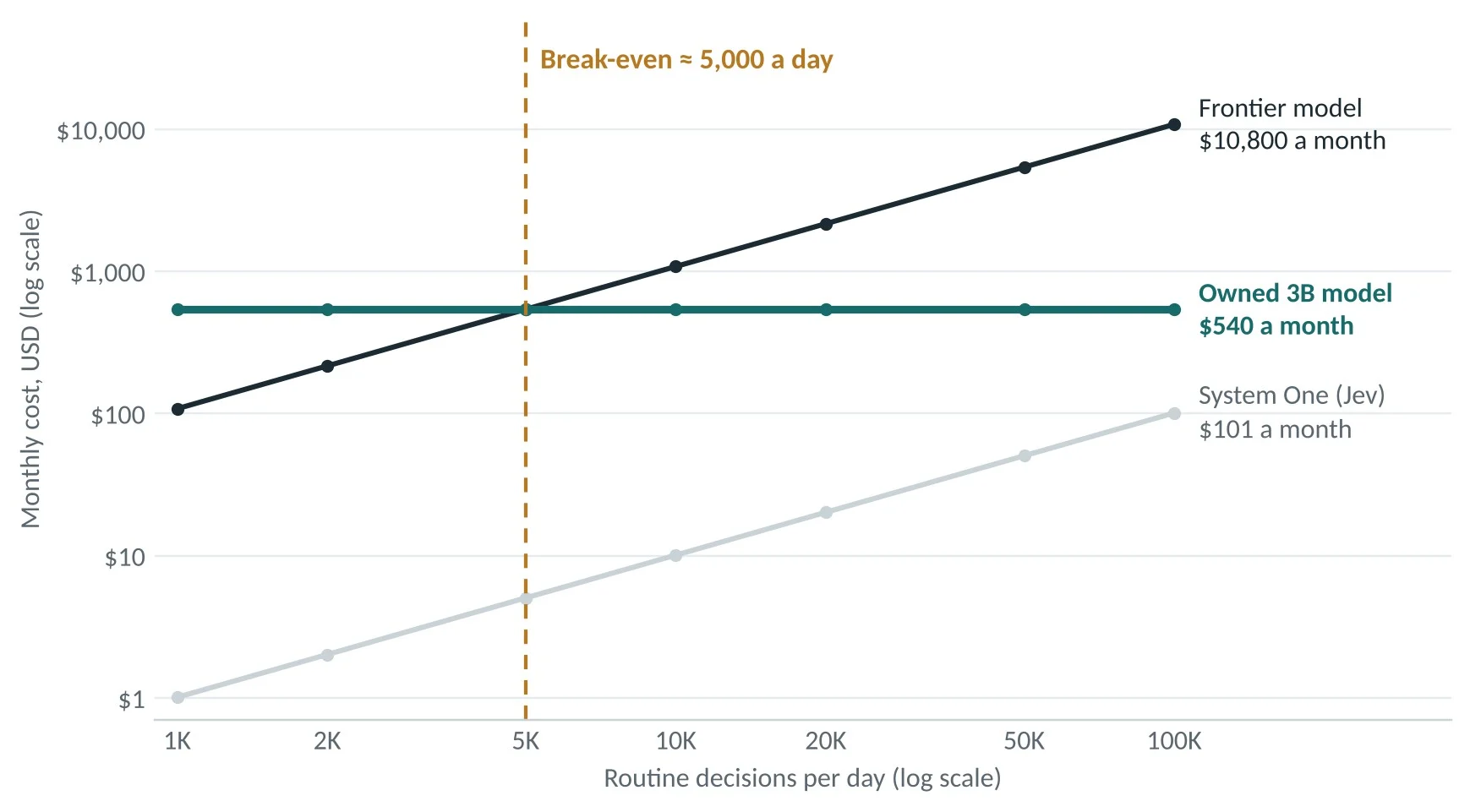
| Decisions a day | Frontier model | Owned 3B model | System One (Jev) |
|---|---|---|---|
| 1,000 | $108 a month | $540 a month | $1 a month |
| 5,000 | $540 a month | $540 a month | $5 a month |
| 10,000 | $1,080 a month | $540 a month | $10 a month |
| 100,000 | $10,800 a month | $540 a month | $101 a month |
The frontier and GPU figures follow the study note’s worked example; the System One line is our own arithmetic from the vendor’s published price. Owning also carries a one-off of a few hundred dollars for the teacher pass. The honest reading has three parts.
- On price alone, renting a System One model wins. Owning a model is not the cheapest way to make a routine decision.
- Owning wins on everything price leaves out. No data leaves the network, nothing reprices or deprecates, and the decision behaves the same way next quarter as it does today. For regulated buyers in the Gulf, that usually decides the matter.
- Below the break-even — about 5,000 decisions a day in this example — keep renting. The engineering effort to own a model costs more than the bill it saves.
The threshold question is not “is the small model as good?” It is “at what volume does the recurring bill exceed the one-off cost of owning?”
7 · Where it works
The best candidates share four traits: high volume, a fixed answer set, an answer drawn from the input alone, and existing traffic to learn from. Across the kinds of system enterprises are now putting into production, these fit well.
| Workload | The decision | Escalates when |
|---|---|---|
| Agent action gating | Is this step safe, does it need approval, or is it blocked? | Confidence is low, or the action writes to a system of record |
| Request routing across a suite of systems | Which agent, queue or module owns this? | The request spans domains |
| Order and intake triage | Intent, urgency and completeness | Information is missing or the customer is unusual |
| Fund-flow classification | Which programme category; is it anomalous? | A transaction falls outside its pattern |
| Lending and leasing document intake | Document type; complete or not | A document is unreadable or contradicts another |
| Regulatory query routing | Which jurisdiction and domain applies? | The question crosses domains or has no clear home |
| Support and operations queues | Category and priority | The ticket is a complaint, or high-value |
Agent action gating is the clearest first win: it is the most frequent decision in any agentic system, its labels are stable, and every escalation is already a human checkpoint. Classification of financial flows that carry no personal data is the cleanest pilot for an owned model, because it removes the residency question from the first experiment.
8 · Where it does not, and the risks
Small models fail confidently when they are asked to know things. Anything that depends on world knowledge, multi-step reasoning or careful writing stays with the frontier model: drafting, underwriting judgements, compliance answers, specifications and planning.
The risks of a decision layer are known ones, and each has a known control.
| Risk | Control |
|---|---|
| Measuring on impressions. A small model that looks right on ten hand-picked examples fails on the long tail. | Build the held-out set before any training; ship nothing that has not been measured against it. |
| False confidence. An uncalibrated gate lets wrong answers through with a high score. | Calibrate, then set the threshold from the cost of a wrong answer, not from a default. |
| Drift. Inputs change, and a model trained once degrades quietly. | Treat the escalation log as the early warning and the retraining set. |
| Vendor and residency exposure. Jev is early-access, US-hosted and benchmarked by its own vendor. | Use it only where data may leave the region, until that changes. |
| Operating overhead. Serving, monitoring, rollback and retraining are real work. | Treat the owned model as a capability to run, not a file to download. |
| Optimising one number. Automated tuning loops find ways to move a metric that nobody intended. | Keep a person in charge of what is being measured. |
9 · What to look for in a delivery model
An enterprise does not need to build a decision layer from first principles. It needs whoever builds its systems to have made room for one. Five tests separate a system that can host a decision layer from one that will have to be rebuilt to get it.
- Does the deterministic layer decide first and act last? If a language model sits in the decision path with the final word, no amount of tiering will make the system governable.
- Is each decision defined as a contract? Input, allowed answers, threshold and escalation rule, written down once, with the model behind it treated as an adapter.
- Does the system run with the language layer down? Every model-touched workflow should have a rules-only fallback. An owned small model makes that fallback far more capable; it should not be the first thing that ever sat there.
- Who owns the model trained on your traffic? A distilled model is built from the enterprise’s own data. It should be the enterprise’s asset, in its own network, under the same terms as the source code.
- Does the commercial model reward a cheaper decision? If the deliverer is paid by usage of a rented model, it has no reason to move decisions off it. If it is paid on outcome or hands over the source, it does.
10 · A phased path to adoption
Start with one decision, not a platform. Each phase has a gate, and most decisions stop well before the last phase.
| Phase | Work | Gate to the next phase |
|---|---|---|
| 1 · Find the decision | Pick the decision the system makes most often. Log real inputs and the frontier model’s answers. | A steady stream of logged input–answer pairs |
| 2 · Build the yardstick | The people who own the work label a held-out sample by hand and agree the accuracy that would justify switching. | A written ship threshold |
| 3 · Try the shelf | Prompt an open small model — and a System One model where residency allows — against the yardstick. | If either clears it, ship behind the confidence gate |
| 4 · Distil | Otherwise, finetune a small open model on the logged pairs and calibrate it. | The threshold is met on the held-out set |
| 5 · Place it | Compress the model, measure the damage on the same set, and size hardware in-network or in-region. | Accuracy and latency hold after compression |
| 6 · Run the flywheel | Ship behind the gate, send unsure cases up the cascade, retrain on them each release. | Then pick the next decision |
None of this makes a small model the equal of a frontier one, and nothing in Karpathy’s work claims it does. What it removes is the mystery. Having trained or distilled one model for one decision, an enterprise will know which of the thousand calls in its system were never a frontier problem at all — and it will own the answer to every one of them.
The reason to own the small model is not that it is better than the frontier one. It is that, having done it once, you know which decisions never needed renting.
Questions a buyer should ask
Answered plainly.
What is a decision layer in an enterprise AI system?
One interface per decision, with several minds behind it. Each decision is defined once as a contract: its input, its allowed answers, its confidence threshold and its escalation rule. Rules decide first. A small model the enterprise owns handles the routine decisions inside its own network. A System One model is an optional adapter where data residency allows. The frontier model is kept for language, judgement and the cases the cheaper minds are unsure about, and a person sees only the genuine forks. Whichever tier answers, a deterministic layer checks entitlements, executes the action and writes the audit.
Which AI decisions can move off a frontier model to a small model?
The ones where the answer is a function of the input: routing, triage, classification, completeness checks, risk gating and format validation. A small model can learn those. If the answer needs knowledge that is not in the input — explaining a regulation, drafting a letter, weighing a credit case, planning a piece of work — it cannot, and the decision stays with the frontier model or with a model that looks the facts up rather than remembering them. The best candidates share four traits: high volume, a fixed answer set, an answer drawn from the input alone, and existing traffic to learn from.
What is a System One model?
A model built to return only typed decisions with calibrated confidence, never free text. The system defines the answer space and the model returns a probability distribution over it, so it cannot invent an option, though it can still choose the wrong one. The name comes from Kahneman’s fast, intuitive mode of thought. Jev, launched in early access by TypeSafe AI in September 2026, is the first public example. It is early-access, US-hosted at launch and benchmarked by its own vendor, so it belongs only where data may leave the region.
Is owning a small model cheaper than calling a frontier model for every decision?
Above a break-even volume, yes; on price alone, renting a System One model is cheaper still. In the paper’s worked example — one routine decision of about 800 input and 20 output tokens, from list prices and not a measurement — a frontier model costs about $10,800 a month at 100,000 decisions a day, an owned three-billion-parameter model on one rented GPU costs about $540 a month whatever the volume, and a System One model about $101. The frontier and owned lines cross at about 5,000 decisions a day. Below that, keep renting: the engineering effort to own a model costs more than the bill it saves. Owning wins on what price leaves out: no data leaves the network, nothing reprices or deprecates, and the decision behaves the same way next quarter.
What does it take to get a small model that makes one decision well?
Almost nobody should train from scratch. There are four routes in rising order of effort: prompt an open small model off the shelf (hours); finetune it on a few thousand labelled examples (days, tens of dollars); distil from the frontier model on real traffic (one to two weeks, hundreds of dollars); or train from scratch (weeks, $100 to $1,000 of compute). The right one is the cheapest that clears the bar. For an enterprise already running AI, distillation is the right default, because the training data already exists in its logs. Two engineering facts decide whether it works: the model’s scores must be calibrated against a held-out set before the gate threshold is set, and its size decides where it can run.
How does a decision layer handle data residency?
Residency becomes a routing rule. For data that may not leave the region, the vendor-hosted System One tier is simply skipped, and the owned model — which runs in the enterprise’s own network or on an in-region host — hands straight to the frontier tier, which can itself be an in-region deployment. Because each decision is a contract and the models behind it are adapters, changing where a decision runs does not change the system.
What are the risks of using small models for decisions?
Small models fail confidently when they are asked to know things, so anything that depends on world knowledge, multi-step reasoning or careful writing stays with the frontier model. The known risks each have a known control. Measuring on impressions: build the held-out set before any training. False confidence: calibrate, then set the threshold from the cost of a wrong answer. Drift: treat the escalation log as the early warning and the retraining set. Vendor and residency exposure: use a hosted System One model only where data may leave the region. Operating overhead: treat the owned model as a capability to run, not a file to download. Optimising one number: keep a person in charge of what is being measured.
How can a buyer tell whether a system can host a decision layer?
Five tests. Does the deterministic layer decide first and act last? Is each decision defined as a contract — input, allowed answers, threshold and escalation rule — with the model behind it treated as an adapter? Does the system run with the language layer down? Who owns the model trained on your traffic — it should be the enterprise’s asset, in its own network, under the same terms as the source code? And does the commercial model reward a cheaper decision: a deliverer paid by usage of a rented model has no reason to move decisions off it.
Where should an enterprise start with a decision layer?
With one decision, not a platform. Pick the decision the system makes most often and log real inputs and the frontier model’s answers. Have the people who own the work label a held-out sample and agree the accuracy that would justify switching. Try an open small model off the shelf against that yardstick; distil only if it falls short. Agent action gating is the clearest first win: it is the most frequent decision in any agentic system, its labels are stable, and every escalation is already a human checkpoint. Classifying financial flows that carry no personal data is the cleanest pilot for an owned model, because it removes the residency question from the first experiment.
Get the PDF
The complete paper, formatted for reading and circulation, with every table, the three figures and the full source list. No form — take it.
Related: the Two Minds architecture · WorkForceOS — a governed AI workforce · AI governance for UAE enterprises · Paper No. 7 — decision sovereignty · Paper No. 8 — who carries the risk of the build
About this series
This is the ninth paper in a series on enterprise AI as an operating system rather than a tool. Paper One established where the value is. Paper Two set out the method for re-deriving a process from its outcome. Paper Three described delivery, and Paper Four turned the method into a strategy. Paper Five applied it to the accounting and advisory practice; Paper Six separated the commercial model from the delivery model that makes an outcome contractable. Paper Seven described the governed workforce that does the routine work, and Paper Eight addressed who builds and who carries the risk. This paper turns to the smallest unit inside all of them: the individual decision, and which mind should make it.
Every paper is readable at xamun.ai/whitepapers. This paper is Xamun’s own position. It is not affiliated with, reviewed by or endorsed by Andrej Karpathy, Eureka Labs, OpenAI or TypeSafe AI. Model figures are reproduced as published by their authors; cost figures are worked examples, not measurements.
Sources and references
- Small Language Model Engineering 2026 — independent study note synthesising Karpathy’s public material; source for the four routes, the distillation loop, the memory arithmetic and the frontier and GPU worked example.
- A. Karpathy, “Introducing nanochat: The best ChatGPT that $100 can buy,” karpathy/nanochat Discussion #1, October 2025 — the four-stage pipeline and the $92.40 speedrun.
- A. Karpathy, “nanochat miniseries v1,” karpathy/nanochat Discussion #420, January 2026 — the depth ladder and its extrapolations.
- A. Karpathy, “$1000 tier nanochat run,” karpathy/nanochat Discussion #8, October 2025 — the depth-32 run.
- A. Karpathy, public post on the LLM “cognitive core,” 2025 — the small, tool-using model that looks facts up.
- A. Karpathy, autoresearch repository and public post, March 2026 — the automated experiment loop.
- TypeSafe AI, “Introducing System One Models and Jev,” September 2026, and product documentation (docs.typesafe.ai) — Jev’s answer types, calibration and pricing.
- DataCamp, “System One Models: Jev,” 2026; P. Pillitteri, “TypeSafe launches Jev,” 16 September 2026 — independent coverage of the launch.
- V. Sanh et al., “DistilBERT, a distilled version of BERT,” 2019 — the reference point for how much a distilled student retains.
- Xamun Position Papers No. 1 to No. 8 (August–October 2026), xamun.ai/whitepapers.
No. 9 in the Xamun position-paper series. © 2026 Xamun Technologies. Version 1.0, October 2026.
The Xamun position-paper series