
Credit Notes for Returns, Breakage and Short Deliveries Under PINT AE
Published 26 September 2026 · By Arup Maity · ~5 min read
Arup Maity is Founder and CEO of Xamun, author of The Always-On Enterprise and adjunct faculty at the Asian Institute of Management.
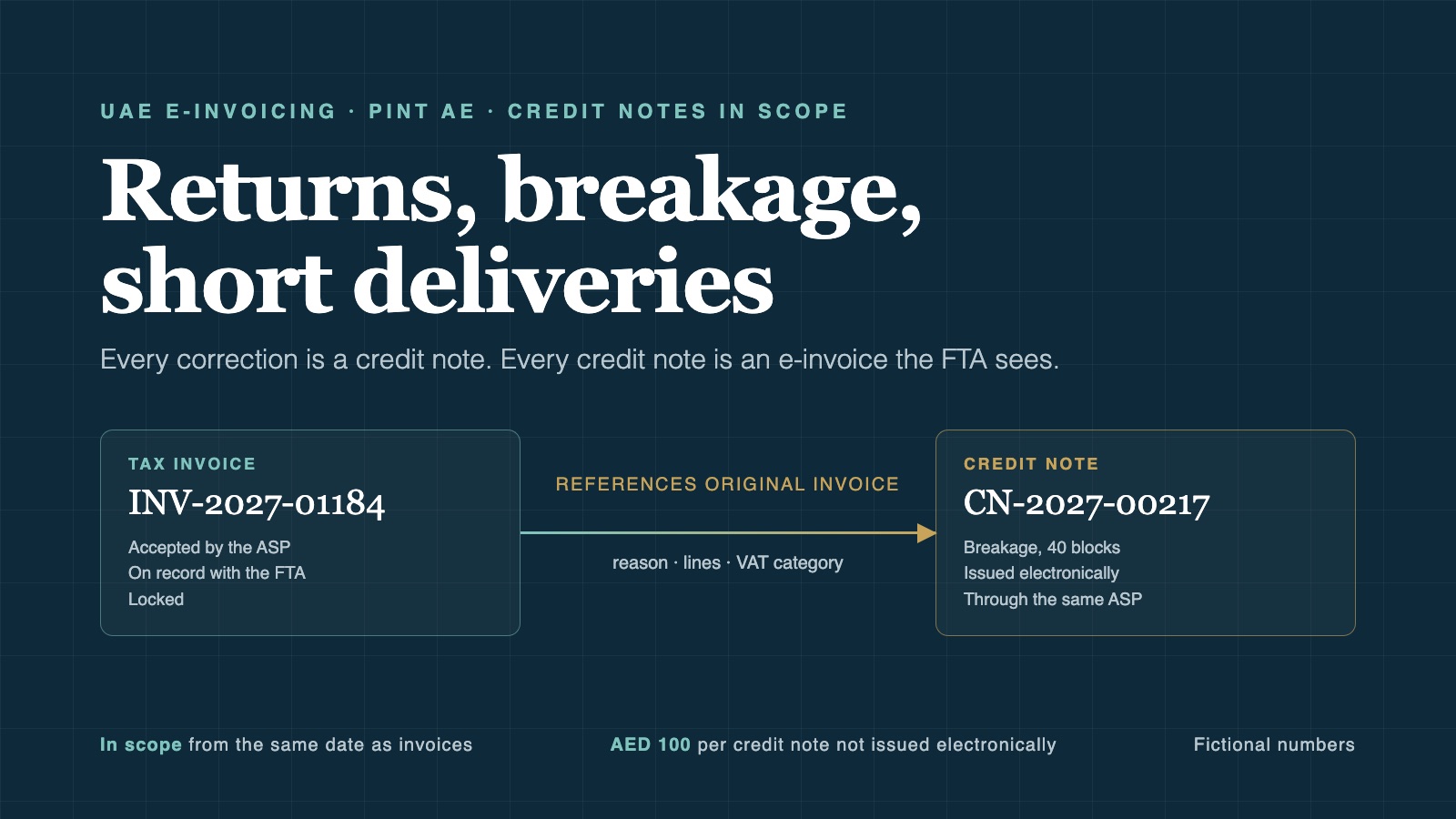
Most of the UAE e-invoicing discussion is about invoices. For a building-materials distributor the harder document is the credit note. Heavy goods break in transit, pallets arrive short, a site rejects a delivery, a price is agreed after the fact. Every one of those events ends in a credit note, and from your go-live date every credit note in scope has to be issued electronically, through your Accredited Service Provider, in the same PINT AE format as the invoice it corrects. It is also reported to the Federal Tax Authority in the same way.
This post covers the three things that change about credit notes under e-invoicing: they are in scope, they have to be linked to the original invoice, and the reason for each one has to be recorded in a way the system can carry. It ends with what that means for how a distributor handles returns today.
Credit notes are in scope, and the fine says so
The rollout decisions treat invoices and credit notes together. A B2B or B2G credit note issued after your go-live date — 1 January 2027 for businesses with revenue of AED 50 million or more, 1 July 2027 for the rest — is a structured e-invoice document like any other. Cabinet Decision No. 106 of 2025 makes the point explicitly: the AED 100 fine per document not issued electronically applies to invoices or credit notes, capped at AED 5,000 a month.
The practical consequence is larger than the fine. A credit note issued as a PDF or a line in a spreadsheet after go-live is not a valid credit note for VAT purposes. The original invoice stands, in full, on record with the tax authority, and the correction you think you made has not happened.
Every credit note points at an invoice
Under e-invoicing a credit note is not a free-standing document. It carries a reference to the original invoice it corrects, so that the tax authority can net the two and your customer’s provider can match the credit against the invoice already received. That reference has to be exact: the invoice number the ASP accepted, not the internal order number, not the delivery note.
This is where many distributors will find their current practice does not survive contact with the system. A typical returns process today is: the driver brings back forty broken blocks, the depot raises a returns slip, and at month end somebody issues a single credit note for that customer covering breakage, a short delivery and a price adjustment from three different invoices. One credit note, three invoices, no line-level link. Under PINT AE that becomes three credit notes, each referencing one invoice, each with lines that correspond to lines on that invoice.
The same applies to the VAT on each line. A credit note for standard-rated blocks carries the standard rate; a credit note against an out-of-scope delivery charge carries no VAT; a credit note to a designated-zone customer carries that customer’s treatment. The credit note inherits the VAT category of the line it corrects, which means the system that issues it has to know what that category was at the time of the original invoice, not what the price list says today.
Reasons, recorded
The second thing that changes is the reason. A credit note has always needed one for audit purposes; under e-invoicing the reason travels with the document rather than sitting in an email thread. For a distributor the reasons fall into a short list, and it is worth agreeing that list before go-live rather than letting every depot invent its own:
- Breakage in transit. Goods delivered, some unusable. Credit for the damaged quantity at the invoiced price.
- Short delivery. Fewer units arrived than were invoiced. Credit for the difference, or a replacement delivery and no credit — but not both.
- Return. Goods delivered and sent back, whether over-ordered or wrong. Credit on receipt at the depot, not on the customer’s say-so.
- Price correction. The invoice carried a price the customer had not agreed. Credit for the difference on the affected lines only.
- Rejected delivery. The whole delivery refused at site. Full credit against the whole invoice.
Two things follow. Each reason maps to specific lines of a specific invoice, which is only easy if the invoice was built from an order that recorded which lines went to which site from which depot. And each reason has a different control: a return needs a goods receipt, a price correction needs an approval, breakage needs a driver’s note. A system that issues credit notes without asking for the evidence behind the reason is a system that will issue too many of them.
What this means before go-live
Take last quarter’s credit notes and ask three questions of each. Can it be tied to exactly one invoice? Do its lines match lines on that invoice, with the same VAT treatment? Is the reason recorded somewhere a system could read? If the answer to any of these is no for a meaningful share of them, the returns process is the thing to fix in the run-up to your date, alongside the customer master data and the line-level VAT categories the readiness checklist covers.
The month-end consolidated credit note is the habit to break first. It is convenient today because nothing checks it. From go-live it is either three documents or no valid document at all.
Where SalesOrderOS fits
We built SalesOrderOS by Xamun for exactly this shape of business, and to be plain about it: it is our product. It starts at the sales order, so every invoice line already knows its order, its depot, its delivery site and its VAT category, frozen at the time of invoicing. Once the ASP accepts an invoice it locks, and any change is a credit note raised against that invoice, which goes through the same connector to whichever ASP you appoint. Invoices, credit memos and the e-invoice queue are visible together on the dashboard in the live demo, on fictional data. It is delivered with no upfront capex, paid per order from go-live. If you want to see what your returns look like as PINT AE credit notes, book a walkthrough.
- Order-to-e-invoice for UAE distributors — SalesOrderOS by Xamun, with the full timeline and legal basis
- The 30 October 2026 ASP deadline — a four-week plan for the weeks left
- UAE e-invoicing in 2027: a distributor’s checklist — the eight checks to run on last quarter’s invoices
- Distribution and wholesale in the UAE — the sector page
Frequently asked questions
Are credit notes in scope for UAE e-invoicing? Yes. B2B and B2G credit notes are issued electronically through your Accredited Service Provider in the same PINT AE format as invoices, from the same go-live date, and Cabinet Decision No. 106 of 2025 applies the AED 100 per-document fine to credit notes as well as invoices.
Does a credit note have to reference the original invoice? Yes. A credit note under e-invoicing corrects a specific invoice and carries a reference to it, so the tax authority and your customer’s provider can match the two. A single month-end credit note covering several invoices does not fit that model.
What VAT rate does a credit note carry? The same treatment as the invoice line it corrects: standard-rated lines are credited at the standard rate, out-of-scope charges with no VAT, and designated-zone or export lines with the treatment applied on the original invoice.
Can I fix a wrong e-invoice by re-issuing it? No. Once your ASP has accepted an invoice it is on record with the Federal Tax Authority. A correction is a credit note referencing that invoice, followed by a new invoice if one is needed.
How does SalesOrderOS by Xamun handle credit notes? A credit note is raised against a specific invoice and its lines, with the reason recorded and the VAT category inherited from the original line, and it is sent through the same ASP connector as the invoice. It is shown alongside invoices and the e-invoice queue in the live demo.
Dates and fines as published by the UAE Ministry of Finance, checked 26 September 2026. This is general information, not tax advice; confirm your own obligations with your tax adviser.