
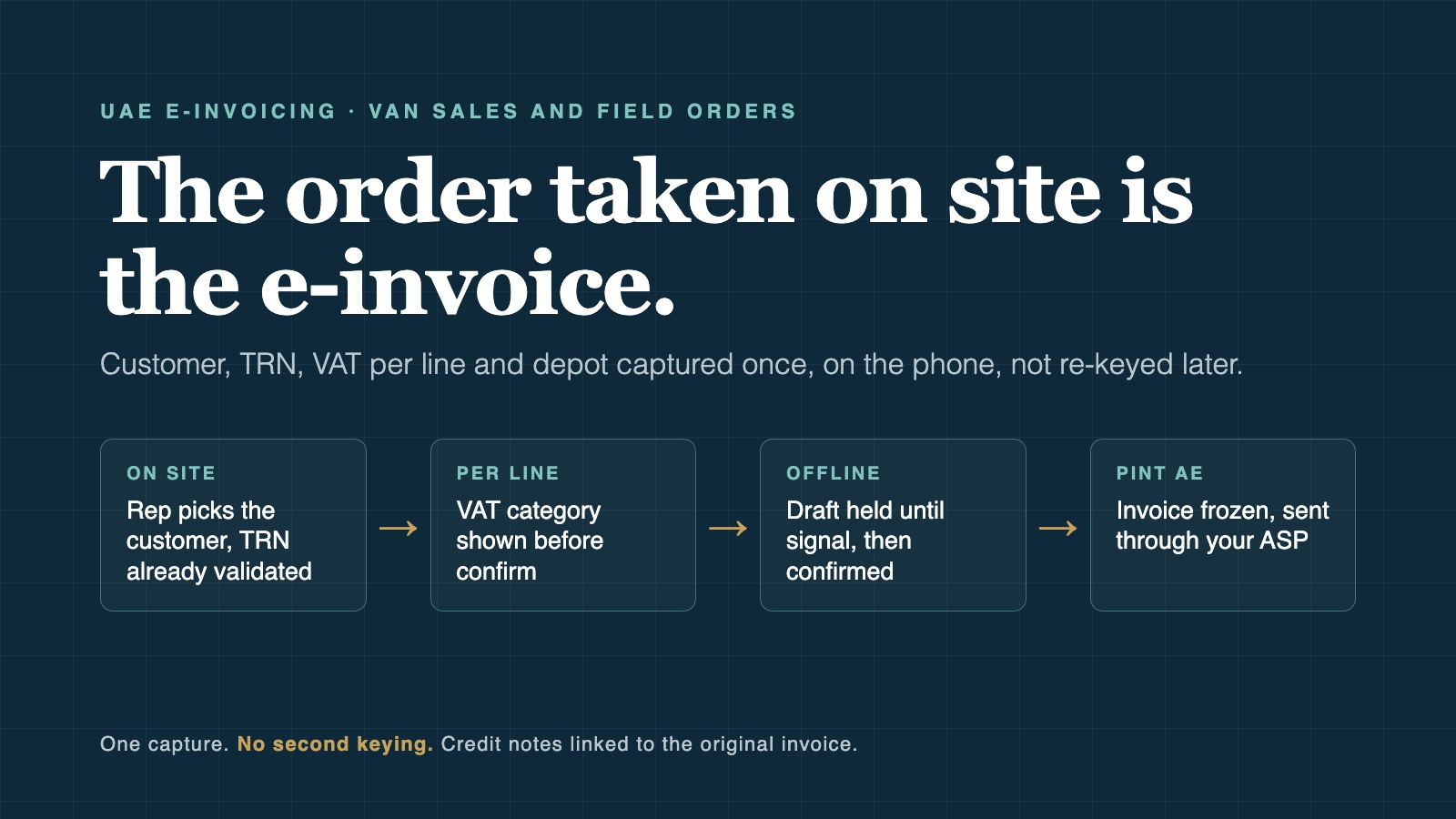
Van Sales and Field Orders Under UAE E-Invoicing: The Order Taken on Site Is the E-Invoice
Published 26 September 2026 · By Arup Maity · ~6 min read
Arup Maity is Founder and CEO of Xamun, author of The Always-On Enterprise and adjunct faculty at the Asian Institute of Management.
A large share of a UAE distributor’s revenue is written down away from a desk: a van rep at a hardware shop, a sales rep at a construction site, a phone order from a contractor at 6 a.m. Under e-invoicing, the invoice that reaches your Accredited Service Provider is built from whatever that rep captured. If the capture is wrong, the PINT AE e-invoice is wrong, and from 1 January 2027 the fix is a credit note the Federal Tax Authority also sees.
Most e-invoicing advice stops at the ERP. This post is about the twenty minutes before the ERP, when the order exists only on a rep’s phone or a notepad, and about the four things that have to be right at that moment: the customer’s TRN, the VAT category of every line, what happens when there is no signal, and the credit-note trail when a delivery comes back short.
Why the field order became a tax document
Today, a field order is a draft. A rep writes it down, someone at the depot re-keys it, and finance issues a PDF invoice that can be quietly re-issued if a detail is wrong. E-invoicing removes that slack. Under Ministerial Decision No. 244 of 2025, businesses with revenue of AED 50 million or more appoint an ASP by 30 October 2026 and issue e-invoices from 1 January 2027; everyone else appoints by 31 March 2027 and goes live on 1 July 2027. From those dates, an in-scope B2B invoice is structured data in PINT AE, validated by your ASP and reported to the Federal Tax Authority. A rejected invoice has not been issued. An accepted one is on record.
Re-keying is where field orders go wrong. Each time an order is typed a second time, the customer, the price, the depot or the VAT treatment can drift from what was agreed on site. The only way to remove the drift is to remove the second keying: the rep’s capture becomes the order, the order becomes the invoice, and the invoice becomes the e-invoice, with nothing typed in between.
TRN capture on the handheld
A missing or mistyped Tax Registration Number is the single most common reason an e-invoice will fail, and it fails on every invoice to that customer until someone fixes the record. In a van-sales business the customer record is often created on the spot, for a new shop or a new site, and the TRN is either not asked for or copied from a trade licence photo later.
The field app has to do three things. It has to show the rep whether the customer already has a validated TRN before the order is confirmed. It has to let the rep capture a TRN on site, in the fifteen-digit format, and flag one that does not pass a basic check. And it has to hold a new customer whose TRN or trade licence is not yet on file in a pending state, so the order can be taken but the invoice cannot be issued until the record is complete. That last rule is unpopular with reps and essential for finance.
Line-level VAT on the phone
PINT AE carries a VAT category on every line, not a rate on the total. A single site delivery can mix standard-rated blocks and tiles, a delivery charge with its own treatment, and a customer in a designated zone or an export shipment where the treatment changes again. If the rep’s app only shows a total, the VAT decision is being made later by someone who was not at the site.
The practical rule is that the VAT category is shown per line, on the phone, before the rep confirms the order. The category comes from the product and the customer’s status, not from the rep’s judgement, and the rep sees the result. A designated-zone customer shows as such on every line; a delivery charge shows its own treatment. If the category is wrong at this point, it is caught by the person standing in front of the customer, which is the cheapest place to catch it.
Offline drafts
Sites, basements and industrial areas lose signal. An app that cannot take an order without a connection sends the rep back to the notepad, and the notepad is where re-keying begins. The app has to hold the order as an offline draft, with the customer, lines, prices and VAT categories as they were last synced, and confirm it when the signal returns.
The trade-off is stock. An offline draft cannot reserve stock at a depot, so the app has to say so plainly: the order is captured, the reservation happens on sync, and if the nearest depot is short by then the rep and the customer are told. That is a smaller problem than an order that was never captured, or one captured twice because the rep could not tell whether the first attempt went through.
The credit-note trail
Heavy goods break, deliveries come up short, and customers return pallets. Every one of those is a credit note, and credit notes are in scope: they must be issued electronically, linked to the original invoice, with the reason recorded. For a field-sales business this means the return or short delivery has to be recorded against the specific invoice line it relates to, at the point the driver or rep sees it, not reconstructed from a phone call two weeks later.
The trail runs order, invoice, credit note, and each step references the one before. If the original invoice was frozen when it was issued, with price, description and VAT category on every line, the credit note inherits those values and the two documents agree. If the invoice was recalculated from a price list at issue time, the credit note may not match, and the mismatch is now visible to the tax authority.
What this means for the ASP project
None of the four items above is solved by choosing a provider. The ASP validates and carries what you send it; it does not know the rep skipped the TRN, or that the VAT on line three was decided at the depot. A distributor that appoints an ASP on time but leaves the field process unchanged will meet the first deadline and then spend January in a rejection queue. The field capture is where the invoice is right or wrong, and it is worth putting it early in the plan.
Where SalesOrderOS fits
We built SalesOrderOS by Xamun for this shape of business, and to be plain about it: it is our product. Its field-sales app runs on the rep’s own phone with no app store: the rep sees their own customer list, builds an order against live depot stock with the VAT category shown on every line before confirming, and can hold a draft offline until there is signal. New customers without a trade licence are held until the record is complete. The invoice freezes price, description and VAT category on every line, locks once the ASP accepts it so any change is a credit note, and the PINT AE file is built from that frozen invoice and sent through whichever ASP you appoint. It is delivered with no upfront capex, paid per order from go-live, and there is a live demo on fictional data.
- Order-to-e-invoice with depot stock and field sales for UAE distributors — the SalesOrderOS product page
- Distribution and wholesale in the UAE — the sector page
- The 30 October 2026 ASP deadline — a four-week plan for the weeks left
- UAE e-invoicing in 2027: a distributor’s checklist — the eight checks to run on last quarter’s invoices
Frequently asked questions
Do field and van-sales orders fall under UAE e-invoicing? Yes. E-invoicing applies to the invoice, not to where the order was taken. A B2B sale written down at a site or from a van is invoiced as a PINT AE e-invoice through your Accredited Service Provider like any other in-scope sale.
Can a rep issue the e-invoice from the phone on site? The order can be captured and confirmed on site. The e-invoice is issued when the invoice is generated from that order and sent through the ASP; whether that happens on delivery or at the desk depends on your process, but the data it uses is the data the rep captured.
What if the customer has no TRN? A B2B customer that is VAT-registered has a TRN and it must be on the invoice. If the customer is not registered, or the TRN is not yet on file, the order can be taken but the invoice should be held until the record is complete, because an invoice with a missing mandatory field will be rejected by the ASP.
Are credit notes for returns and breakage in scope? Yes. Credit notes must be issued electronically, linked to the original invoice, in the same way as invoices. Under Cabinet Decision No. 106 of 2025 each invoice or credit note not issued electronically carries a fine of AED 100, capped at AED 5,000 a month.
Does an offline order still comply? Capturing an order offline is fine; the obligation is on the invoice. The order syncs when the phone has signal, stock is reserved then, and the invoice and e-invoice are generated from the synced order.
Dates and fines as published by the UAE Ministry of Finance, checked 26 September 2026. This is general information, not tax advice; confirm your own obligations with your tax adviser.