
PlayStudio decomposes strategic initiatives into Plays — human + agent steps that run end-to-end across Microsoft 365, Teams, email and XI. Outcomes loop back into governance. Strategy doesn't drift; it ships.
Built for CFOs, COOs, CROs accountable for outcomes.

"The One Thing" — your single most important item right now. "Two Things That Can Wait" — what's next-up. Pending decisions queue routed to you. KPI deltas. Team activity. Xami co-pilot rail.
No more "open the dashboard, see seventeen panels, close it." The CXO opens this once a day and knows what to do in 30 seconds.
The anti-pattern of every other CXO dashboard
When the CEO commits an initiative in XI, it lands in the relevant workspace's Roadmap Inbox. The CXO triages each one — Plan it · Defer · Reject. No initiative gets lost in someone's calendar.
Four tabs separate New, Planning (in discovery), Active (running plays), and Recurring (BAU). Recurring work — monthly close, weekly pipeline, vendor reviews — is first-class, not an afterthought.
From strategy to execution, traced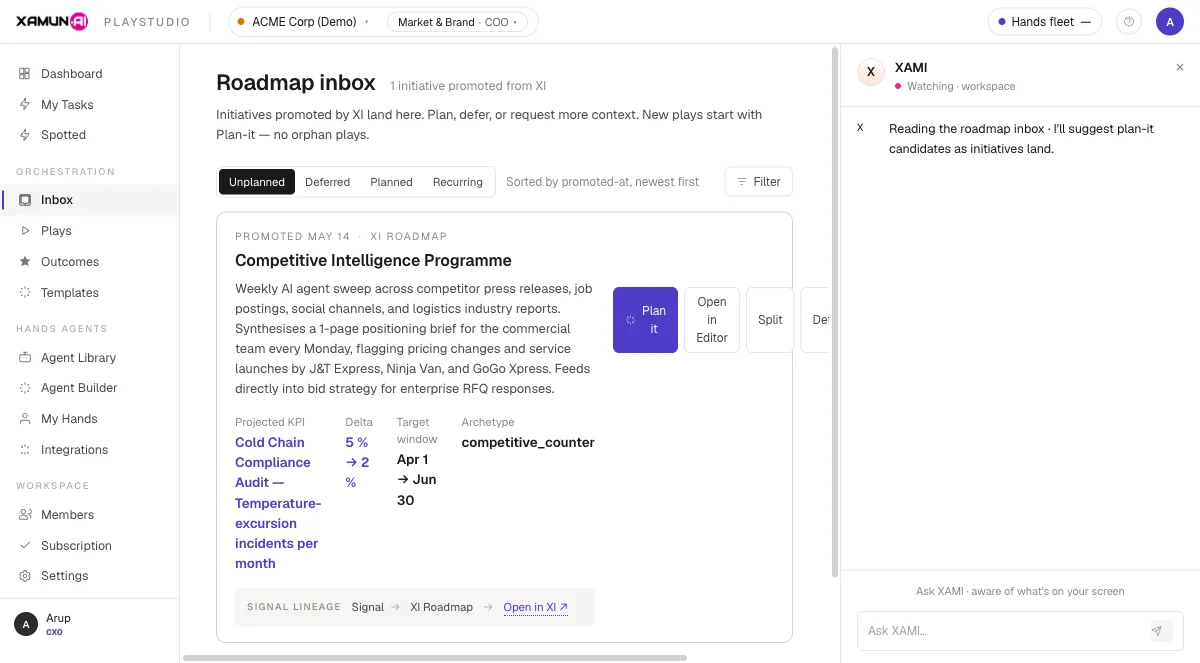
Each Play has a sequence of steps — some human, some agent — running in order. Live state per step. Comments and evidence threaded inline. Agent run history available on every step for audit.
When conditions change, operators replan mid-flight. The system re-decomposes from the current step instead of restarting. Plays bend without breaking.
Filter the index by status, domain, or assignee. Domain-scoped — finance operators see only finance plays; the CFO sees all of finance; the CEO sees everything.
No Play without a KR it's trying to move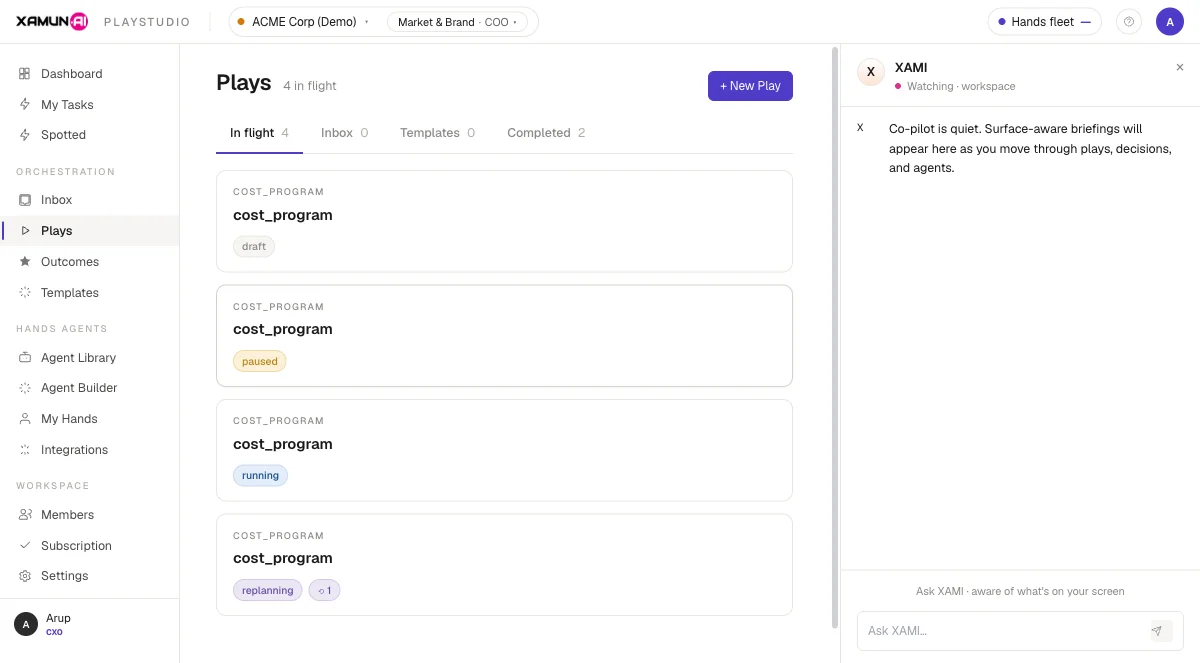
The planner is a graph — nodes are steps, edges are dependencies, columns are execution depth, rows are swimlanes. Decisions, comms, waits and tasks are first-class node types. Every step has an owner, a window, and an execution mode: human, agent-with-review, or autonomous.
Before you launch, the planner shows three things you can't get from a project tracker:

Operators submit risks, opportunities, client requests, anomalies. Xami classifies and routes each Spot into one of three honest dispositions:
External partners and customers can also file Spots via token-protected forms. Bottom-up isn't limited to employees.
Every spot has a visible destination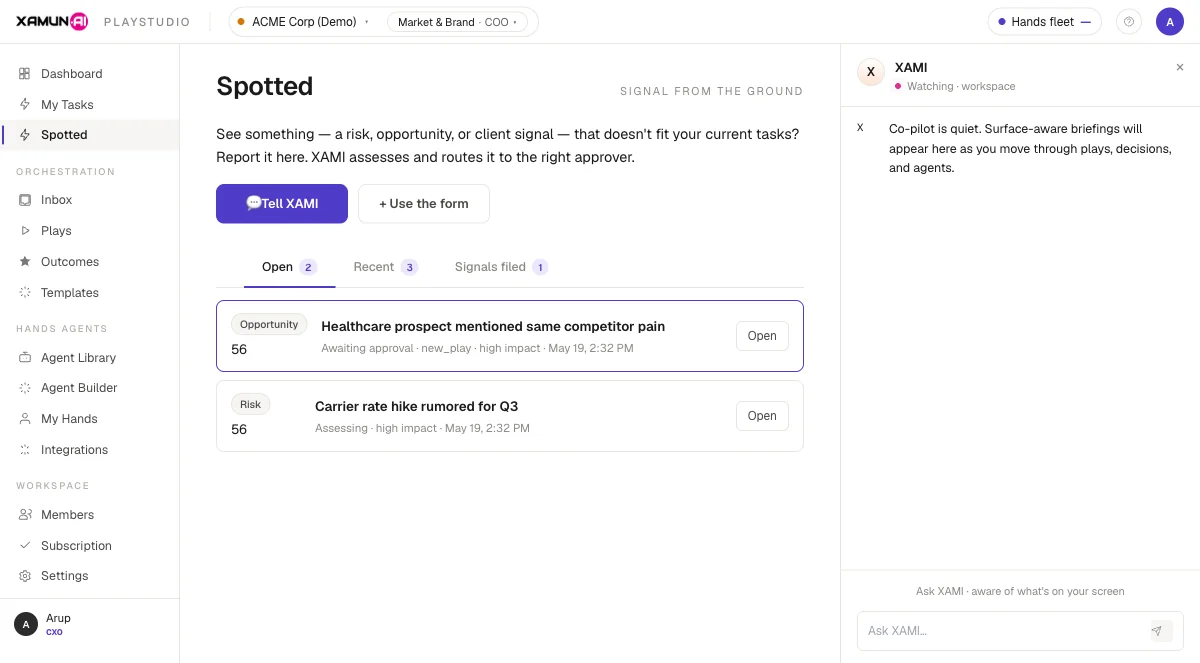
A growing catalogue of templates covers common strategic moves across Distribution, Healthcare, Professional Services and more. Pick a template, configure it, run it.
When no template matches the move, Xami runs a Discovery interview — voice-guided, structured — and outputs a custom Play composed from first principles. Every Discovery output becomes a candidate template for the next customer.
First Play running in minutes, not weeks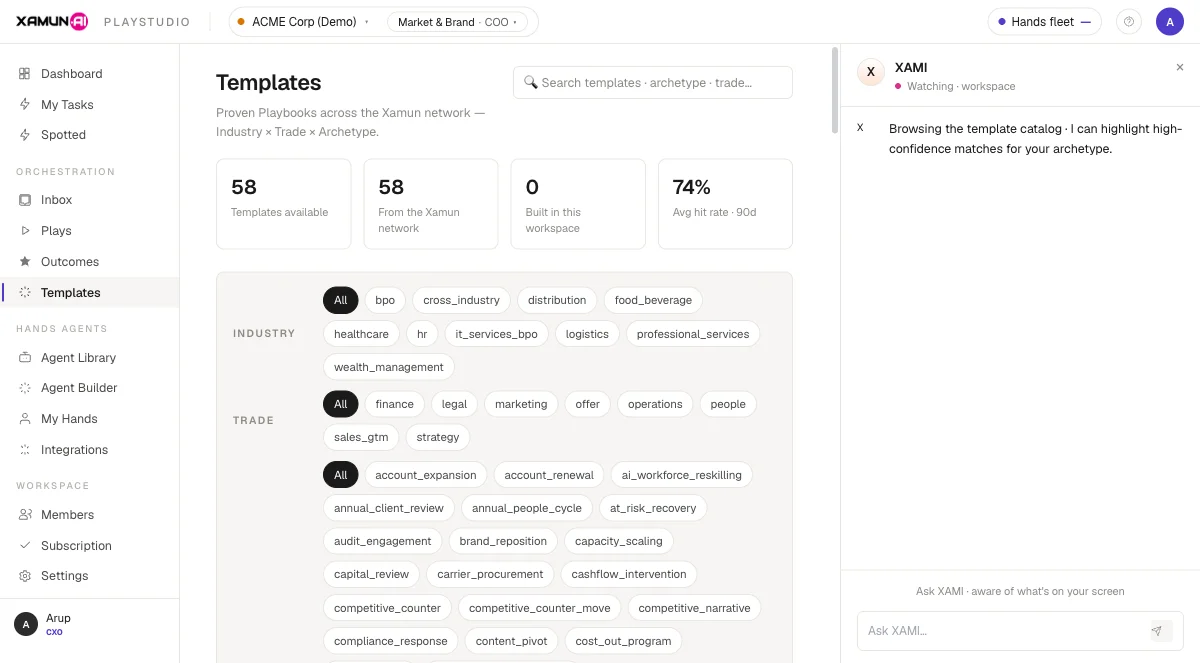
Hands is the operational agent layer of PlayStudio. Real workers across every CXO domain — each with a versioned personality, an accountable owner, an eval pass-rate, and an operational status. The full agent lifecycle lives in one place.

A growing catalogue across Sales, Marketing, Ops, Finance, Strategy, HR, Legal and General. Public Library, Company Library, My Hands. Filter by domain and industry. Install with one click, or fork & customise to your workspace.
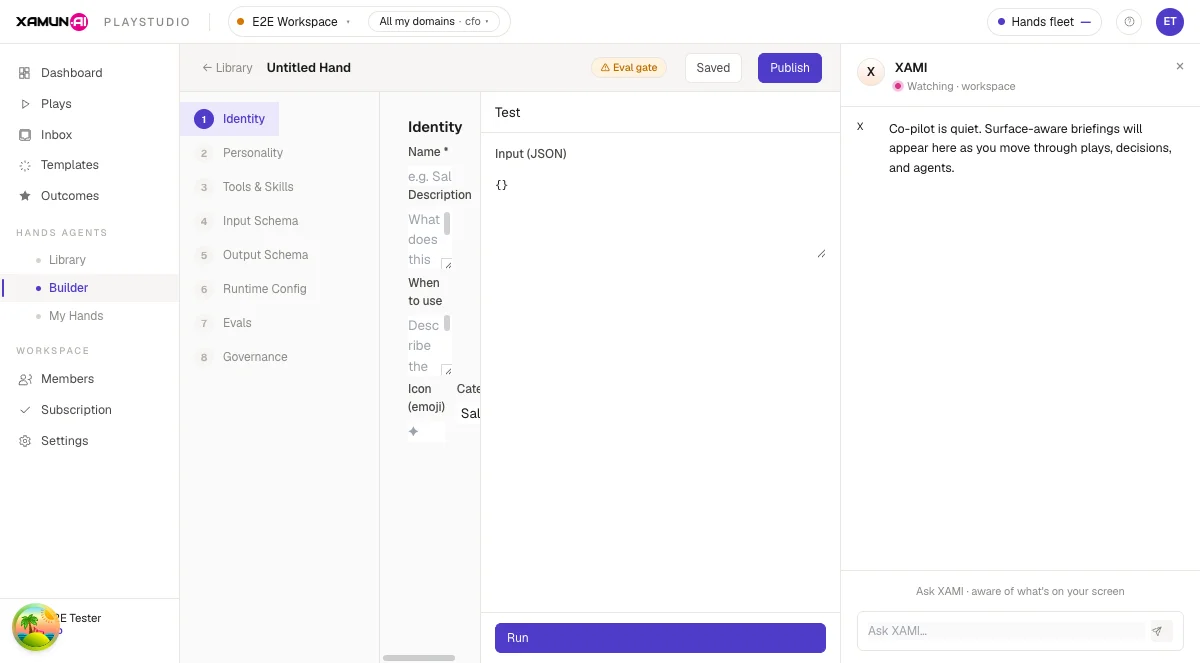
Build a new agent across eight surfaces — identity, personality, tools & skills, input/output schemas, runtime config, evals and governance. An Eval gate blocks publish until the agent passes the eval set. No mystery automation reaches production.
Where agents act: Hands agents act on the surfaces operators already use — Microsoft 365, Teams, email and a co-working desktop. Not on a separate "agent dashboard." Production runs feed calibration data back. New runs are gated by personality version and policy. Every agent step in a Play has an audit trail.
Two named classes across the platform: Xami is XI's strategic co-pilot — Discovery interviews, risk surfacing, outcome narration. Hands is PlayStudio's operational fleet — the agents that actually run steps inside a Play.
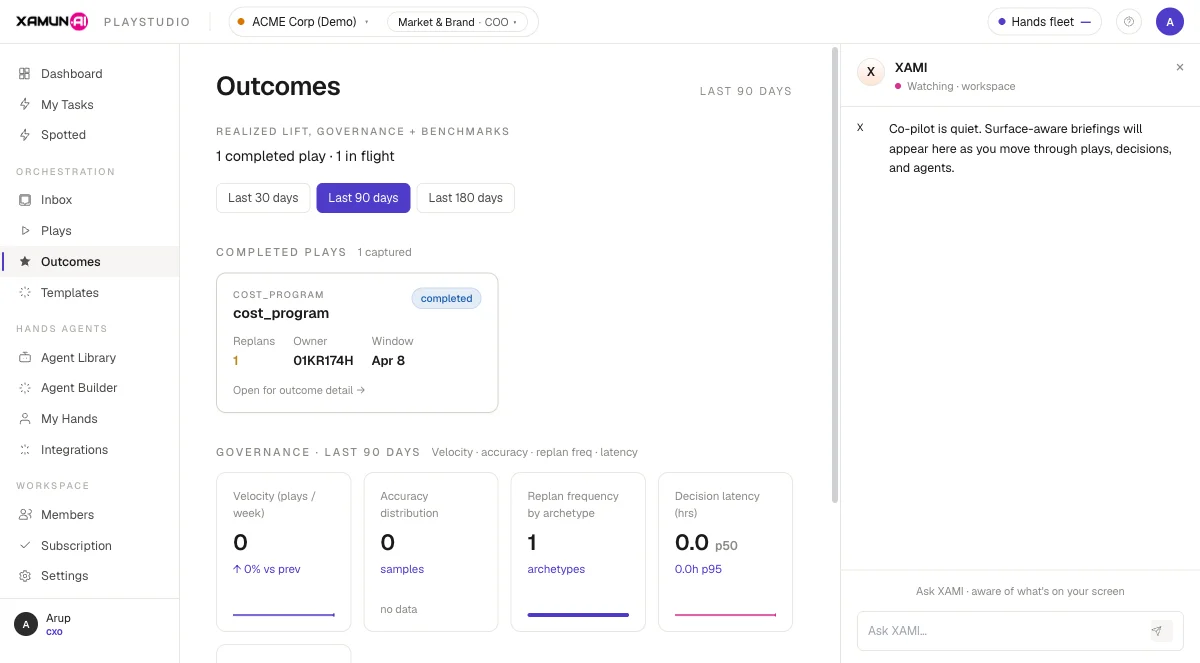
When a Play finishes, the system captures what actually changed: KR movement, qualitative result, time-to-completion, what surprised us. No spreadsheet round-trip. No "let me put together a deck."
Captured outcomes flow into XI's governance. KRs update. If the metric slipped, the CxO Inbox surfaces it. If the metric overshot, the system recalibrates its scoring for similar future moves.
A project tracker tells you "task done."
PlayStudio tells you "metric moved."
Each operator gets a personal queue scoped to assigned steps and decisions across all running plays. No hunting through a dozen plays to find what needs you next.
Domain enforcement is a first-class control — operators see only their domain (e.g. finance operators see finance plays); the CFO sees all of finance; the CEO sees everything.
A Daily Brief surface is today-shaped — the most useful 8-second read of what changed since yesterday.
Domain-scoped: see what's yours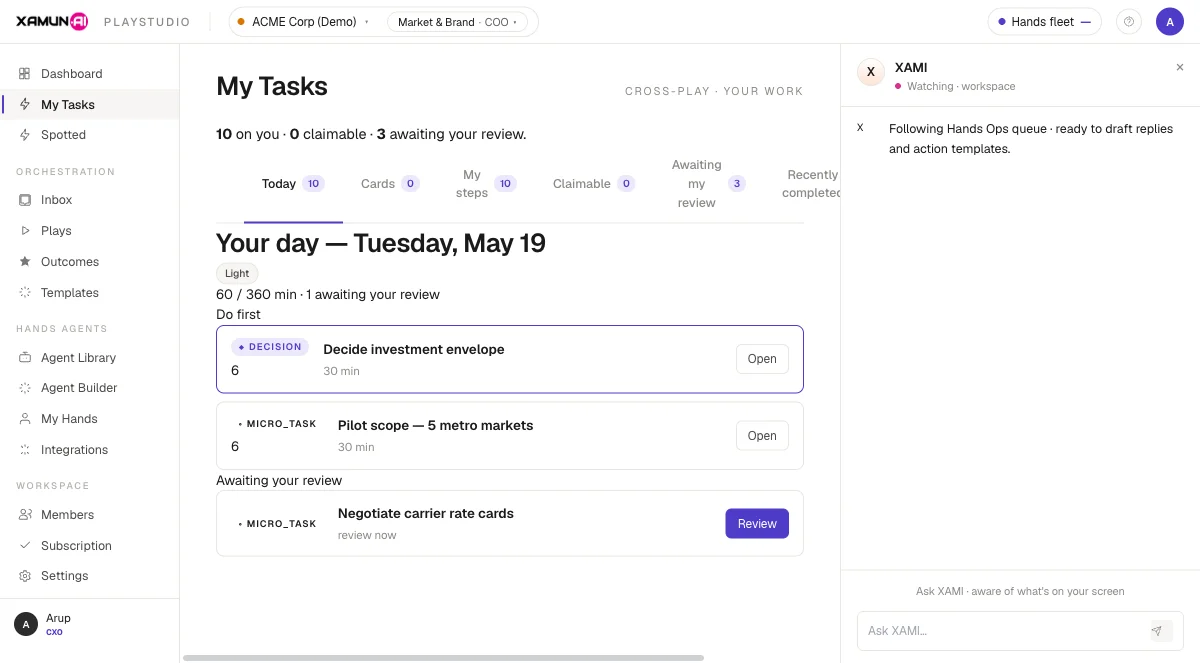
PlayStudio sits at the execution corner of the loop. It picks up where XI's Roadmap commits leave off and runs the work — then hands measured outcomes back to XI's governance. See the full loop on the Platform page →
CXO-as-tenant workspaces. Each leader gets their own surface; cross-CXO Plays are first-class.
Quarterly strategy refresh as a Play. Cross-functional moves that touch every domain. CEO Inbox of pending decisions.
Month-end close as a recurring Play. Finance ops automation. Vendor review cadences. Annual planning workflows.
Pipeline ops as orchestrated Plays. Account-based moves with mixed human + agent steps. Quarterly territory reviews.
Service delivery, supplier management, internal-process rollouts. Operational change as a tracked Play, not a hope.
A workshop walks through one of your real strategic moves — decomposed into a Play, run end-to-end, outcome captured.