
AcuteOS — The clock is clinical.
When a patient needs a bed their hospital cannot provide, the search for that bed is still a phone call. Emergency transfers between hospitals, run as one governed workflow. The referral becomes structured data, an SLA clock set by the patient’s acuity starts at once, every facility in the network is checked against six named rules, the receiving clinician decides on the full clinical picture, and the handoff is signed at the far end. Every step is written to an append-only, hash-chained ledger.
Who is responsible for the bed between two hospitals?
Usually nobody’s system. The EHR knows what happened inside one hospital, not who has a free bed across the network. Dispatch software moves vehicles, not clinical decisions. So the sickest patients are moved by a coordinator with a phone list and no way to prove afterwards why it happened the way it did.
The bed search is a phone call
Who has a free bed across the network lives in someone’s head or a WhatsApp thread. Nobody sees the network as it is right now.
Nobody is watching the clock
There is no decision window on a transfer, so a breach is found in a review months later, not while it can still be fixed.
“No capacity” leaves no record
A refusal is a verbal answer. Which sites were considered, and why each was ruled out, is never written down, so the case cannot be reconstructed for a review.
What is AcuteOS?
Emergency transfers between hospitals, run as one governed workflow. The referral becomes structured data, an SLA clock set by the patient’s acuity starts at once, every facility in the network is checked against six named rules, the receiving clinician decides on the full clinical picture, and the handoff is signed at the far end. Every step is written to an append-only, hash-chained ledger. It sits between facilities rather than inside one, so it consumes from the hospitals’ own systems instead of competing with them.
Who works in AcuteOS?
Hospital networks and transfer centres that move acute patients between facilities. Each role gets its own workspace, enforced on every request, and everyone works from the same live case.
Referring clinicians
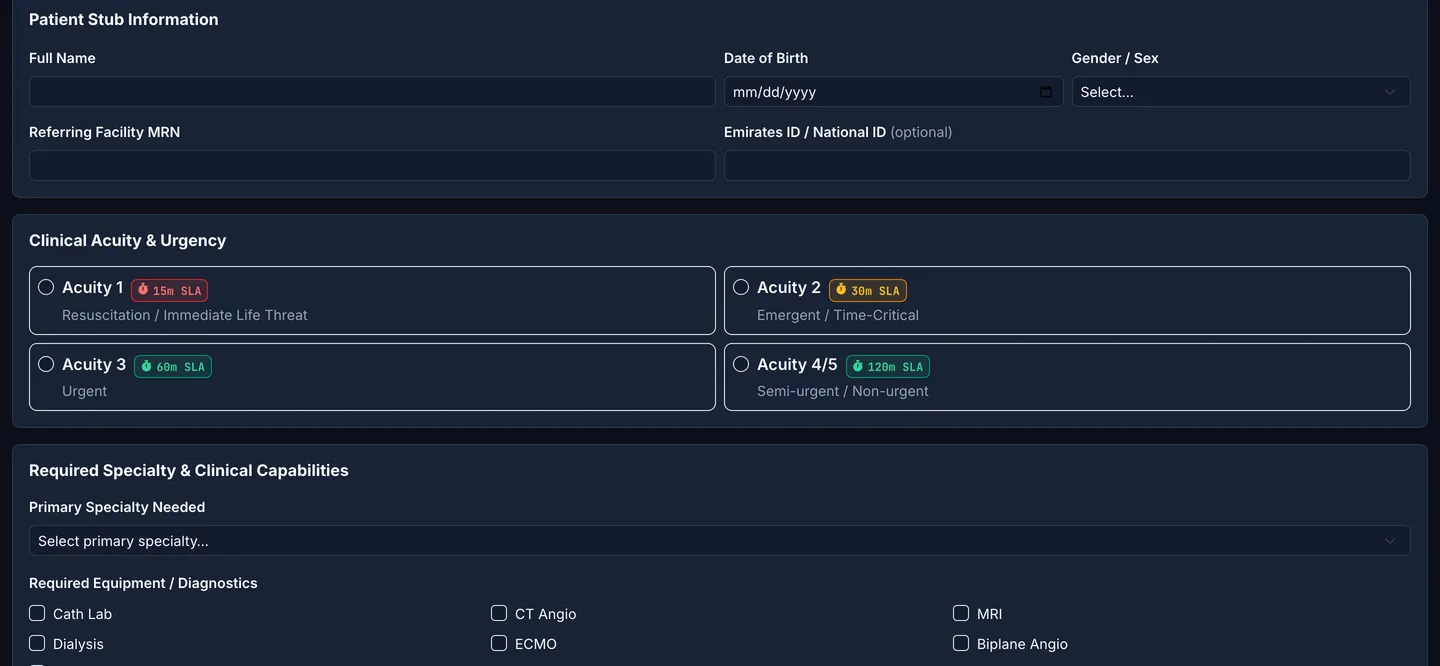
Submit the transfer as structured data in one form; the clock starts on submission.
Transfer coordinators
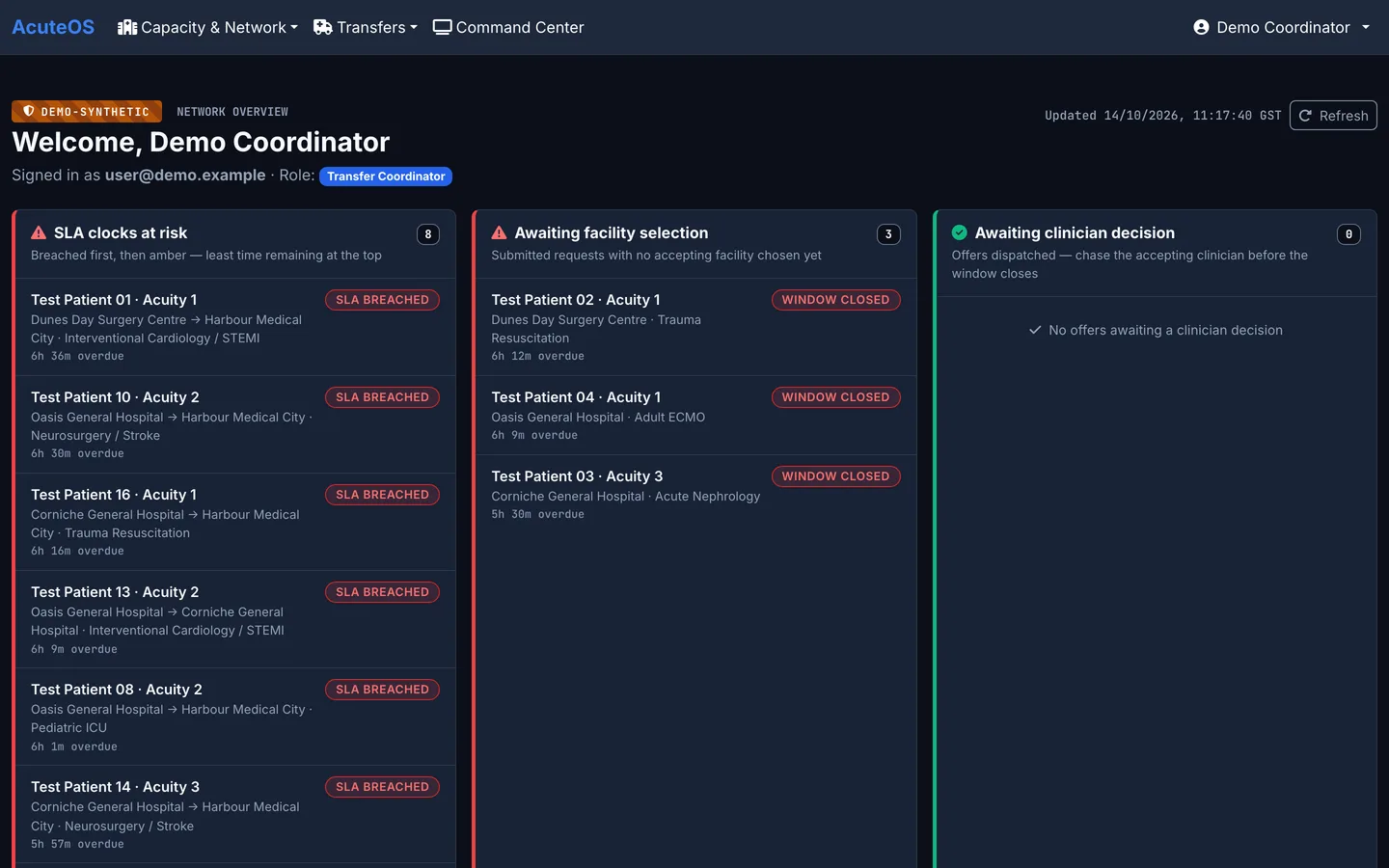
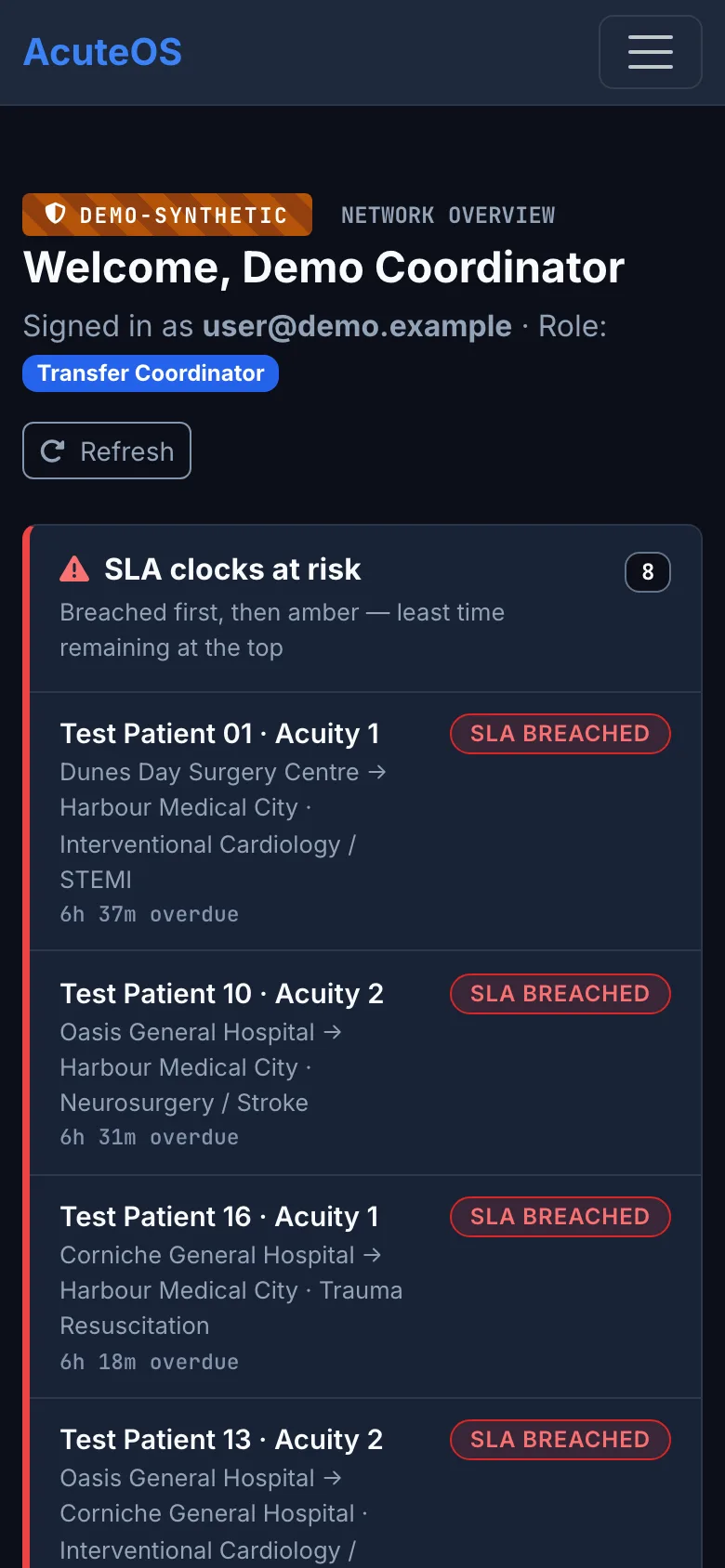
One queue for the whole network, ordered by time left on the clock, with the match and its reasons on screen.
Accepting clinicians
Accept or decline an offer with the clinical summary, bed class, payor status and transport mode in front of them.
Bed managers
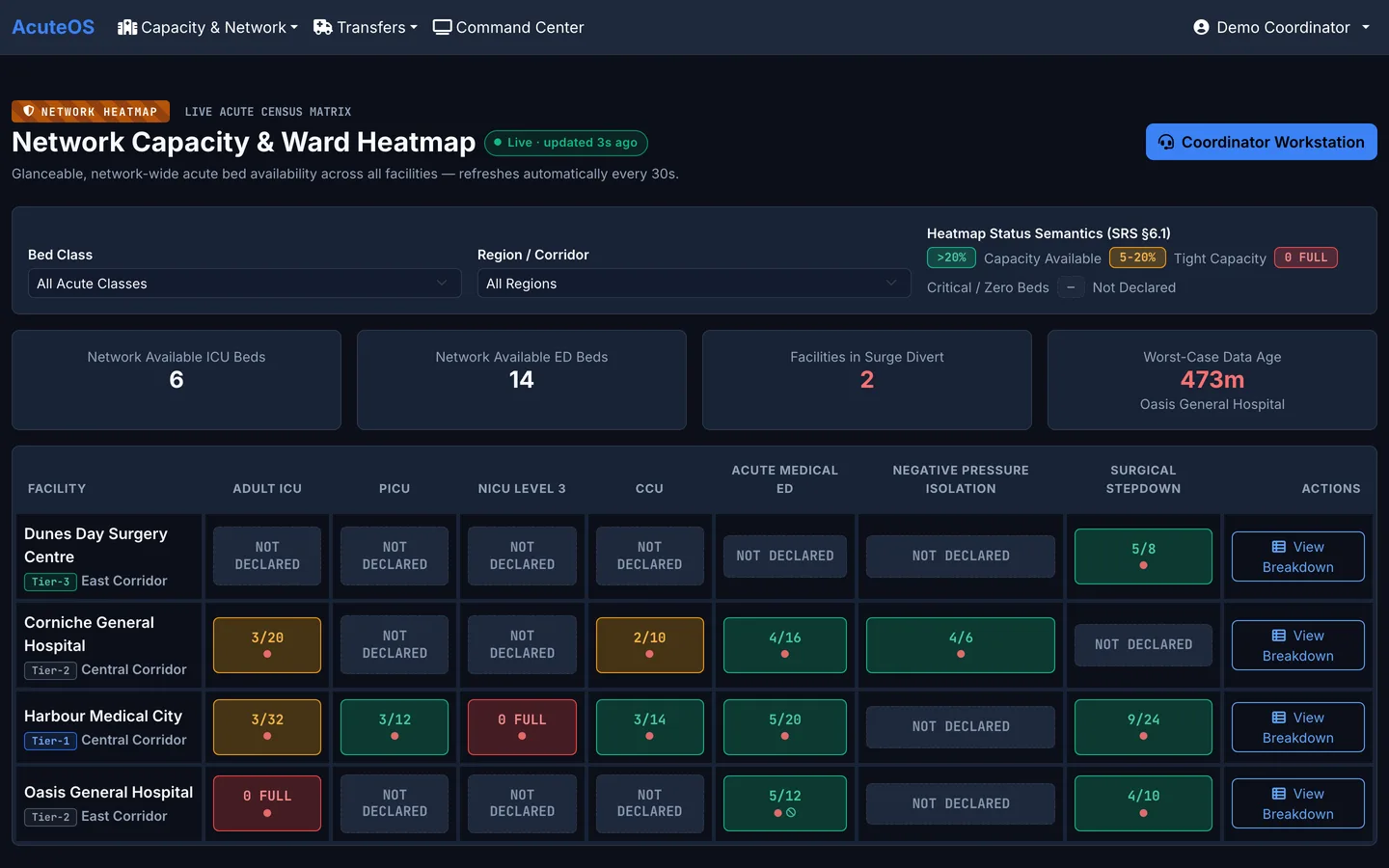
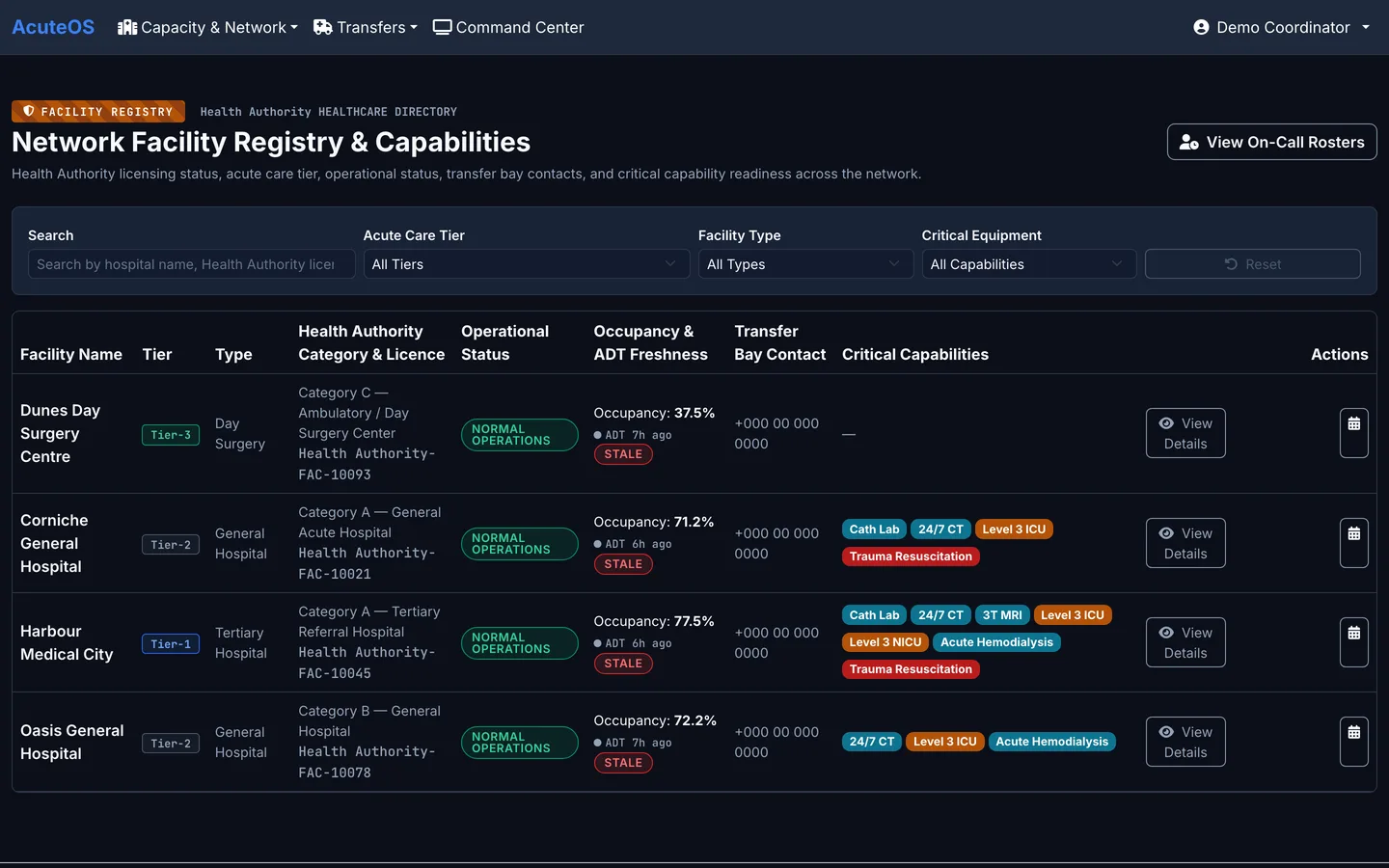
Declare ward capacity, and see how fresh every declaration across the network is.
Duty managers and command rooms
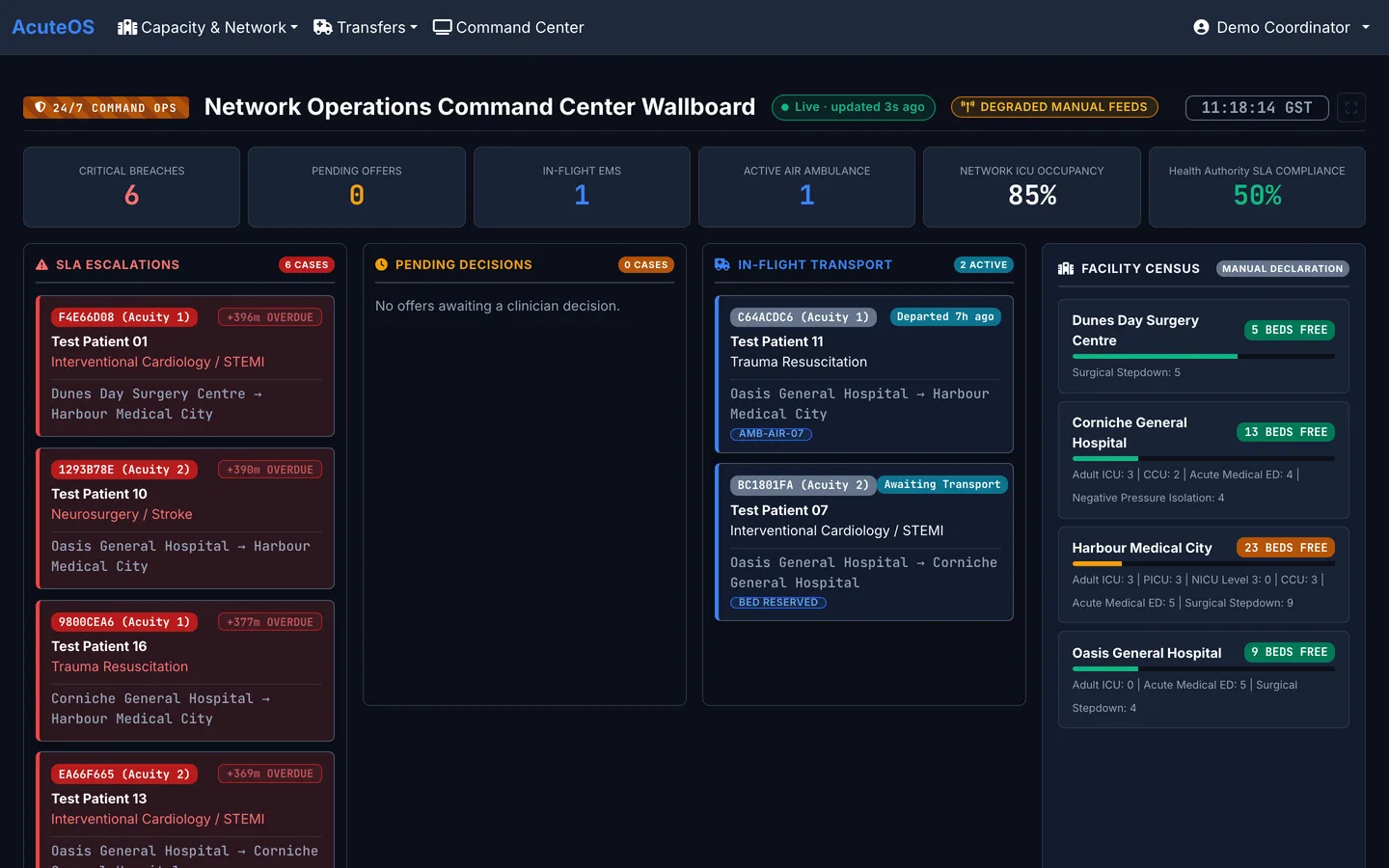
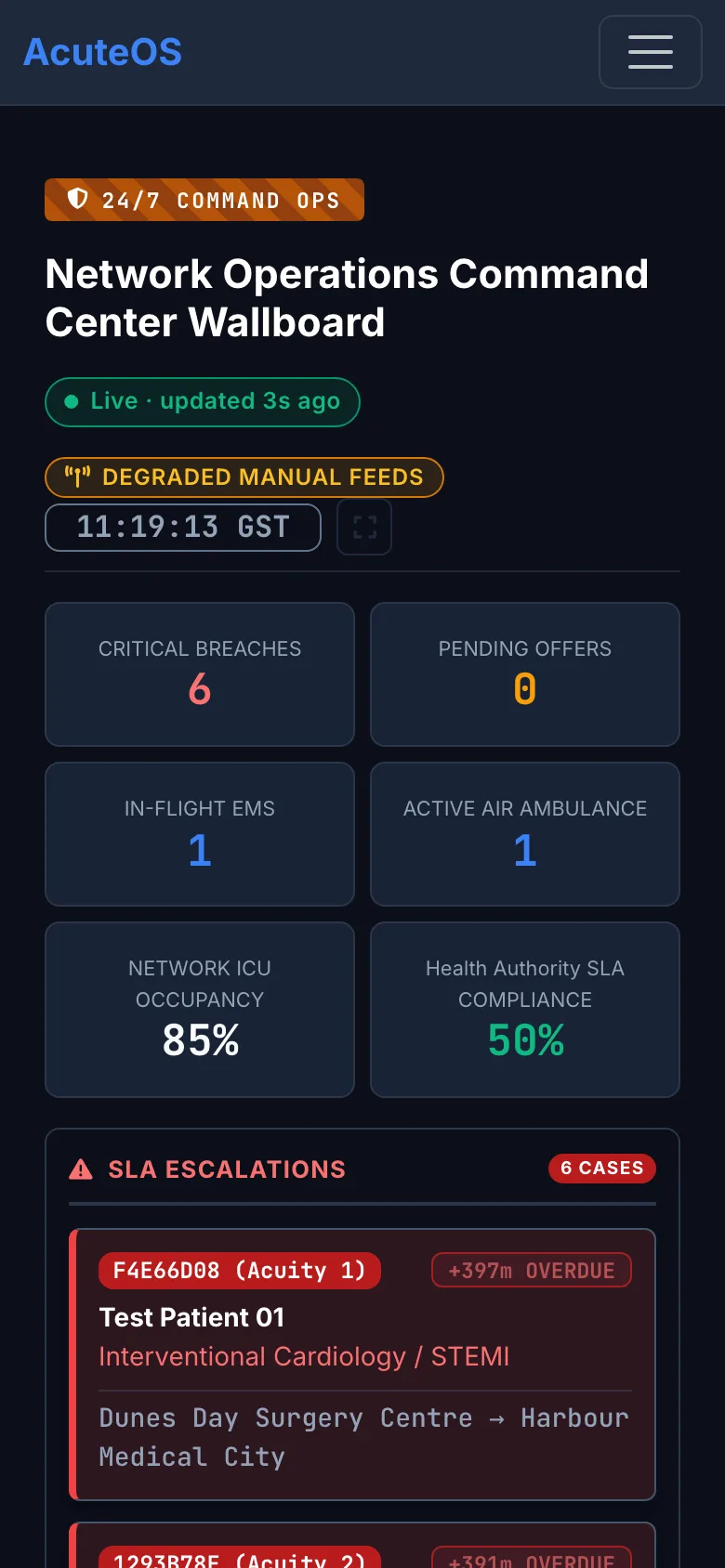
A wall display of breaches, pending decisions, transport in flight and facility census.
Auditors and network leads
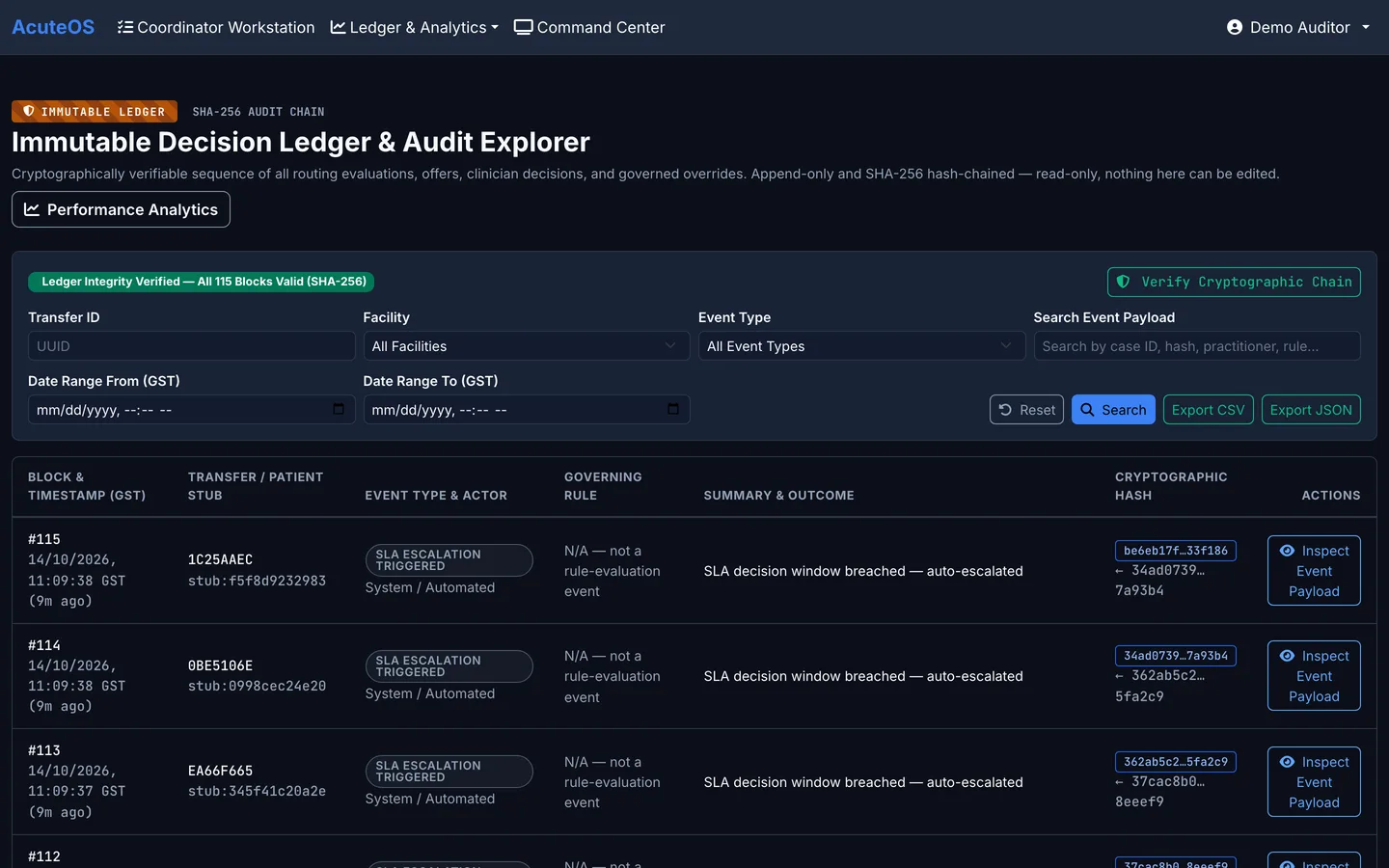
A read-only ledger and reporting computed from it, not re-keyed into a spreadsheet.
How does a transfer run, from referral to bedside?
As one tracked case rather than five systems and a phone. The acuity clock runs on every desk and on the command wall from submission to arrival, and every step is appended to the ledger as it happens.
Intake
Acuity, specialty, equipment need and a clinical summary, captured as data. Submitting starts the clock.
Match
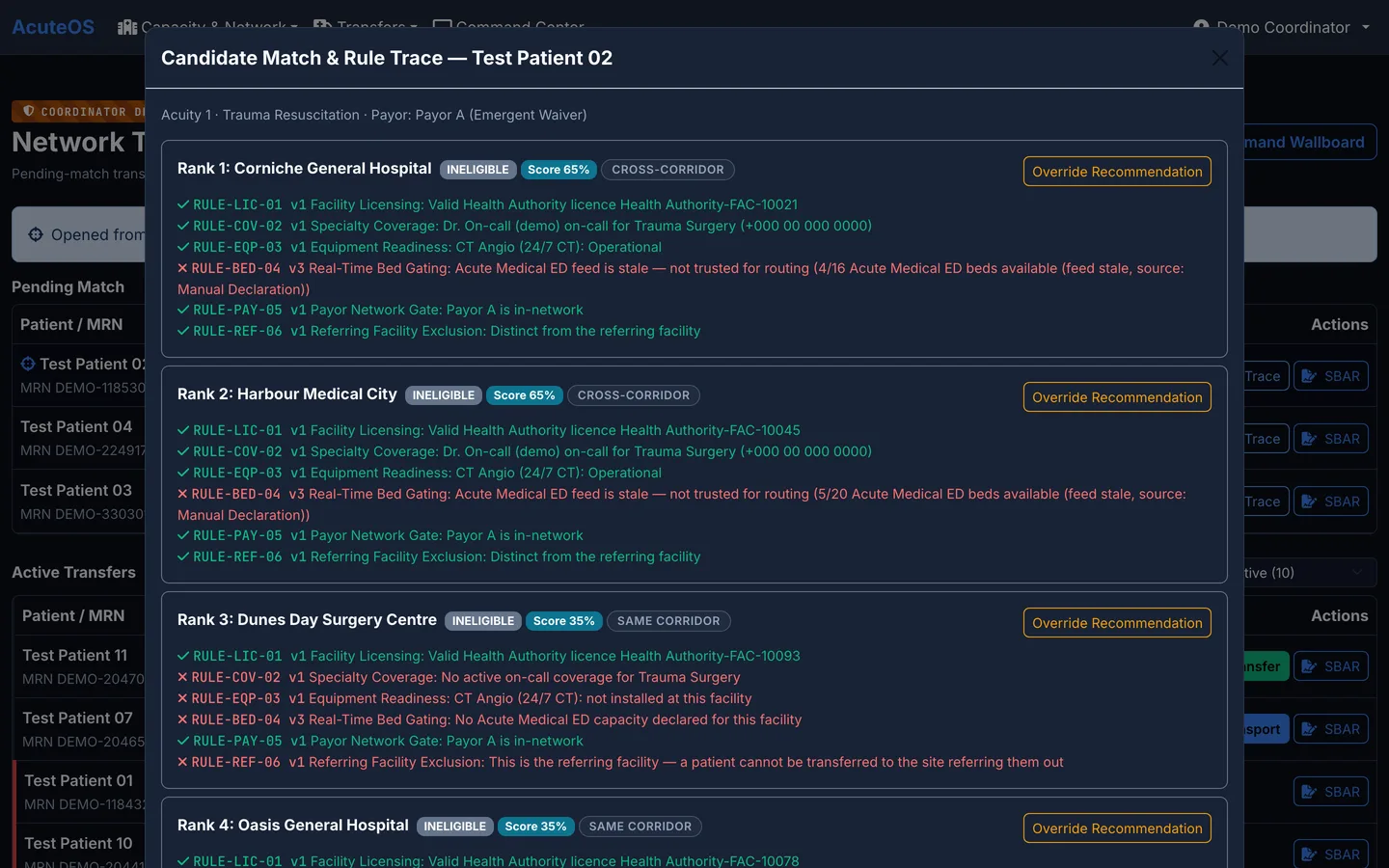
Six named rules are checked against every facility in the network, and the trace says which rule each one failed.
Offer
The receiving clinician gets the full clinical picture and a countdown to escalation.
Decision
Accept or decline. A decline needs a classified reason and is recorded as a decision.
Transport
Accepting locks the bed network-wide; transport is coordinated through to arrival.
Handoff
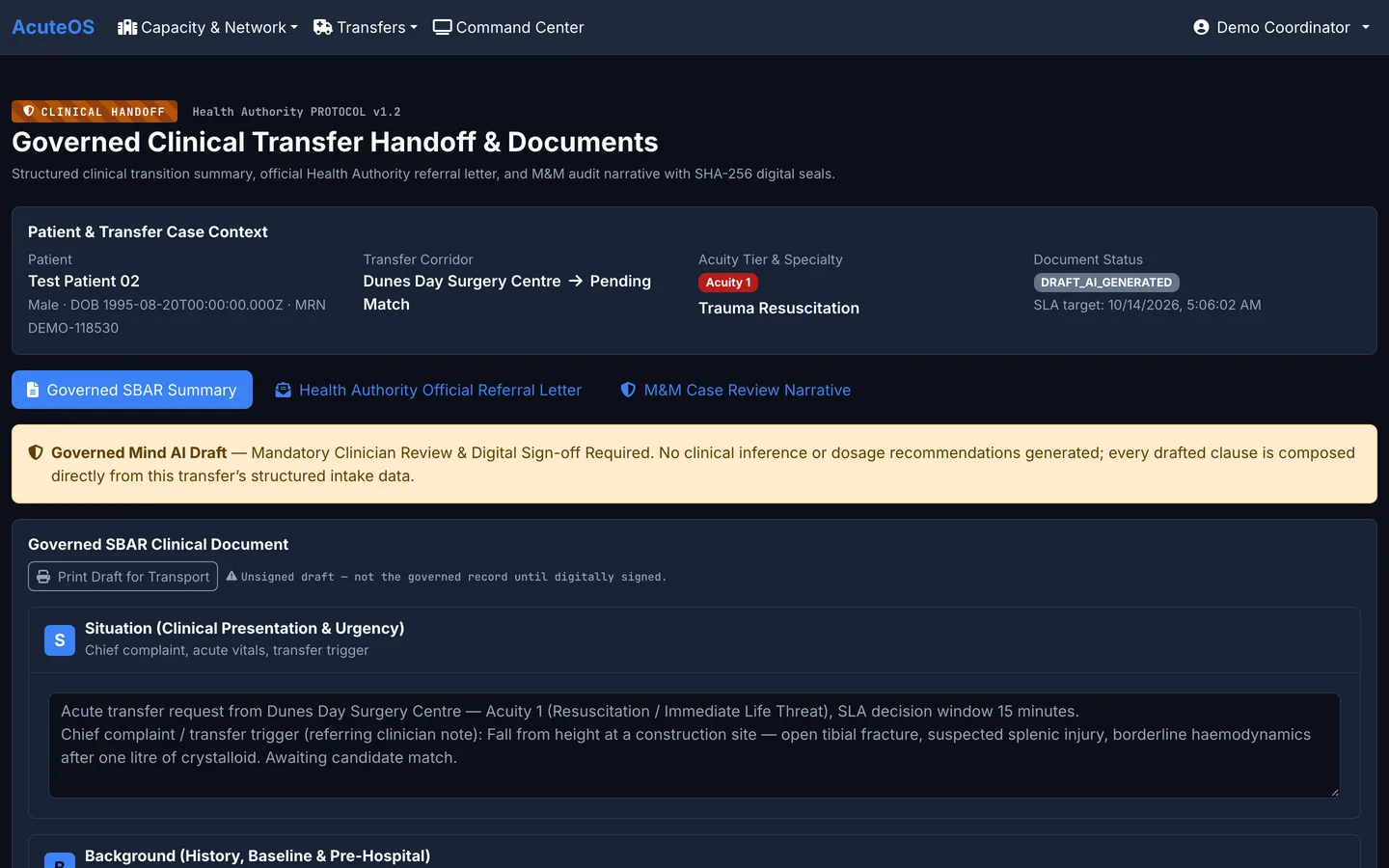
A structured SBAR summary is drafted from the intake fields and signed by the clinicians before it becomes the record.
How does it decide which hospital can take the patient?
With six named rules, checked against every facility in the network. No black-box score: each candidate shows what passed, what failed and why. The rules are versioned, and thresholds, ward classes and payors are your configuration.
RULE-LIC-01 · Facility licensing
A valid health-authority licence for the service the patient needs, checked against the facility registry.
RULE-COV-02 · Specialty coverage
A named consultant on call for the specialty, checked against the live roster.
RULE-EQP-03 · Equipment readiness
The required equipment installed and working at the receiving site.
RULE-BED-04 · Real-time bed gating
Free beds in the right ward class, with the age and source of the declaration attached. A stale feed is not trusted for routing.
RULE-PAY-05 · Payor network gate
The patient’s payor is in network at the candidate site, with emergent-waiver handling.
RULE-REF-06 · Referring facility exclusion
A patient is never routed back to the site referring them out.
What changes for the network?
The transfer becomes something you can see while it happens and prove after it has.
Between facilities, not inside one
It does not replace an EHR. It reads capacity from hospital systems and coordinates across them.
Every refusal has a reason
Ineligible sites state the rule they failed, so “no capacity” is evidence, not an anecdote.
Breaches seen while they can be fixed
Acuity sets the decision window, and escalation is automatic when it closes.
Stale data cannot look healthy
Every bed count carries its age; “not declared” is shown as not declared, never as zero.
Rules you can change
Thresholds, ward classes and payors are configuration, and every rule is versioned.
A record that stands up to review
Each ledger block carries the hash of the one before it; altering a past entry breaks the chain.
What does AcuteOS look like?
Real screens from the live demo you can open above. The patients, clinicians and facilities in them are synthetic, and the demo is a pilot environment with no historical baseline. Your own deployment is a separate instance, connected to your hospitals.
How does AcuteOS connect to the hospitals’ systems?
It reads, it does not replace. Bed capacity arrives from hospital systems over read-only feeds or by declaration from a bed manager, and every figure carries its source and age.
- HL7 v2 capacity feeds (read-only)
- FHIR capacity feeds (read-only)
- Manual declaration with freshness shown
- SBAR structured handoff
- SHA-256 hash-chained ledger
- Role-based access on every request
- Versioned, configurable rules
- CSV and JSON ledger export
How do we start, and how do we pay?
Start with one corridor of facilities and a walkthrough of the demo with your transfer team, then choose how to buy it.
Licence
Your own instance on your infrastructure, white-label and source-available. Patient data and transfer history stay in infrastructure you control.
Outcome-as-a-Service
Xamun runs it with your team and is paid per transaction, on the unit your network is paid on, agreed with you.
Questions transfer teams ask
Does AcuteOS replace our EHR or ambulance dispatch system?
No. An EHR sees one hospital and dispatch software moves vehicles; neither owns the transfer between facilities. AcuteOS sits between them: it reads bed capacity from hospital systems over read-only HL7 v2 or FHIR feeds, or takes manual declarations, and coordinates the transfer across the network.
How does AcuteOS choose a receiving facility?
With six named rules, not a black-box score: licensing, specialty coverage on the live on-call roster, equipment readiness, real-time bed gating, payor network and exclusion of the referring site. Every candidate is shown with what passed and what failed, and the rules are versioned, so a past decision can be read against the rules in force at the time.
Can a coordinator override the recommendation?
Yes. Overrides are allowed but structured: the coordinator classifies the reason, and the override is written to the ledger like every other decision.
What happens when an SLA window is breached?
Each acuity tier sets a decision window when the request is submitted: 15, 30, 60 or 120 minutes. When a window closes without a decision, the case escalates automatically and moves to the top of the coordinator queue and the command wall.
How does it handle bed counts that are out of date?
Every declaration carries its source and age. A stale feed is not trusted for routing, “not declared” is reported as not declared rather than zero, and the worst-case data age is a headline figure on the capacity screen.
Does AcuteOS use AI to make clinical decisions?
No. It gives no diagnosis or dosage advice. Matching is done by deterministic rules, the SBAR handoff is drafted from the structured intake fields, and nothing becomes the record until a clinician signs it.
How is the record protected?
Every state change is appended to a SHA-256 hash-chained ledger: each block carries the hash of the one before it, so altering a past entry breaks the chain, and the chain can be verified end to end. Reporting is computed from the same ledger.
Who uses AcuteOS?
Seven roles, each with its own workspace: referring clinician, transfer coordinator, bed manager, accepting clinician, duty manager, auditor and network administrator.
How do we buy AcuteOS?
As a licence, with your own instance on your infrastructure, white-label and source-available; or under Outcome-as-a-Service, priced per transaction on the unit your network is paid on. Either way it starts with one corridor of facilities.
Bring us one transfer corridor
We will write down how transfers run across it today, with your coordinators and bed managers, and show the same cases running in AcuteOS. You keep the document whether or not we work together.