
AssetOS — The hotel asset register that agrees with the books.
One record of everything a hotel owns: where it is, what condition it is in, what it has cost to keep running and what it is worth on the books. Housekeeping, engineering and stores prove what is in each room with a scan; finance gets the depreciation and the month-end journal from the same record. Keep your maintenance or facility management system; AssetOS adds the asset and finance layer beside it.
Why don’t a hotel’s asset register and its books agree?
Because there are two of them, and neither is walked against the rooms. The physical truth (what is in Room 1204 right now) and the finance truth (what is capitalised, how it depreciates, what the ledger needs this month) live in different systems, kept by different teams.
The maintenance log tracks jobs
Hotel maintenance and facility management tools are built around work orders: who fixed what, and when. They rarely know what an item cost, how it is depreciating, or whether it is still in the room it was bought for.
The fixed-asset register tracks book value
Finance keeps cost, useful life and net book value, usually in a spreadsheet or an accounting module. Nobody walks it. Items sit on the books after they have left the building, and items in the building never reach the books.
AssetOS keeps one record
A scan in Room 1204 and a line in the month-end journal come from the same asset record. When an audit finds a missing TV, the exception carries its value; when it is written off, the disposal journal follows from the same event.
Keep your ops tool. Add the asset and finance layer.
What is AssetOS?
AssetOS is hotel asset register software for the whole property: guest rooms, outlets, kitchens, stores, plant rooms and public areas. One record of everything a hotel owns: where it is, what condition it is in, what it has cost to keep running and what it is worth on the books. Housekeeping, engineering and stores prove what is in each room with a scan; finance gets the depreciation and the month-end journal from the same record. Keep your maintenance or facility management system; AssetOS adds the asset and finance layer beside it.
Who is AssetOS for?
Hotels, resorts, serviced apartments and high-end residences, one property or a group. The buyers are the general manager, the director of finance and the chief engineer; the daily users are housekeeping, engineering, kitchen stewarding, stores and outlet supervisors.
For the general manager and owner
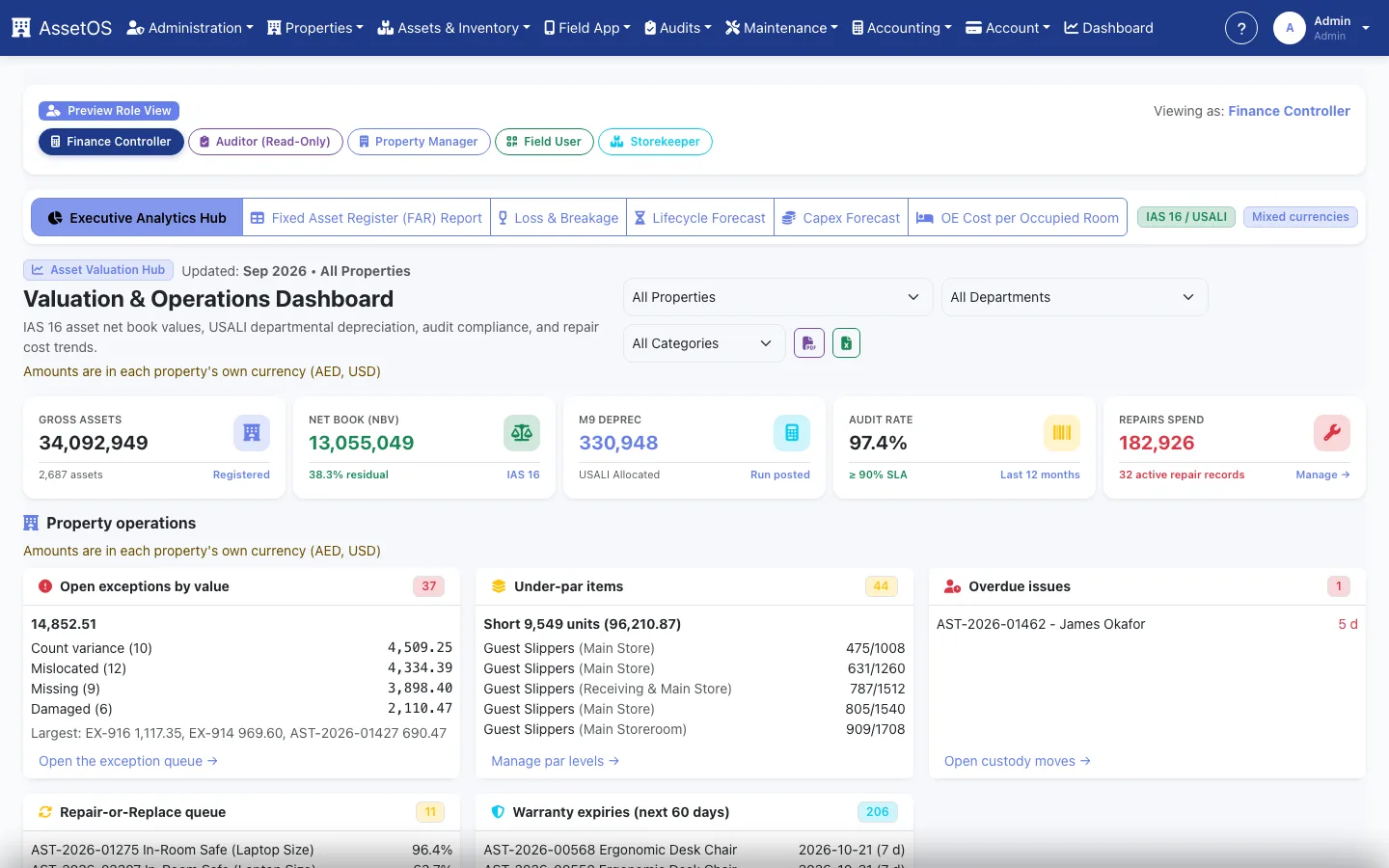
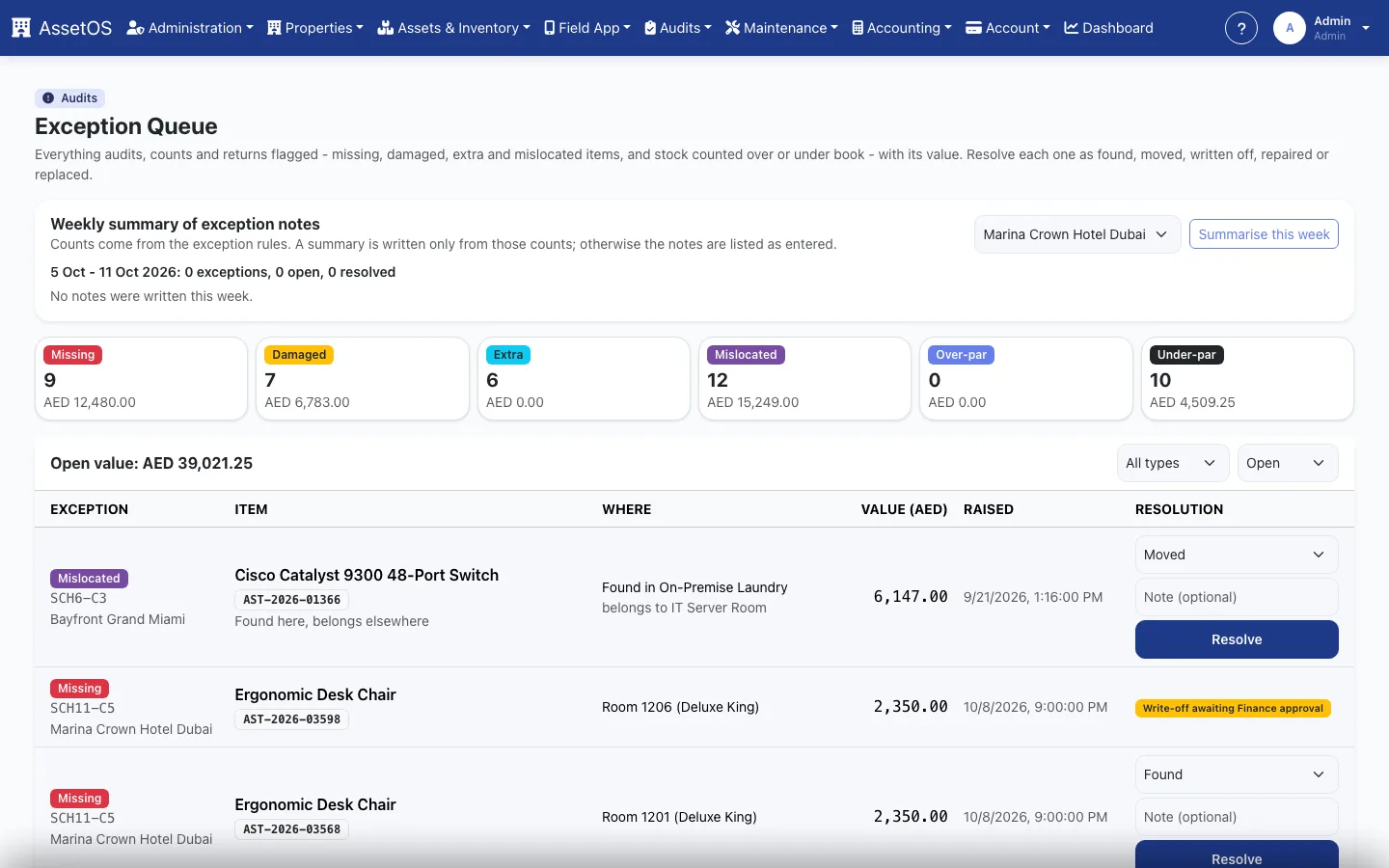
One view of what the property holds, what is missing or damaged by value, what is due for replacement, and what capital spend is coming.
For finance
A fixed-asset register proved by scans and counts, monthly depreciation under your own book policy, and a balanced journal ready for the general ledger.
For housekeeping, engineering and stores
A phone app with one big button: scan. Audit a room, count linen, move an item, report damage. It keeps working when the signal drops.
How does a hotel get onto AssetOS without a rollout project?
By describing each room type once instead of entering every item in every room. The design goal is a property live after one setup session and one scan walk.
Build the property once
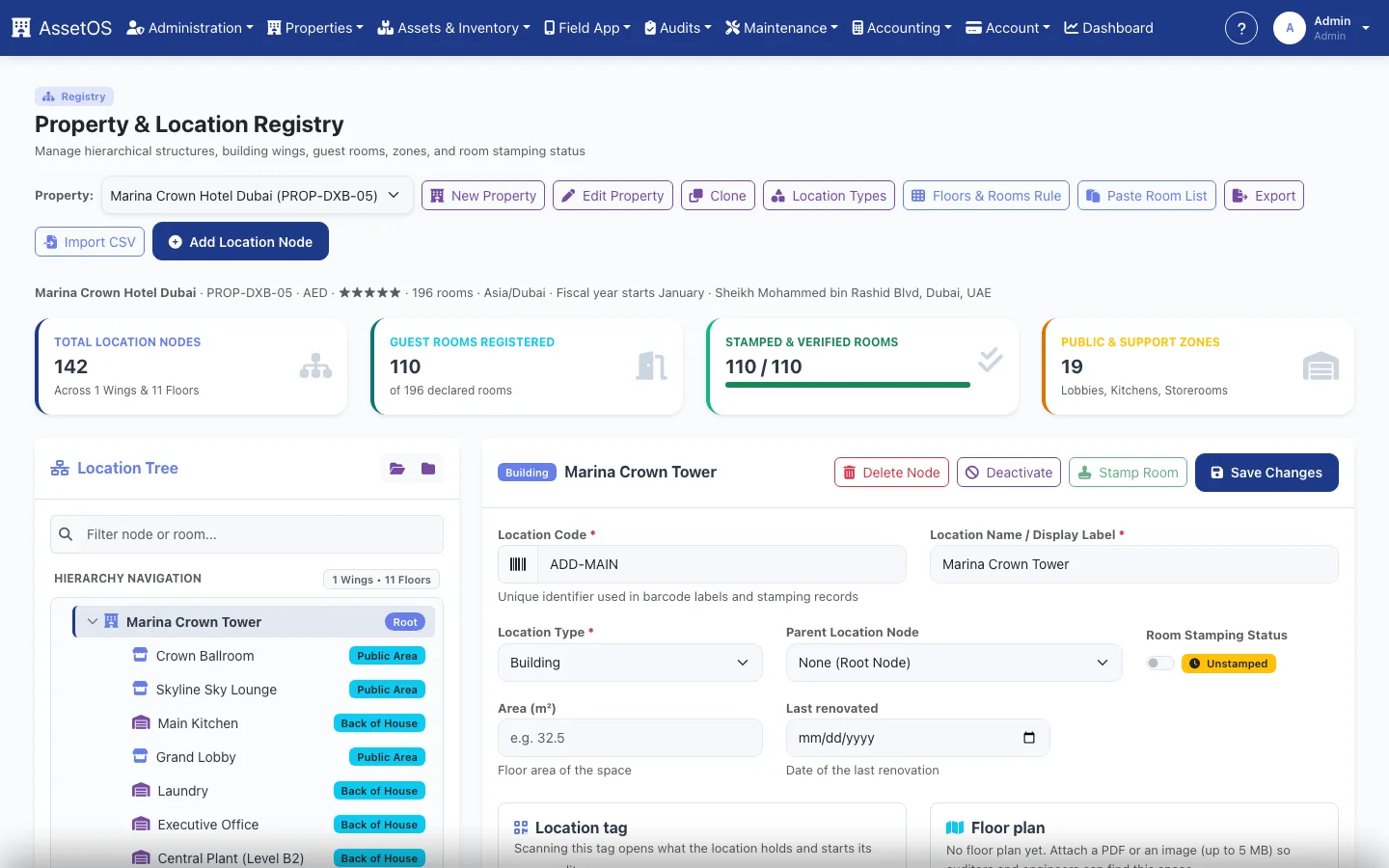
Wings, floors and rooms from a rule (“floors 3 to 15, rooms 01 to 24”), a CSV or a room list pasted from the property management system. Clone the whole structure to the next hotel in the group.
Define a room kit, stamp it everywhere
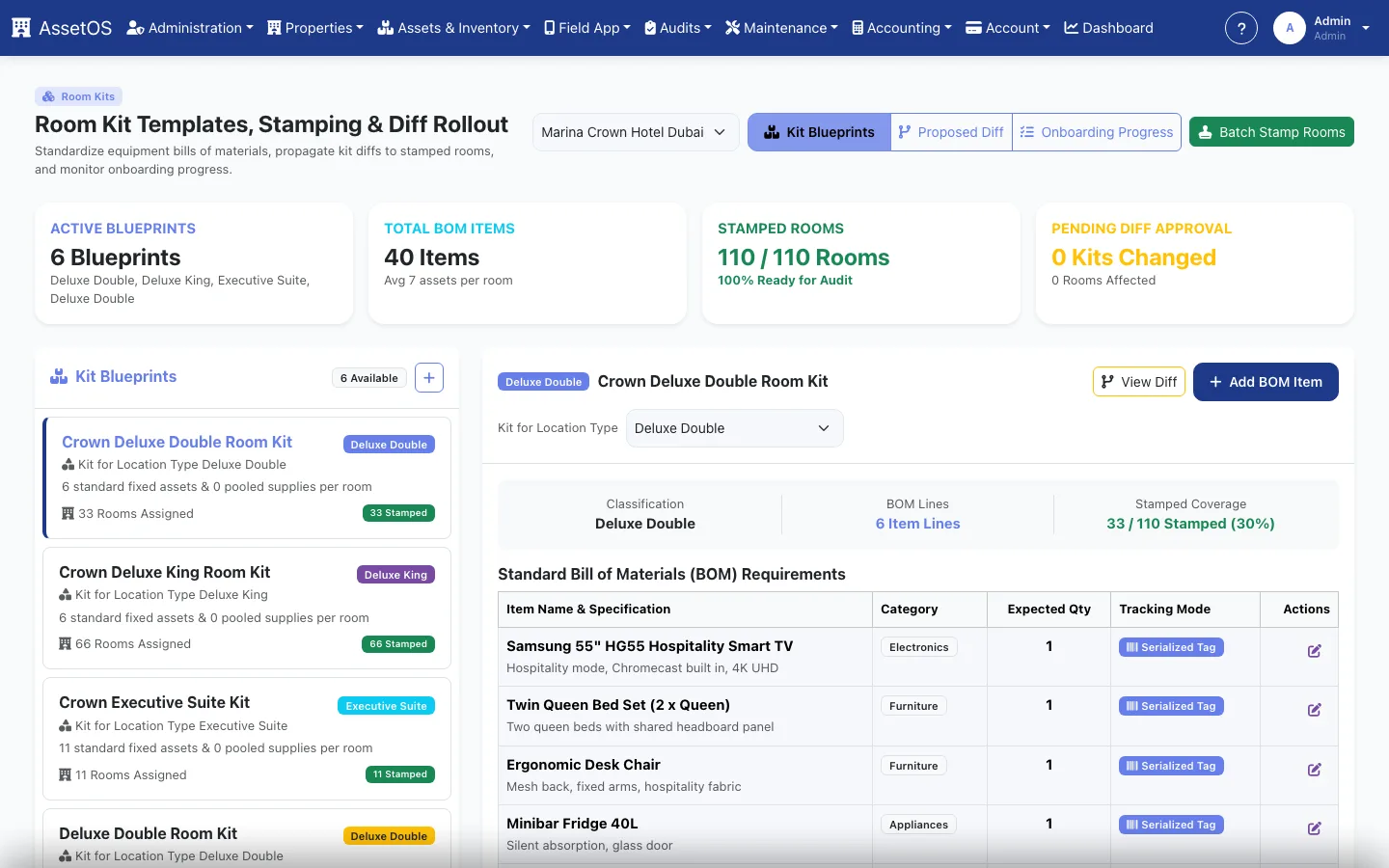
Describe a Deluxe King once: the TV, the bed, the minibar, the safe. Stamp it onto every Deluxe King and AssetOS creates the expected contents of each room. Change the kit later and the rooms get a proposed diff to approve, not a silent overwrite.
Print tags, walk the floors
Print QR tags floor by floor. The first scan walk binds each tag to an item that is already expected, so the team confirms rather than types. Progress shows per property.
The same kits serve a hotel that has not opened yet: the pre-opening team stamps the expected contents of every room type before the first guest arrives. The UAE alone has about 25,000 hotel rooms in its construction pipeline (Lodging Econometrics, Q2 2026).
What do housekeeping, engineering and stores use?
A phone app built for staff who were hired last week. It opens on one button, every screen has one primary action, and it keeps working in a basement plant room with no signal. Nothing to download: it runs in the phone’s browser.
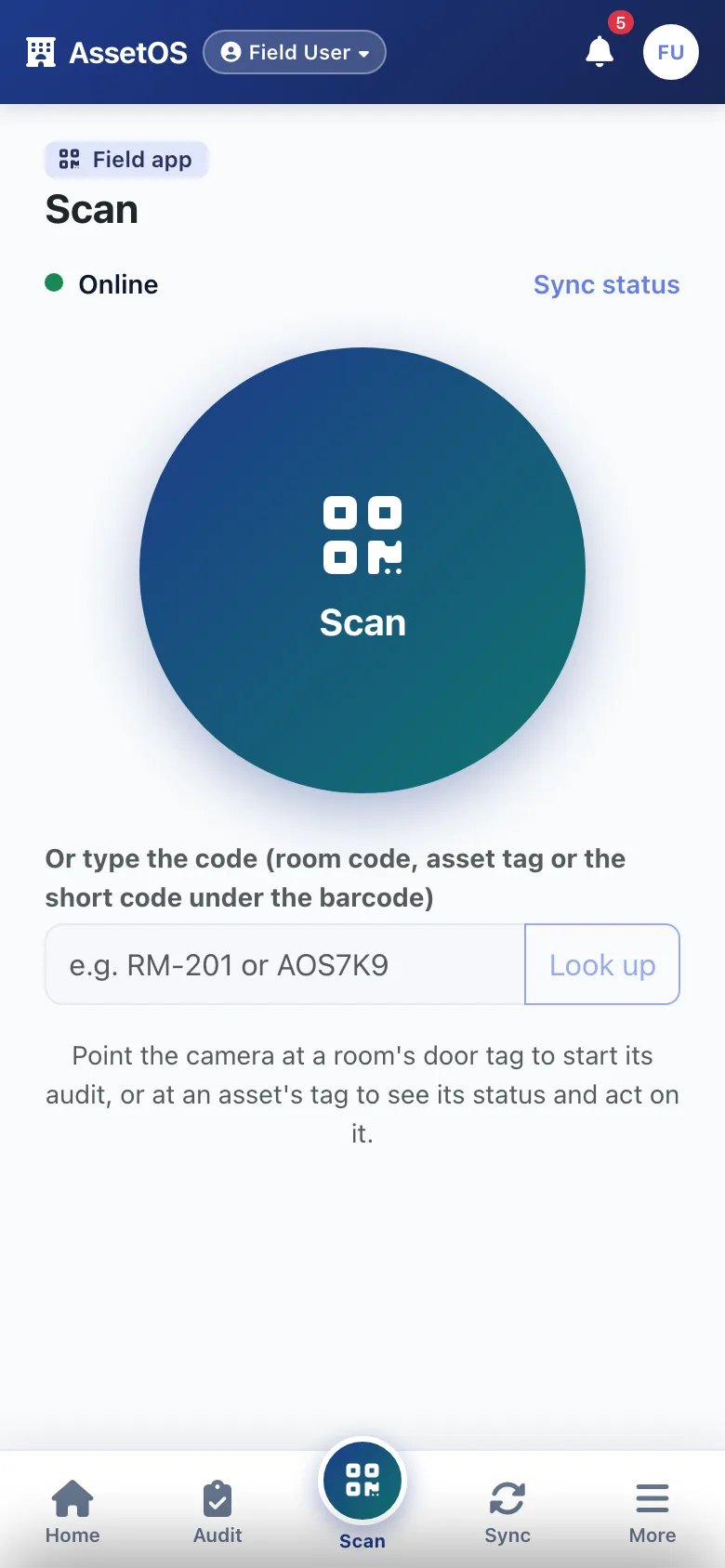
One button: scan
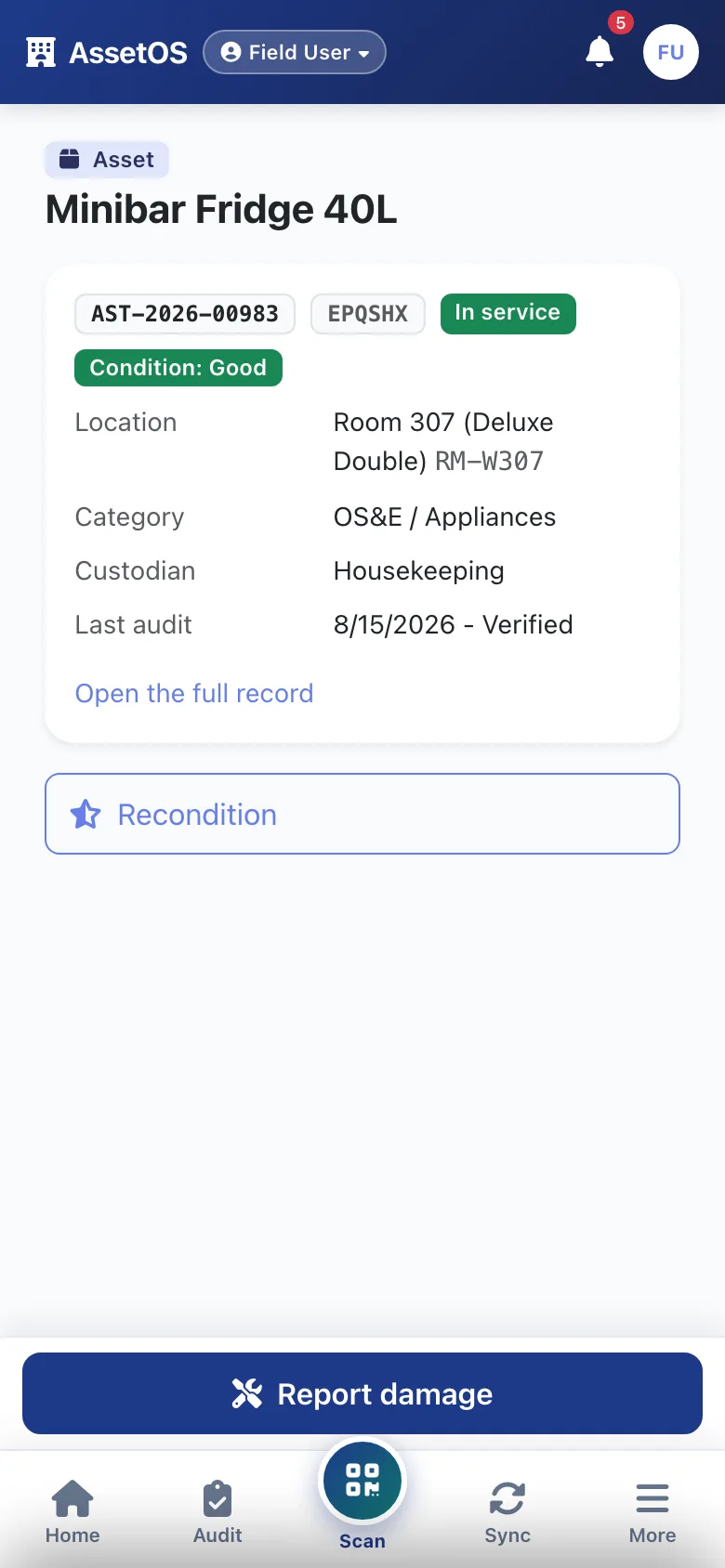
Point the phone at a room’s door tag to start its audit, or at an asset’s tag to see its status. A short code under every tag can be typed when the camera fails.
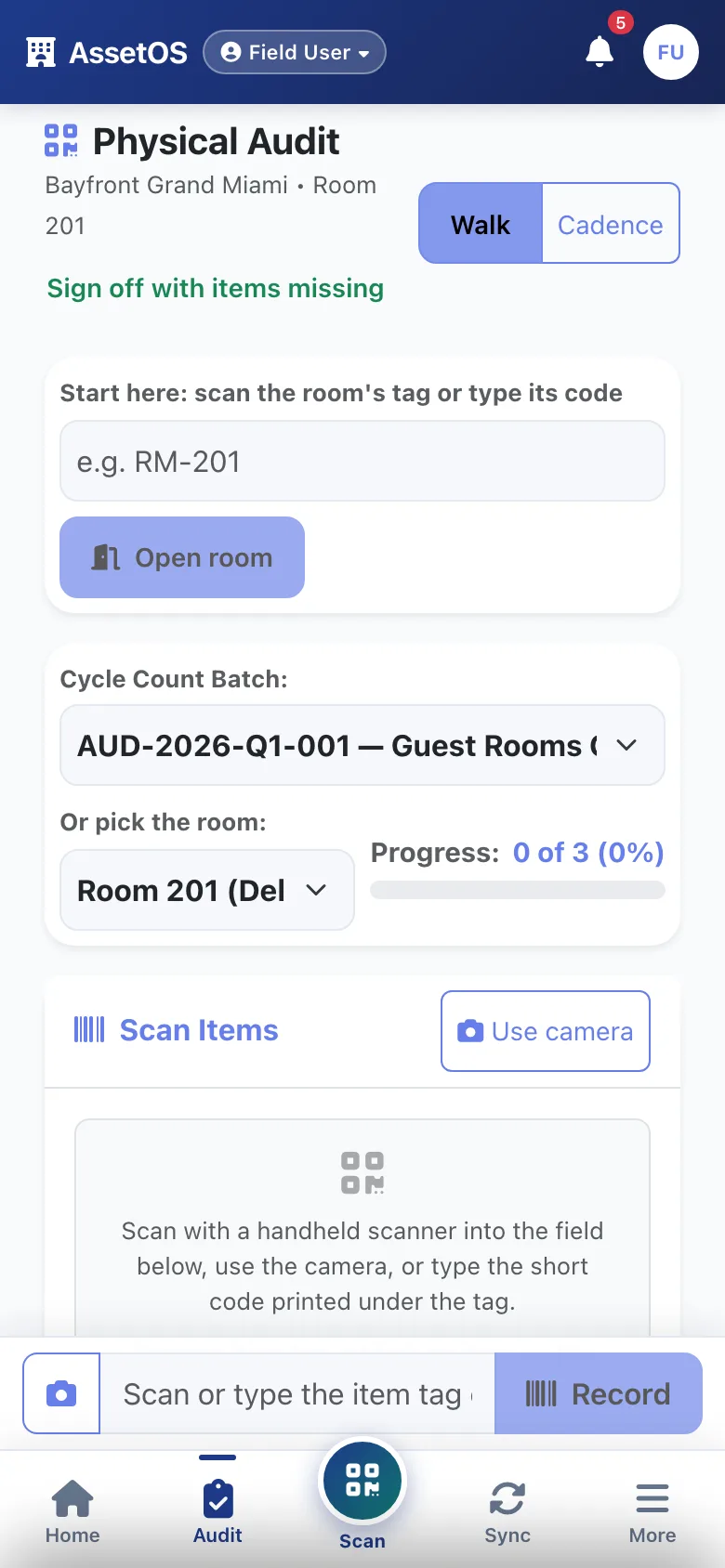
Audit walks with expected contents
The app shows what should be in the room. Scan or tick each item, set its condition, sign off. Anything not found becomes an exception with a value.
Mislocated, never silently moved
Scan a TV that belongs in another room and the app asks: move it here, or flag it.
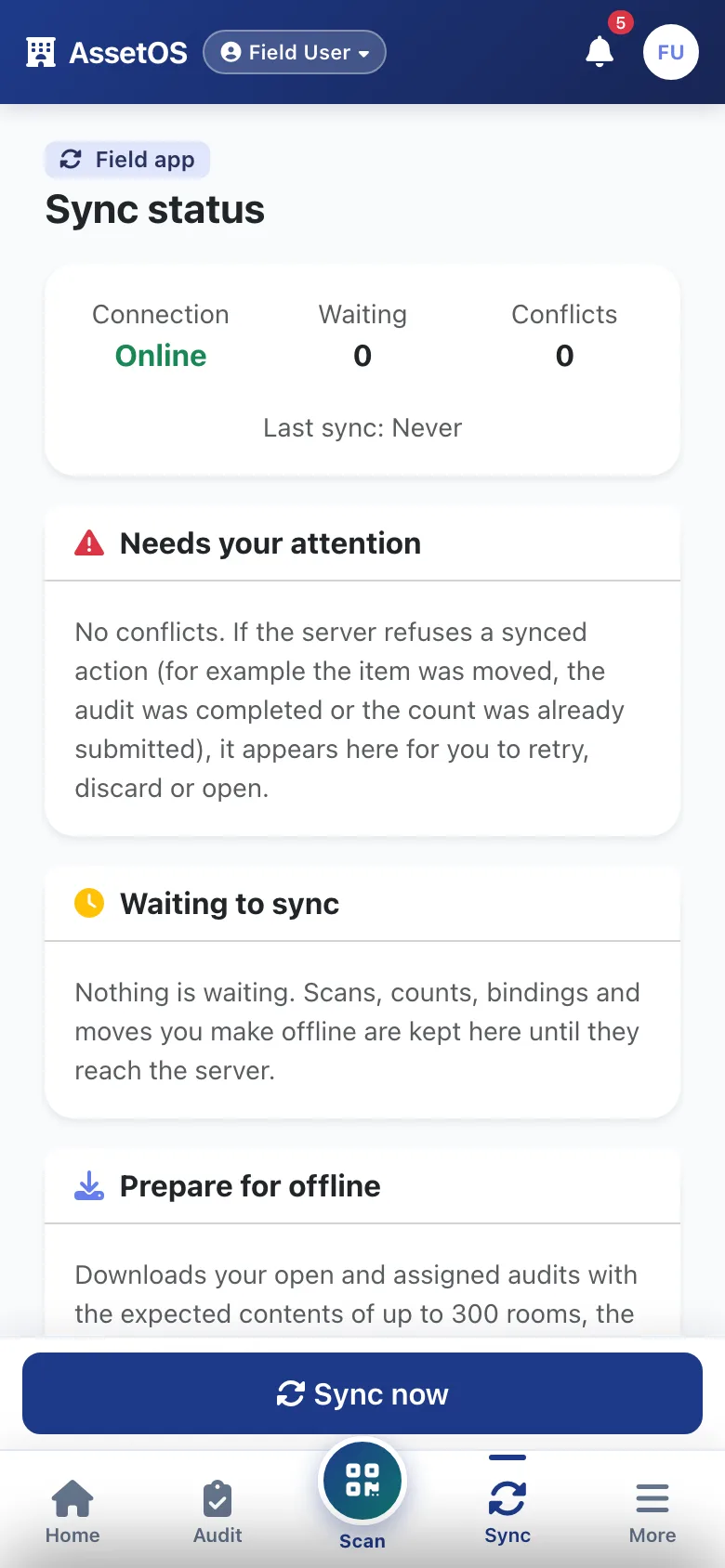
Works offline
Scans, counts, bindings and moves made without signal wait on the phone and sync when it reconnects. Conflicts are shown to resolve, never dropped.
Custody that follows the item
Issue, return and transfer between departments, with the receiving department signing off. Overdue items are listed and nudged.
Guest loaners and banquet kits
Irons, cribs and adaptors are tracked to the guest room. A whole banquet set goes out as one move and is reconciled when it comes back.
How does AssetOS handle Operating Equipment par and breakage?
Linen, china, glassware, silverware and uniforms are where hotel losses hide, and where the accounting treatment is argued over. Generic asset trackers count things one by one and stop there. AssetOS counts pooled stock against par and gives finance the book treatment it chooses.
Par set by rule
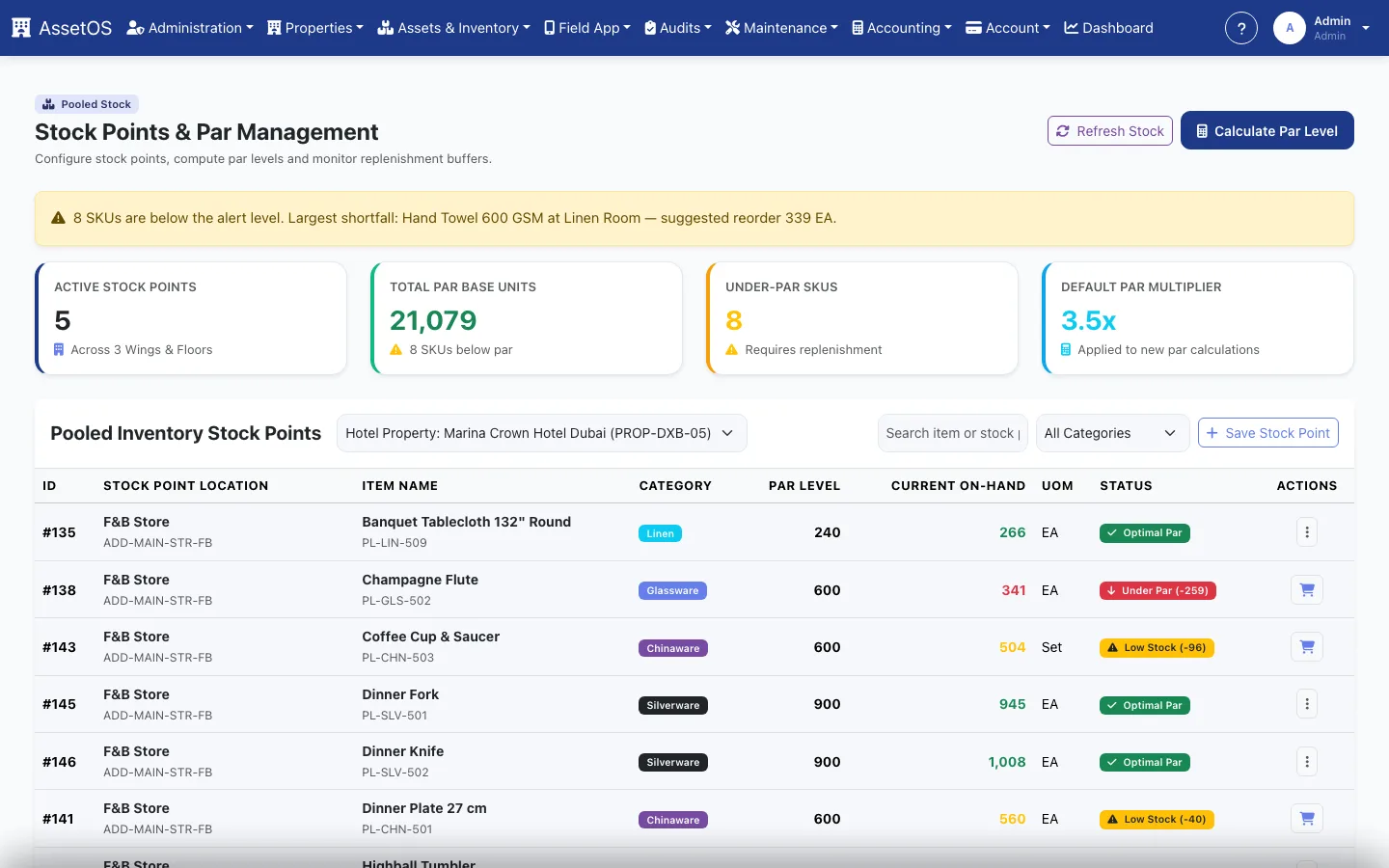
Par for a linen item is rooms × sets per room × a par multiplier (3.5 by default, editable per item). Under-par items come with a suggested reorder quantity.
Blind counts
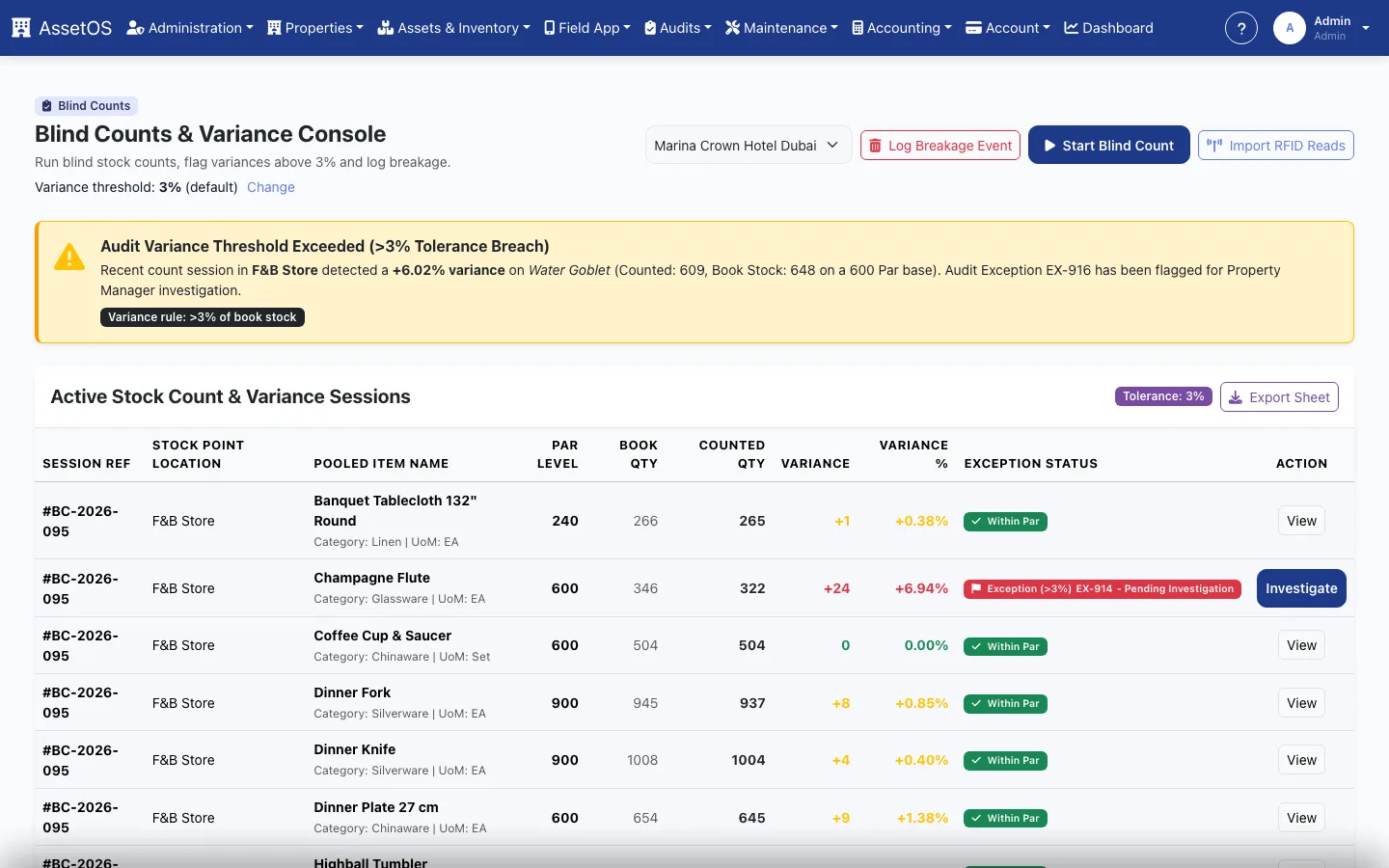
Storekeepers count without seeing the book quantity, so the count is honest. A variance over the threshold (3% by default) raises an exception, valued at standard cost.
Breakage logged where it happens
A broken plate, a torn sheet or a guest-taken item is logged with a reason at the stock point, and reported by item, outlet, department and reason.
Your book treatment, not ours
Operating Equipment can be treated as a capitalised base stock amortised to a floor with replacements expensed, expensed on issue, or depreciated as a pool. Finance picks it per category in the book policy.
What does finance get at month end?
A fixed-asset register that the floor has proved, depreciation under your own policy, and a journal your general ledger accepts. AssetOS sends journals to the ledger; it does not replace it.
Capitalise or expense, by category
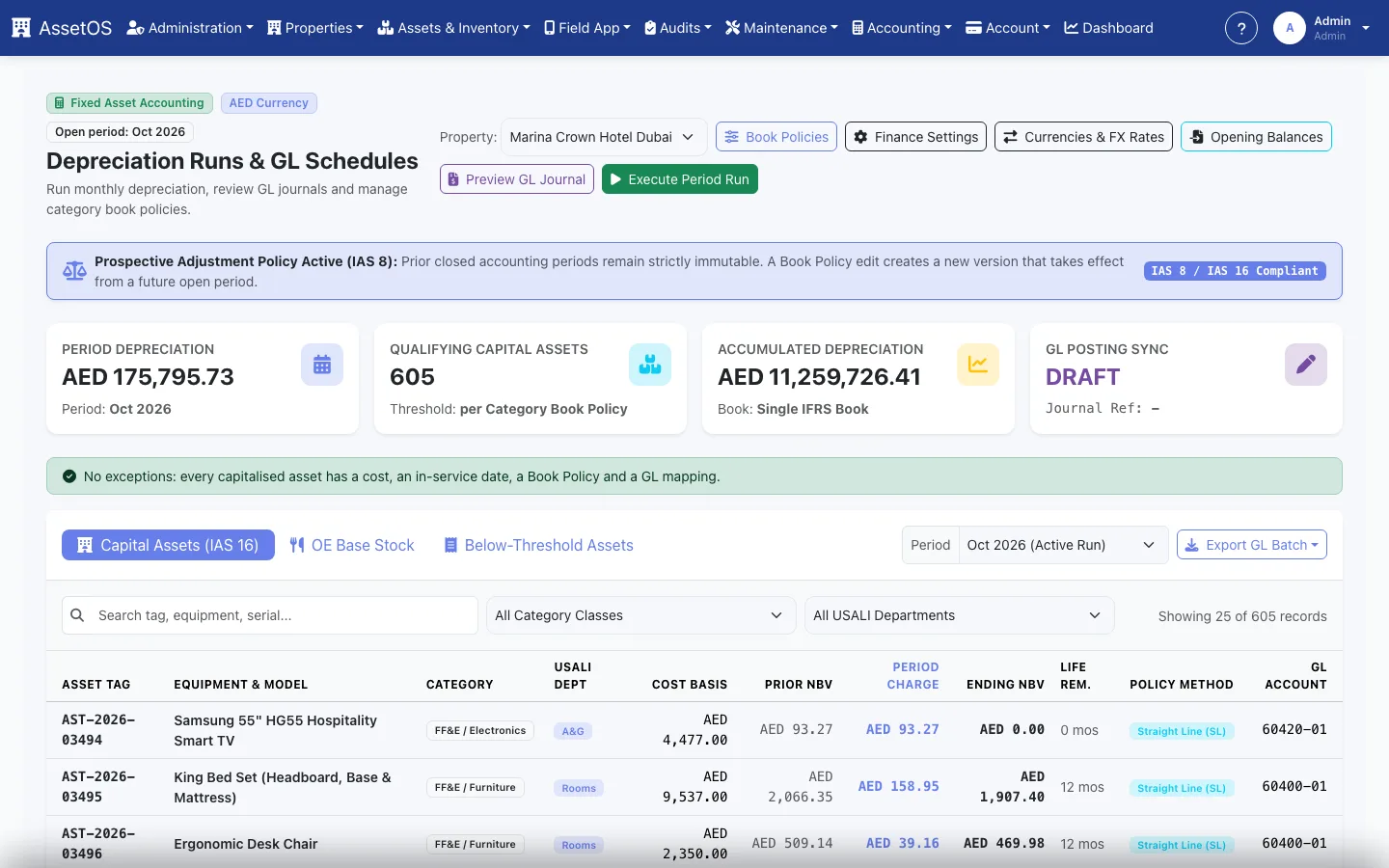
Each category carries its threshold, method (straight-line or declining balance), useful life, residual and GL accounts. Items under the threshold are tracked physically without a book. A policy change creates a new version that applies from a future period; closed periods are never touched.
Preview, check, post
The monthly depreciation run is previewed first and lists anything missing a cost, an in-service date or a GL mapping. Posting closes the run. Corrections post as adjustments in the next open period.
Balanced, by department and property
Every journal line carries its account, USALI department, property and the event it came from. Disposals and write-offs produce the cost, accumulated depreciation and gain or loss lines. The batch exports to the general ledger.
Repair or replace, on the numbers
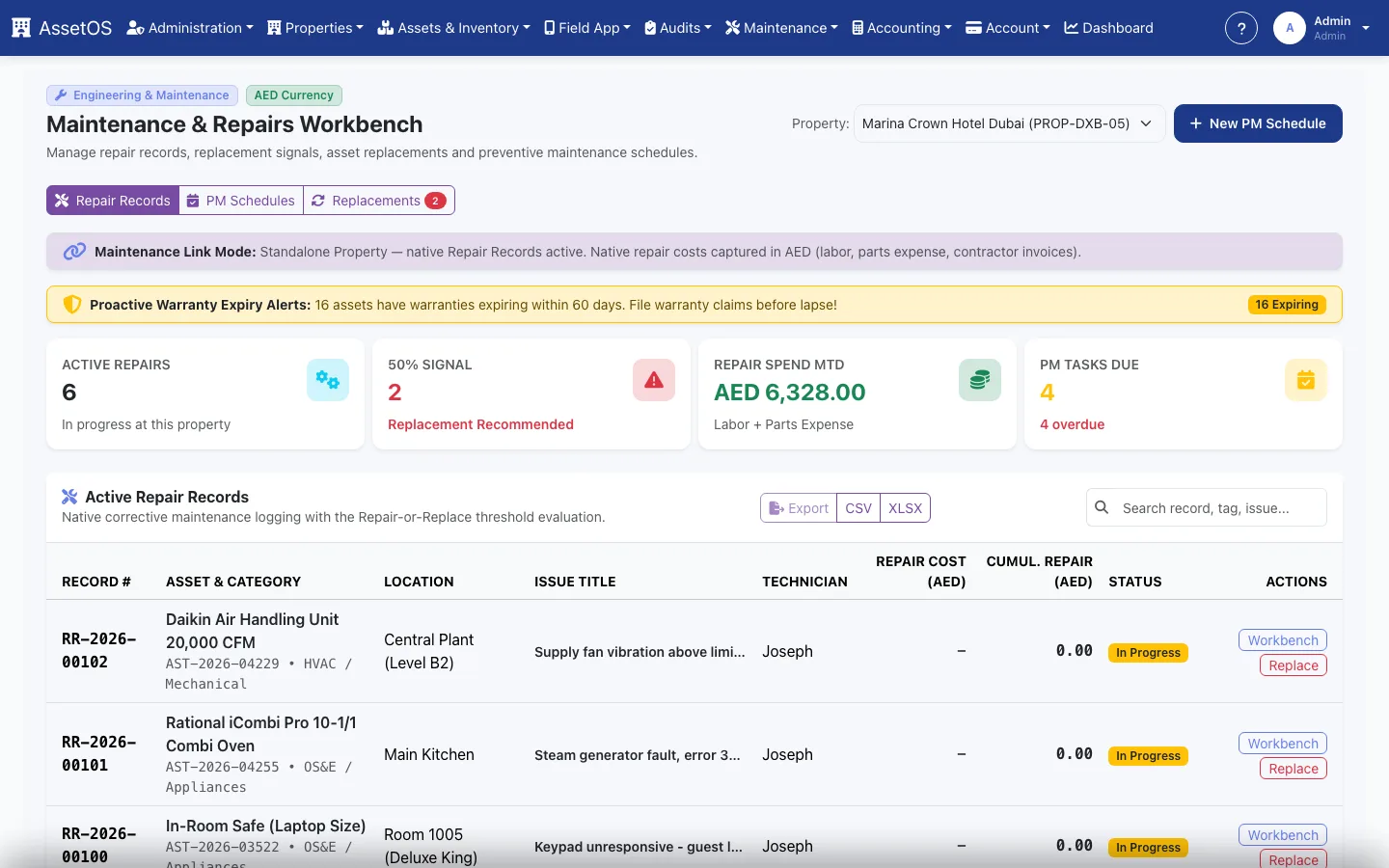
Repair costs land on the asset. When cumulative repairs pass half the replacement cost (the default), AssetOS raises a repair-or-replace signal. Replacing retires the old item with its disposal journal and links the new one to the same room.
Is AssetOS a CAFM or facility management system?
No, and it does not ask you to replace one. Hotel CAFM and facility management tools are good at work orders; finance modules are good at book value. AssetOS is the layer between them: the room-by-room register, Operating Equipment par, custody, and the depreciation and journals.
Beside the system you already run
Link one maintenance system per property through signed webhooks or a CSV export. Its approved repair costs land on the right asset; damage found in an audit reaches its queue. Messages that cannot be matched to an asset wait in a review queue, never discarded.
Natively with PunchlistOS
Where there is no maintenance system, PunchlistOS pairs both ways: AssetOS owns the rooms and the assets, PunchlistOS owns the repair ticket and its charges.
On its own
With nothing linked, AssetOS keeps its own repair records, preventive maintenance schedules and warranty alerts.
Six reasons hotels choose AssetOS
The first one is the reason it exists.
One record, two truths
What is in the room and what is on the books come from the same events.
No rollout project
Kits and stamping replace item-by-item entry; a property is designed to be live after one setup session and one scan walk.
No training for the floor
Every field screen has one primary action, so new housekeeping and engineering staff can use it on day one.
Keeps your ops tool
Runs beside the maintenance or facility management system you already have.
Finance-grade output
IAS 16 depreciation, USALI departments and journals that balance by construction.
Rules decide, AI drafts
Language features suggest and summarise; every figure and posting comes from the rule engine.
What does AssetOS look like?
Real screens from the live demo you can open above. The demo is a hotel group with invented properties, guests and figures.
Which accounting standards and integrations does AssetOS support?
Hotel finance already works to IFRS and the USALI departmental structure, so AssetOS does too. Book policies are yours to set; the defaults are a starting point.
- IFRS · IAS 16 cost model
- IAS 8 prospective policy changes
- USALI departmental mapping
- Operating Equipment book treatment
- Straight-line and declining balance
- QR tags with a printed short code
- Offline-first field app
- Webhooks and CSV to your maintenance system
- Journal export to your general ledger
- Immutable audit trail
From demo to a register that matches the books
Three steps to the first month end, bought the way it suits your business.
See it on the demo
A walkthrough of the demo hotel group with your general manager, finance and engineering leads: a room audit, a linen count and a month-end run.
Set up one property
Load the room structure, define the kits, print the tags and do the first scan walk. Bring opening balances in from your current register and reconcile them before go-live.
Close a month, then roll out
Run one audit cycle, one count and one month-end journal your ledger accepts, then add the next properties in the group.
Two ways to buy it
Per property, per month
Outcome-as-a-Service priced on the unit you are paid on: you earn per property you manage, so that is how Xamun charges. Configured to how your hotels run, mapped to your outcome goals, hosted by Xamun and priced to replace the software you rent today.
Licence
Your own instance on your infrastructure, white-label and source-available.
Questions hotel owners and finance teams ask
Why don’t a hotel’s asset register and its books agree?
Because they are usually two different records. Maintenance and facility management systems track jobs; the finance fixed-asset register tracks cost and book value; nobody reconciles the two against what is physically in the rooms. AssetOS keeps one record per item, proved by scans and counts, and produces the depreciation and journals from it.
Is AssetOS a CAFM or facility management system?
No. Keep your CAFM, your maintenance system or your facility management contractor. AssetOS adds what those leave thin: the room-by-room asset register, Operating Equipment par and breakage, custody, and the depreciation and general-ledger output finance needs. It connects to the maintenance system through webhooks or a CSV export, so repair costs land on the right asset and damage found in an audit reaches the maintenance queue.
How does AssetOS handle hotel Operating Equipment par?
Linen, china, glassware, silverware and other Operating Equipment are held at stock points and counted against par. Par is calculated from rooms, sets per room and a par multiplier. Counts can be blind, variances over the threshold raise a valued exception, and breakage is logged with a reason. Finance chooses the book treatment per category: base stock amortised to a floor with replacements expensed, expensed on issue, or depreciated as a pool.
How does AssetOS depreciate hotel FF&E under IFRS?
Under the IAS 16 cost model. Each category has a book policy with a capitalisation threshold, straight-line or declining-balance method, useful life, residual value and GL accounts. The monthly run is previewed, checked for missing data and posted; posted runs and closed periods cannot be edited, and policy changes apply prospectively. Journal lines carry the USALI department and property.
How long does it take to set up a hotel?
The design goal is one setup session and one scan walk. The room structure is built from a rule, a CSV or a pasted room list, and room kits are stamped onto every room of a type, so the first walk confirms expected items instead of typing them in. Physical tagging of a large property is the longest part, and it is a floor-by-floor job.
Does AssetOS help a hotel that has not opened yet?
Yes. A pre-opening team can define the kit for every room type and stamp it before the first guest, so every room has its expected contents and every item is waiting to be tagged. The UAE alone has about 25,000 hotel rooms in its construction pipeline (Lodging Econometrics, Q2 2026).
Do housekeeping and engineering staff need training?
No training is the design target. The field app opens on one scan button, every screen has one primary action, and it works offline for a whole audit shift. That matters in a workforce where new staff arrive every month.
Does AssetOS work with PunchlistOS?
Yes, natively and optionally. With PunchlistOS paired, AssetOS owns the rooms and the assets, PunchlistOS owns the repair ticket and its charges: a damaged item found in an audit becomes a ticket, and the approved charge comes back as a repair record on the asset. AssetOS also runs on its own, or beside another maintenance system.
Is there a live demo, and how is AssetOS sold?
Yes, at assetos.xamun.ai, on a demo hotel group with invented data. It is sold per property per month, the same unit a hotel management company is paid on, configured to your operation, hosted by Xamun and priced to replace the software you rent today; or as a licence for your own instance, white-label and source-available.
Make the register and the books agree
A walkthrough of the demo with your general manager, finance and engineering leads: a room audit, a linen count and a month-end run.