
MarginOS — Margin you can prove. Cash you can see.
Winning the work is the half every firm measures. Between the signature and the bank balance sit a dozen handoffs, and each one is where margin quietly goes. Your CRM stops at closed-won and your ledger starts at the invoice; MarginOS runs everything in between.
Where does margin go between the deal and the cash?
Into the stretch no system owns. A consulting firm’s revenue owner is held to booked revenue, but the firm lives on collected cash, and the two numbers part ways in five predictable places.
Your CRM stops at closed-won
It knows the deal. It knows nothing about whether the work was delivered, billed or paid.
Your ledger starts at the invoice
It knows the invoice. It knows nothing about the promise the invoice came from.
The stretch in between runs on spreadsheets
Scope, margin floors, sign-off, billing triggers, chasing and renewals live in inboxes and memory. That stretch is where margin leaves the building.
What is MarginOS?
One record from the deal to the cash. Every stage hands the next a locked baseline, not a fresh guess: the price the client agreed is the price that gets contracted, the milestone that was signed off is the one that gets billed, and the terms in the contract are the terms collections chases. Nothing is re-keyed, so nothing drifts.
- Dealfrom your CRM
- Proposalmargin governed
- Contractterms locked
- Deliveryproof required
- InvoiceVAT ready
- Collectterms-aware
- Cashreconciled
- Renewbefore it lapses
How does MarginOS protect margin at each stage?
Margin is protected by rule, not good intentions
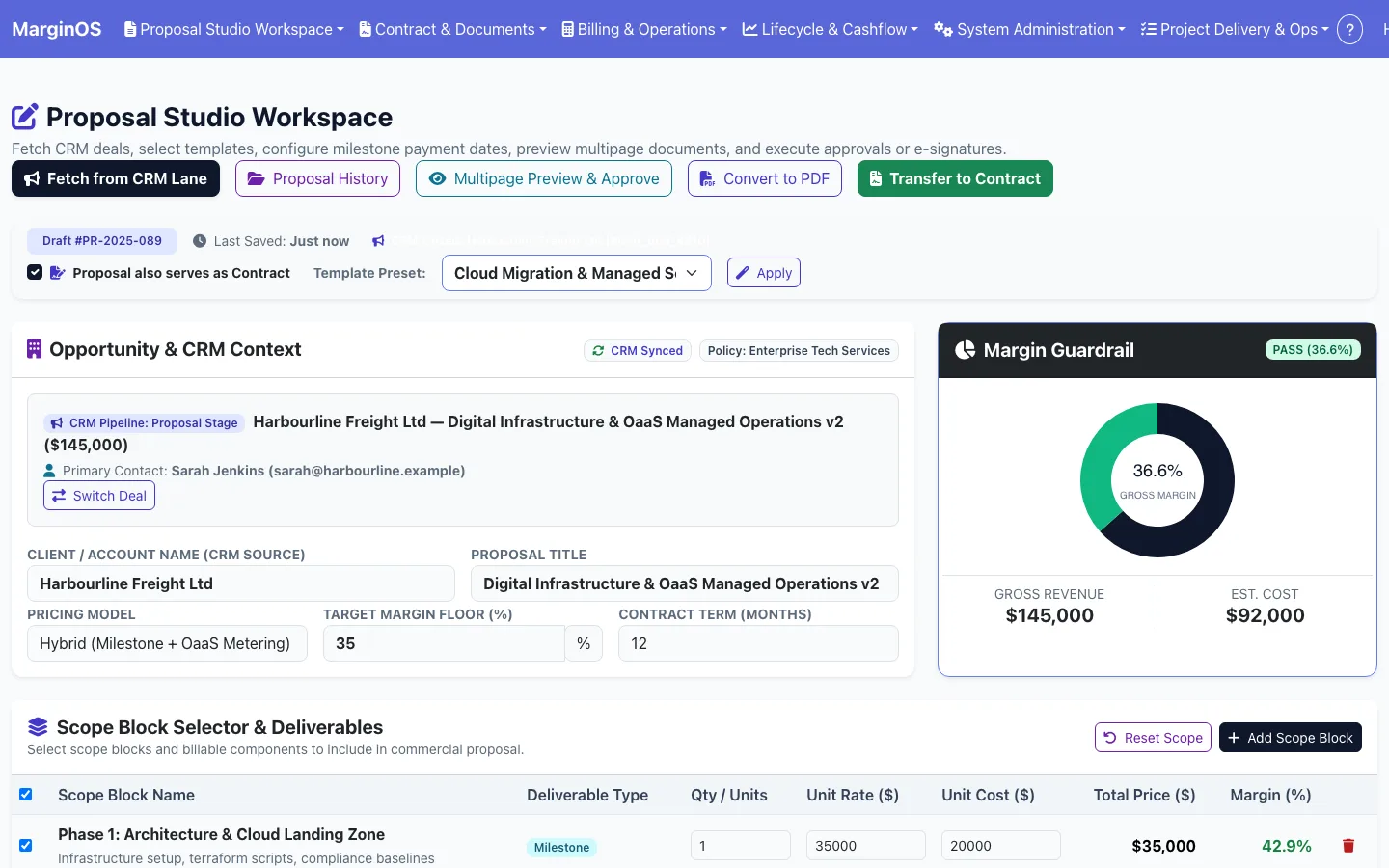
Proposals are built from templates and scope blocks, each with its unit rate and cost. A margin guardrail shows gross margin against your floor as the quote is built, and a quote that breaks the floor goes to an approvals queue with the requester, the calculated margin and the variance recorded.
What was quoted is what is owed
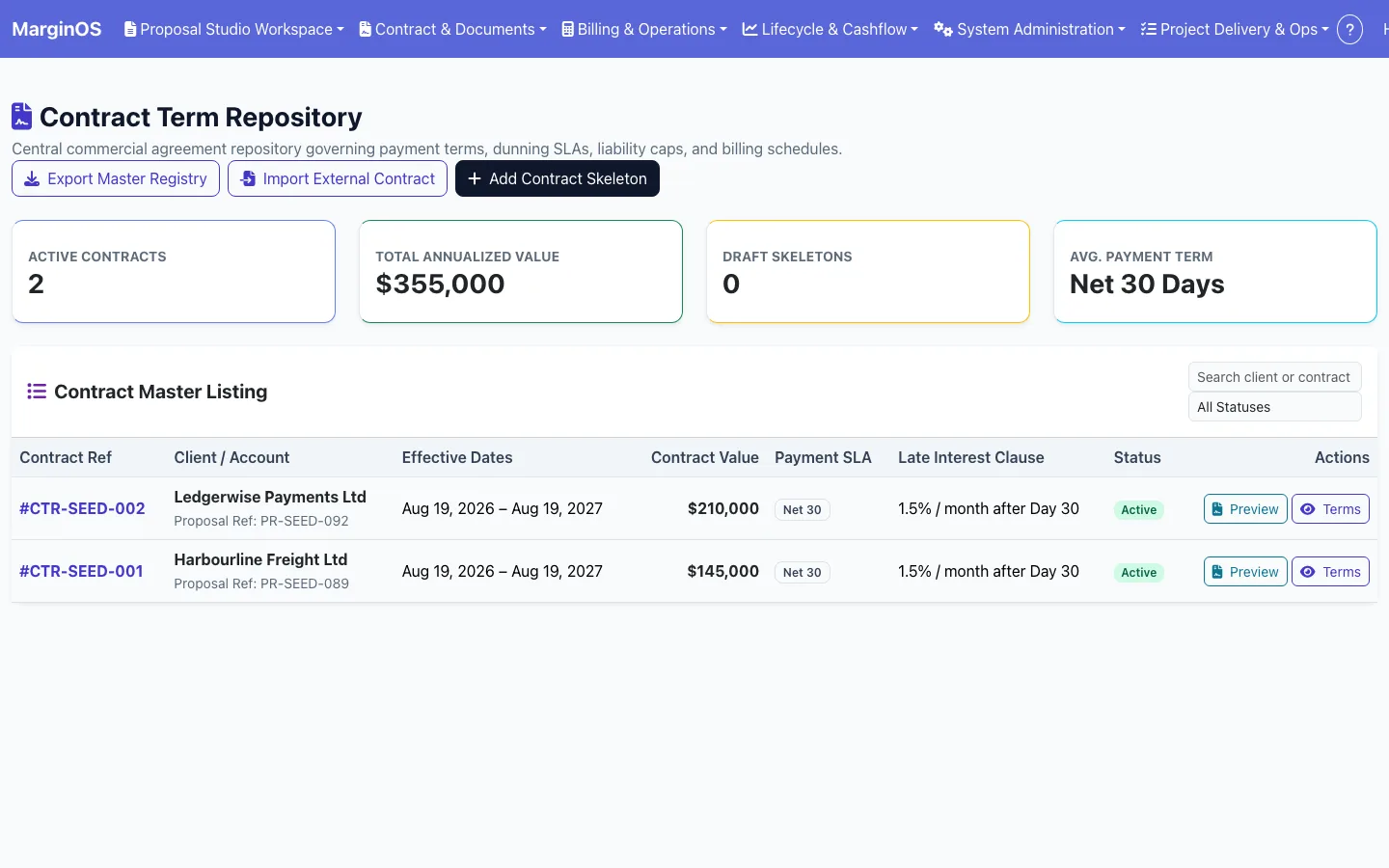
Approved commercial terms and the milestone payment schedule carry into the contract as a locked record: payment terms, late-interest clause and billing schedule. Contracts drafted outside the platform can be imported into the same shape, so older paper joins the same lifecycle.
No invoice without proof
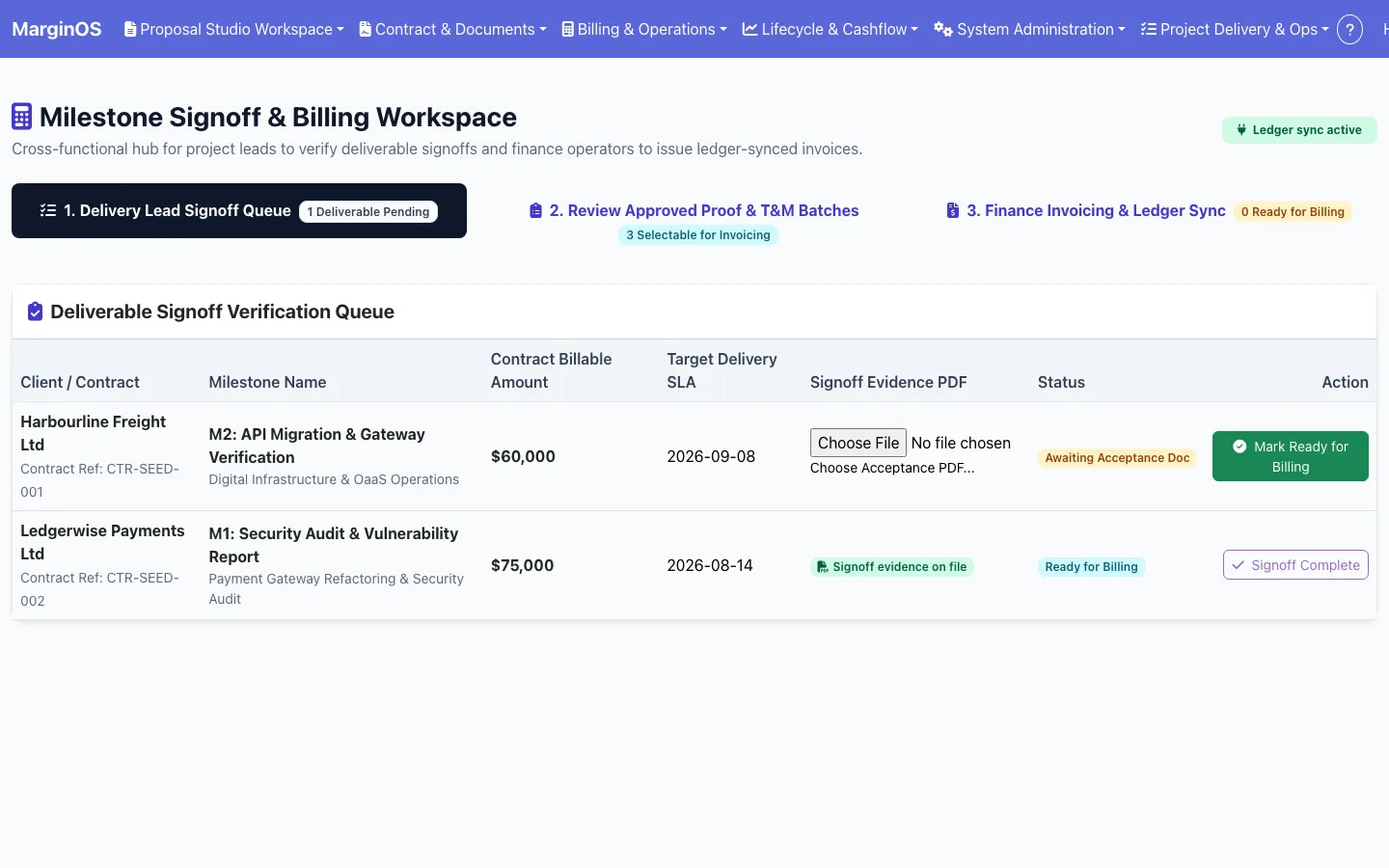
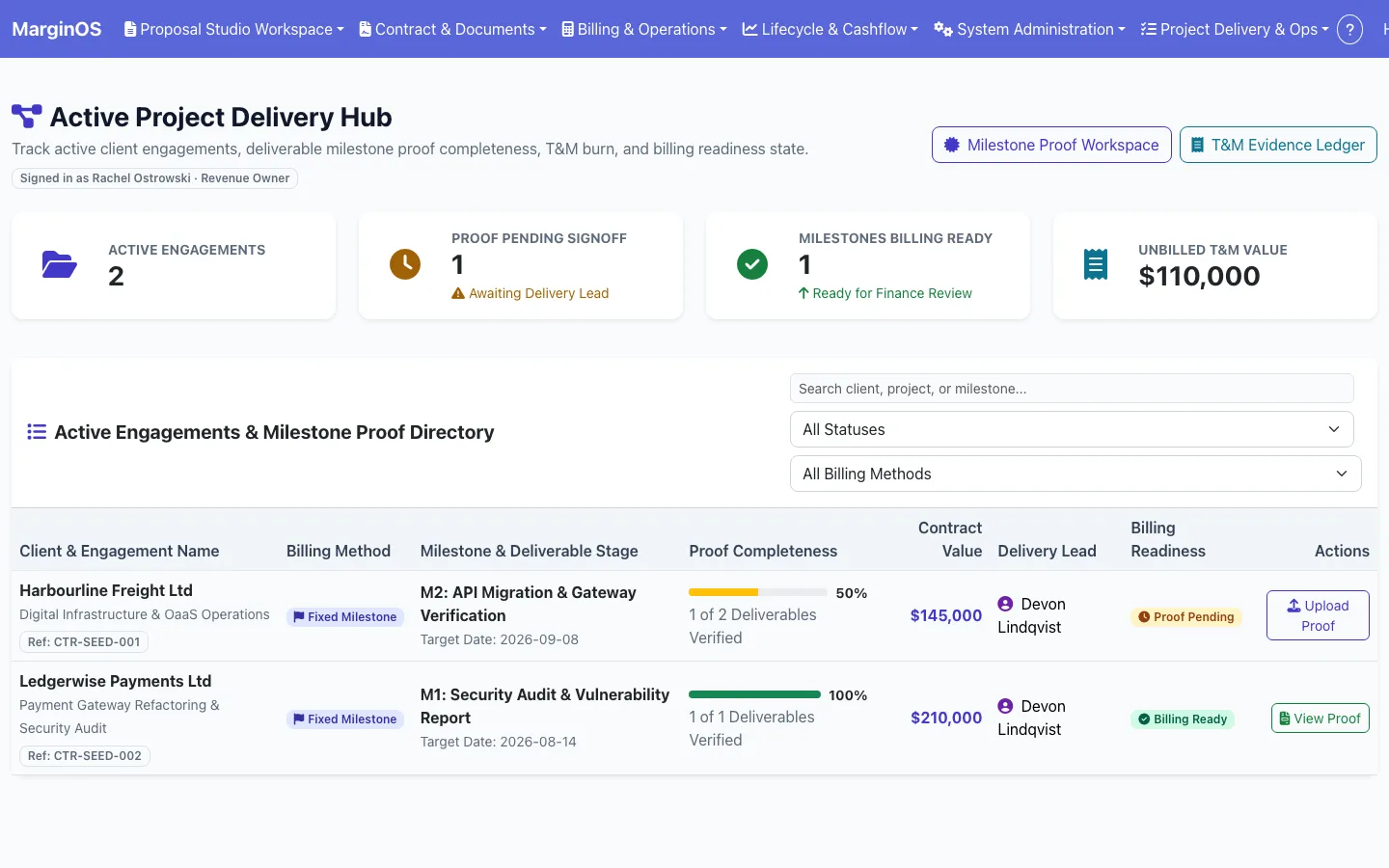
Delivery leads attach sign-off evidence to each milestone, and time-and-materials work is logged with its evidence. Finance invoices only what is signed off and ready, and invoices post to your ledger.
Chasing that follows the contract
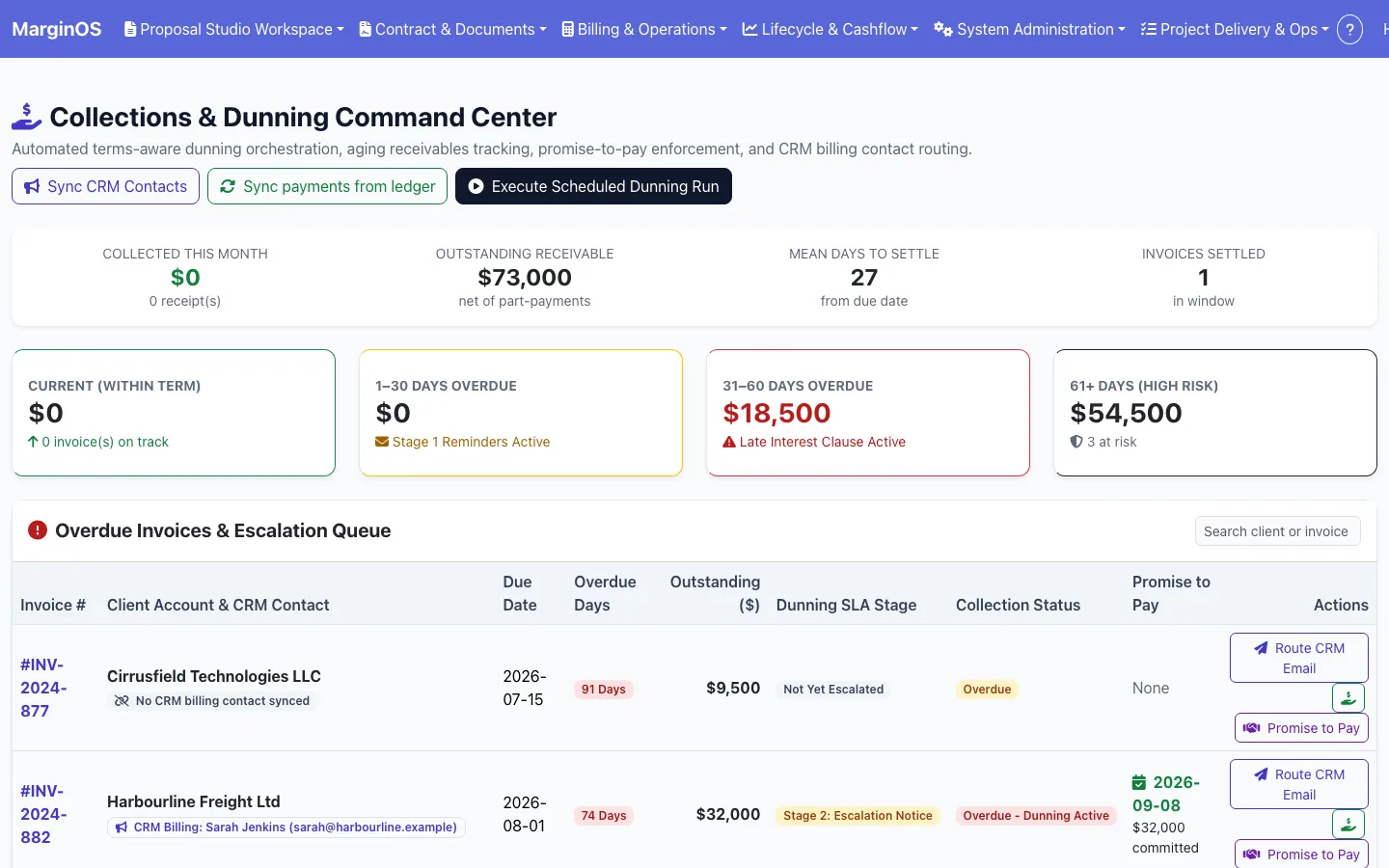
Dunning escalates by each client’s own payment terms and pauses the moment a promise to pay is logged. Notices go to the billing contact held in your CRM, not whichever address was on the last email.
Aging that empties as cash arrives
Receipts sync back from your accounting ledger and settle invoices. Outstanding balances are measured net of part-payments, with days to settle measured against each contract’s terms.
Renewals with the context to run the conversation
Engagements surface as they approach their end date, with value, owner, unbilled work, outstanding balance and how the client has been paying.
What else does the finance team get?
The questions a revenue owner is asked every month, answered from the record rather than a spreadsheet: did we discount below floor, is delivered work billed, did the cash arrive, which campaigns pay for themselves, and what renews next quarter.
Revenue traced to the campaign
Campaign and lead source travel with the deal through contract, invoice and payment, so spend is measured against cash collected. Revenue with no campaign is shown as unattributed, never hidden.
A payer scorecard from your own history
Each client’s days to pay, paid invoices and dispute rate from your own records, with a recommended payment term for the next proposal.
UAE e-invoicing readiness
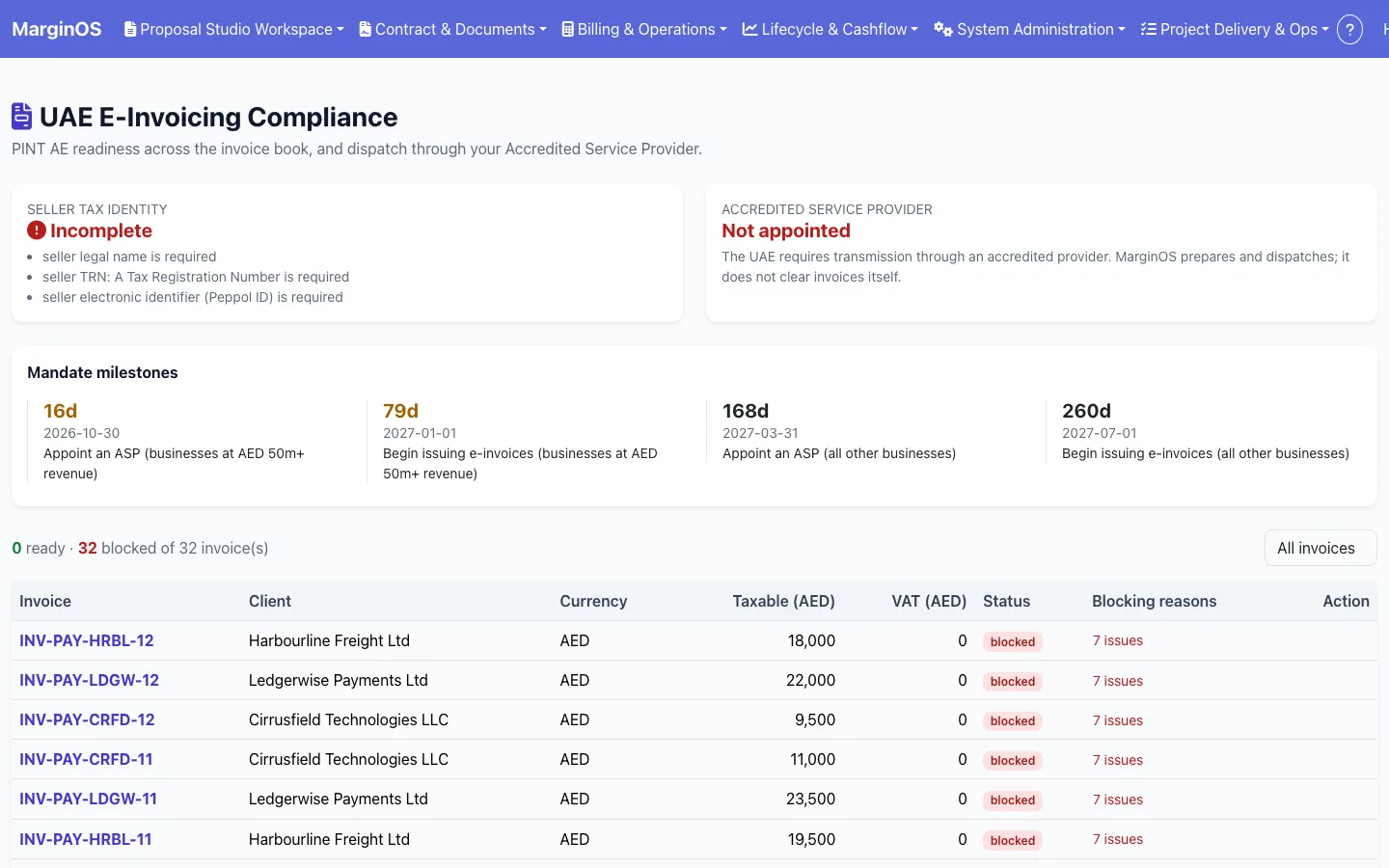
Every invoice is checked against the PINT AE format and the blocking issues are listed, so they can be fixed before dispatch through your Accredited Service Provider.
It runs on a schedule, with a log
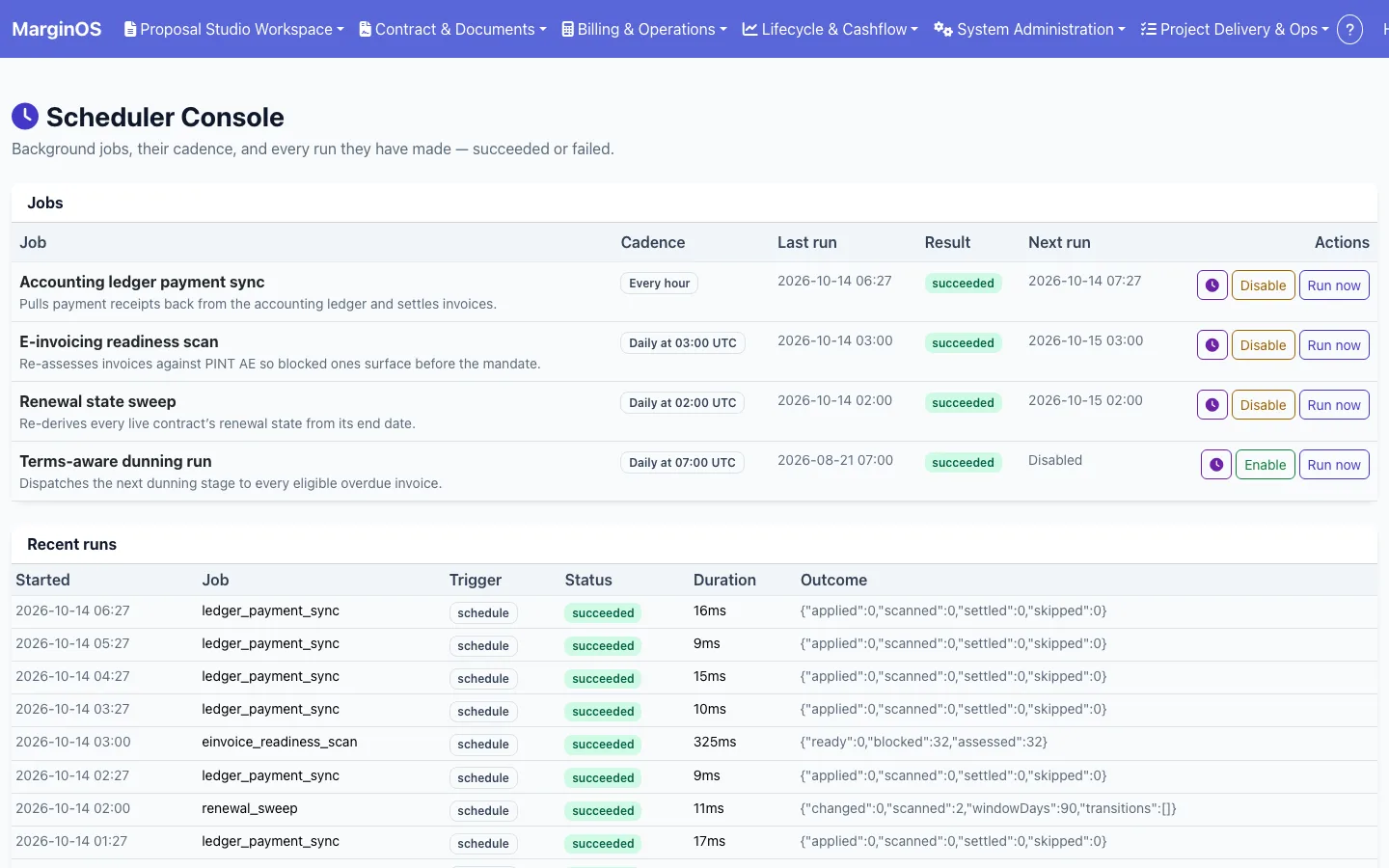
Ledger payment sync, the e-invoicing readiness scan, the renewal sweep and the dunning run happen on their own, and every run is recorded with its outcome.
A workspace for each role
Revenue owner, finance and receivables, delivery lead, operations and account manager each see the screens their job needs, and nothing else.
Keeps your CRM and your ledger
Deals come in from the CRM you already use, invoices post out to your ledger and payments come back. MarginOS does not ask you to replace either.
What does MarginOS look like?
Real screens from the live demo you can open above, on invented clients and data. Your own deployment is a separate instance connected to your CRM and your ledger.
How is MarginOS bought?
Start with the demo and one contract book, then choose the way that suits the business.
Outcome-as-a-Service
Xamun invests the build and runs it with your team. You pay per transaction on the unit your own business is paid on, agreed with you, so the cost moves with your revenue.
Licence
Your own instance on your infrastructure, white-label and source-available, configured to how your firm prices, bills and collects.
Questions revenue and finance leads ask
Who is MarginOS for?
Consulting and professional services firms that sell projects, retainers or managed services: IT services and managed service providers, consultancies, engineering and architecture practices, and agencies. The buyers are the revenue owner and the finance lead; delivery leads and account managers use it daily.
Does MarginOS replace our CRM or our accounting system?
No. Deals come in from the CRM you already run and invoices post to your accounting ledger, with payments syncing back. MarginOS is the record for everything between the signed deal and the cash: proposal, contract, delivery proof, billing, collections and renewal.
How does MarginOS stop discounting below our margin floor?
The floor is set per proposal template and checked as the quote is built. A quote below the floor cannot go out quietly: it goes to an approvals queue that records who asked, the calculated margin, the target and the variance, and who approved the exception.
How does MarginOS make sure delivered work gets billed?
Milestones are billed from signed-off proof. The delivery lead attaches acceptance evidence, time-and-materials work is logged with its evidence, and finance sees exactly which items are ready for billing, then invoices post to the ledger.
How does collections work?
Dunning follows each contract’s own payment terms and late-interest clause, pauses when a promise to pay is logged, and routes notices to the billing contact from your CRM. Receipts from the ledger settle invoices, so the aging report shows what is genuinely outstanding, net of part-payments.
Is MarginOS ready for UAE e-invoicing?
MarginOS works in AED with UAE VAT and checks every invoice against the PINT AE format used in the UAE programme, listing what would block it, so it can be fixed before dispatch through your Accredited Service Provider. MarginOS prepares the data and dispatches; the provider clears the invoice.
Can we bring in contracts signed before MarginOS?
Yes. Contracts drafted outside the platform can be imported into the same contract shape, so they follow the same billing, collections and renewal lifecycle as new ones.
How is MarginOS bought?
Two ways. A licence: your own instance on your infrastructure, white-label and source-available. Or Outcome-as-a-Service: Xamun invests the build and is paid per transaction on the unit your own business is paid on, agreed with you, so the cost moves with your revenue.
Is there a live demo?
Yes, at marginos.xamun.ai, on invented clients and data. Your own deployment is a separate instance connected to your CRM and your ledger.
See MarginOS against your own contracts
Bring one contract book and your aging report. We will map them into MarginOS with you and show where margin is leaving between the deal and the cash.