
How do insurance approvals and extension requests work for physiotherapy in Abu Dhabi?
The clinic sends the patient’s insurer an electronic prior request through the Department of Health’s Shafafiya system, carrying the diagnosis, the physiotherapy codes and the sessions planned. The insurer answers yes or no, with its own authorisation ID, the sessions it authorises and the dates. When those run out, the clinic sends a new request of type Extension.
Most pages that rank for this question are written for patients and are about Dubai insurers. This one is for the clinic, in Abu Dhabi, where the Department of Health (DoH) sets the rules. It covers the request, the answer, the extension, where rejections come from, a short contrast with Dubai, and what to write down in every session so the next extension is not refused.
Shafafiya is the DoH e-claims system. The rules below come from DoH’s own documents, listed with their dates under Sources. Session limits and approval periods are set by each plan and insurer, not by one DoH number, so this page does not quote one.
1. Check whether the plan needs approval at all
Prior authorisation is a plan rule, not a blanket one. The DoH claims adjudication standard (issued in 2010 by the Health Authority – Abu Dhabi, now DoH) says an insurer may deny a claim for lack of prior authorisation only if the plan’s schedule of benefits requires it for that service.
For physiotherapy, many do. Daman’s public FAQ for DoH-regulated plans says physiotherapy “is covered but requires pre-authorization”. That is one insurer’s statement, not a DoH rule, so check each patient’s plan.
Shafafiya also has an Eligibility request. The insurer’s eligibility answer carries an ID, and the claim can report it later to show the insurer confirmed the patient was covered. Run the eligibility check before the first session, not after the fifth.
2. Send the prior request
The request is an XML transaction (PriorRequest) the clinic’s system uploads to Shafafiya. The DoH schema gives it these parts:
| Part | What it holds | Why it matters for physiotherapy |
|---|---|---|
| Type | Eligibility, Authorization, Cancellation, Extension, Status Inquiry or Prescription | The first course is an Authorization. More sessions on the same plan of care are an Extension. |
| ID | The clinic’s own unique ID, starting with its facility licence number | The thread that ties the request, the answer and the claim together. |
| Member and payer | The insurance member number from the card and the insurer’s DoH licence | A wrong member number fails before anyone reads the clinical case. |
| Date ordered | When the order or referral was made | Used to check the order is still valid and when the condition began. |
| Diagnosis | Diagnosis codes (ICD), with the principal one marked | The insurer’s edits check the codes against each other. |
| Activity | Each service: code, planned start date, quantity and estimated amount | Quantity is where the number of sessions asked for goes. |
| Observations | Coded values and measures added to an activity | Where the clinical case travels: findings and scores. |
| Resubmission | Comments and attachments when a request is sent again | Used to answer a refusal with more evidence. |
One field trips up rehab clinics. For most services the activity clinician is the person who gives the treatment. The Shafafiya dictionary makes an exception for all types of rehabilitation therapy, including physiotherapy: there, the activity clinician is the ordering physician. The request and the claim need the referring doctor’s licence on the activity, not only the physiotherapist’s.
3. Read the insurer’s answer
The insurer replies with a PriorAuthorization transaction. Per the DoH data definitions it carries:
- Result: Yes or No.
- The insurer’s authorisation ID (IDPayer). This is what goes on the claim.
- Start and end dates for the authorisation.
- Authorised quantity per activity: the number of sessions approved, which may be fewer than asked.
- Payment amount per activity: the amount the insurer guarantees for it.
- A denial code and comments where the answer is no or reduced. DoH publishes the list of denial codes in the Shafafiya dictionary.
- Limit: the amount available on the policy at that moment. DoH says this figure is advisory only and guarantees nothing.
The 2010 standard also protects the clinic in three places. An answer that is underspecified or incomplete is read in the provider’s favour and counts as approved. An approval downgraded from what was asked without justification is treated as abuse. If an insurer wrongly denies a claim for lack of authorisation, the provider is owed the full payment, and the delay beyond the 45-day payment period counts as late payment. The Shafafiya dictionary also lets the claim carry the clinic’s own prior-request ID where the insurer did not give an authorisation within the defined time limit.
4. Ask for an extension before the last approved session
An extension is a prior request of type Extension. It goes in when the sessions or dates already authorised will not cover the rest of the plan of care. The practical rule is timing: send it while sessions are still left, so the patient does not arrive for a visit no approval covers.
DoH defines the transaction, not the clinical test. Each insurer sets that in its own adjudication guidelines. The standard requires those guidelines to be published or available to contracted providers, version-numbered and dated. Ask each insurer you work with for the current one. What an extension usually has to show is the case for more sessions:
- The diagnosis and the plan of care: the goal, and the sessions still needed to reach it.
- The same outcome measures as at the start, now against that baseline. Pain score, range of motion, strength, a functional test.
- Attendance: sessions booked, attended and missed.
- Home practice, if the plan depends on it.
- A short reason, in the clinician’s words, why the gain so far justifies more.
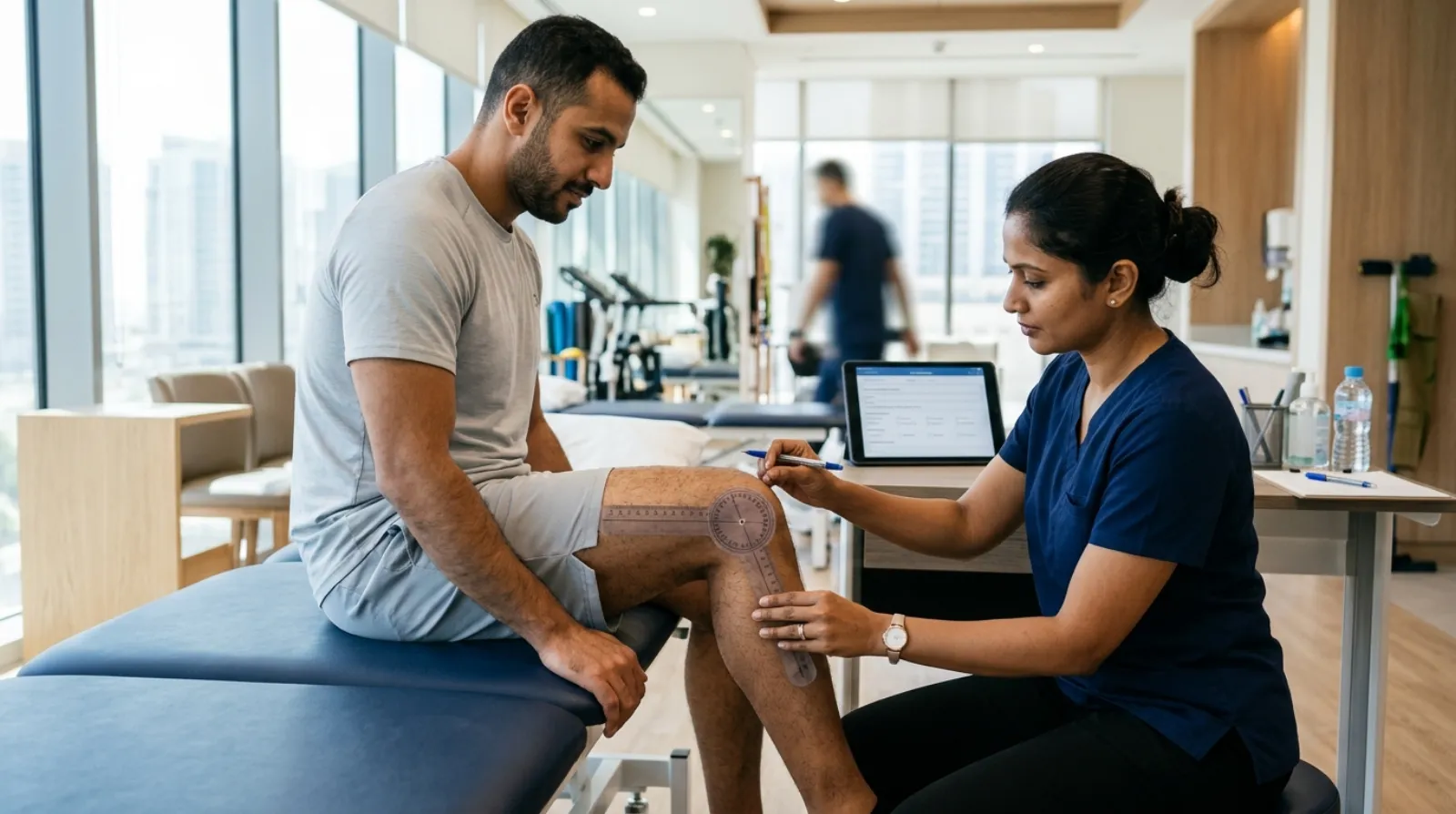
A request that says “patient still in pain, needs 6 more” asks the insurer to trust the clinic. One that shows the knee went from 70° to 100° of flexion against a goal of 120° gives it a number to approve.
Where rejections come from
Every partly or fully denied claim must carry a denial code, so the reason is always on the remittance advice. Read against the DoH documents, the avoidable causes are these:
- No authorisation where the plan needs one. The one ground the standard allows when the schedule of benefits requires approval.
- Sessions outside the approval. A visit after the end date, or one more than the authorised quantity, is not covered by that authorisation.
- The wrong clinician on the activity. For physiotherapy, the ordering physician’s licence, as above.
- Codes that fail the insurer’s edits. DoH requires insurers to share their simple edits with contracted providers. Coding disputes that cannot be settled go to a DoH clinical coding arbitration sub-committee.
- Eligibility or member details wrong. Caught by an eligibility check before the first session.
- An extension with no evidence. No numbers against baseline, no attendance, no reason.
If an insurer decides identical claims differently, the standard gives the clinic a route to challenge the inconsistency, once DoH’s coding arbitration sub-committee has validated the cases.
How Dubai is different
Dubai runs on the Dubai Health Authority’s eClaimLink, not Shafafiya, under its own rules. Two points matter to a group with sites in both emirates:
- Timings. According to an Al Tamimi & Company summary (a law firm, 31 October 2025), Dubai’s Health Insurance Claims Management Policy Directive, effective 16 November 2025, asks providers to send a pre-authorisation request within one hour of the physician’s order. Insurers answer elective outpatient requests within 6 hours and elective inpatient requests within 24 hours. Claims go through eClaimLink. Read the directive itself before you rely on these figures.
- The basic plan’s cap. Dubai’s Essential Benefits Plan (DHA General Circular 03/2024, 23 July 2024) allows physiotherapy for a maximum of 6 sessions a year. Each needs the insurer’s prior approval, with 20% co-insurance per session.
None of these Dubai numbers applies in Abu Dhabi. They are here so a group running both does not carry one emirate’s habits into the other.
What to record in every session
An extension is written from the record. If the record holds the right things session by session, the request takes minutes. If it does not, someone rebuilds it from memory at night. Each session should leave:
| Record | Why |
|---|---|
| Authorisation ID, sessions approved / used / left, end date | So nobody books a session no approval covers, and the extension goes in while sessions remain. |
| Diagnosis code and the referring doctor’s licence | Both travel on the request and the claim. For physiotherapy the ordering physician is the activity clinician. |
| Attended or missed, and why | Insurers weigh attendance. A missed week explains a slower gain. |
| The same measures, each time, against baseline and goal | The evidence an extension rests on. A new test at session 8 has no baseline to compare. |
| Home practice done or not | Shows whether the plan is being followed between visits. |
| A signed note | The extension is the clinician’s request; the record should show who said what. |
The same record serves Jawda
Since the fourth quarter of 2026, outpatient rehab providers licensed in Abu Dhabi report DoH’s outpatient rehabilitation Jawda indicators each quarter. They count patients against a baseline documented before therapy starts and a reassessment on a fixed clock, day 42 for most indicators. The guidance also says the Jawda team may check what a provider reports against the claims it sent through Shafafiya. The baseline and reassessment an extension needs are the ones Jawda counts, so one record can serve both. Our Position Paper No. 10, “Jawda counts what you wrote down, not what you did”, sets out what each indicator asks a clinic to record.
Where Xamun fits
This is the problem ClinicOS for physiotherapy and outpatient rehab was built around. In ClinicOS each programme carries its approval: sessions approved, used and left, and the expiry date. The board flags approvals running low and caps reached, and shows sessions booked beyond an approval in dirhams. When an extension is needed, the request is drafted from the record, with the measures against baseline and goal, attendance and home practice. The physiotherapist adds a sentence in their own words and signs. Drafts stay drafts until a clinician signs them.
The rest of our healthcare work, for clinics, insurers and care networks, is on the healthcare hub.
Confirm before you rely on this. This is Xamun’s reading of DoH and Shafafiya documents, not advice and not endorsed by DoH. Rules, codes and plan terms change. Confirm the current requirements with the Department of Health – Abu Dhabi and with each patient’s insurer, or a lawyer, before you rely on them.
Sources
- Health Authority – Abu Dhabi (now Department of Health – Abu Dhabi), HAAD Health Insurance Claims Adjudication Standard, ref. HSF/CA/1.0, Version 1.0, issued December 2010: prior-authorisation rules 3.1–3.4, denial codes on remittance (5.4), published adjudication guidelines (4.3), shared simple edits (5.3), coding arbitration (5.7), consistency rule 2. doh.gov.ae. Still published by DoH; check for a later version.
- Department of Health – Abu Dhabi, Shafafiya dictionary, PriorRequest schema: the elements of a prior request. shafafiyaportal.doh.gov.ae. Undated online schema, read 6 November 2026.
- Department of Health – Abu Dhabi, Shafafiya dictionary, CommonTypes data definitions: authorisation types (incl. Extension), Result, IDPayer, Limit (advisory), authorised quantity, payment amount, denial codes, the activity-clinician rule for rehabilitation therapy, eligibility ID on claims, prior-request ID where no authorisation is given in time. shafafiyaportal.doh.gov.ae. Undated online schema, read 6 November 2026. Index of Shafafiya standards and XSDs: doh.gov.ae/en/Shafafiya/dictionary.
- Department of Health – Abu Dhabi, Outpatient Rehabilitation Service Jawda Guidance, Version 1, issued May 2026, effective Q4 2026. doh.gov.ae.
- Daman (National Health Insurance Company), FAQ: DoH, “physiotherapy is covered but requires pre-authorization”. Insurer’s own page, undated, read 6 November 2026. damaninsurance.ae.
- Dubai Health Authority, General Circular GC 03/2024: Updated Table of Benefits for Essential Benefits Plan, 23 July 2024: physiotherapy maximum 6 sessions a year, prior approval, 20% co-insurance. isahd.ae.
- Al Tamimi & Company (Anand Singh, Veena Shankar), “Dubai issues comprehensive overhaul of health insurance claims management framework”, 31 October 2025. Law-firm summary of the DHIC Health Insurance Claims Management Policy Directive, effective 16 November 2025. tamimi.com.