
InsureOS — Every claim, adjudicated and paid.
A modern third-party administration platform for Philippine HMOs and health insurers — cashless LOA, AI-assisted claims adjudication, clinical pre-authorisation, coordination of benefits, fraud detection and BIR-compliant disbursement. PhilHealth, BIR and Data Privacy Act compliance are built in, across medical, dental and veterinary lines.
What is InsureOS?
A modern third-party administration platform for Philippine HMOs and health insurers — cashless LOA, AI-assisted claims adjudication, clinical pre-authorisation, coordination of benefits, fraud detection and BIR-compliant disbursement. PhilHealth, BIR and Data Privacy Act compliance are built in, across medical, dental and veterinary lines.
Who is InsureOS for?
InsureOS is built for health insurers, HMOs and third-party administrators (TPAs). You buy it as a licence, or under Outcome-as-a-Service: Xamun invests the build and you pay per transaction the system processes. UAE rollouts run on UAE-compliant hosting, in the UAE.
What regulation does InsureOS handle?
InsureOS carries the following regulatory and compliance surface, enforced in the workflow rather than documented beside it. The GraphIQ compliance layer keeps these rules current as they change.
- VAT
- BIR
The rules a UAE TPA adjudicates against
Each emirate’s regulator runs its own claims platform and rulebook. These are the rules a UAE insurer or TPA works to, each taken from the regulator’s own document or, where marked, a law firm’s summary of it.
eClaimLink · Dubai
Since 1 January 2013, every claim in Dubai goes to the insurer or TPA electronically through DHA’s eClaimLink, and each licensed facility claims on its own facility ID. The Dubai Health Insurance Corporation’s Claims Management Policy Directive took effect on 16 November 2025. It replaced the earlier claims rules and covers pre-authorisation, submission, adjudication, remittance with denial codes, settlement and reconciliation.
Source: DHA Circular 35/2012, 4 Dec 2012 · Al Tamimi & Co. summary of the 2025 directive, 31 Oct 2025
Shafafiya · Abu Dhabi
DoH requires licensed entities to use electronic person-register, claim and remittance transactions only. Shafafiya’s data dictionary defines the claim submission, remittance advice, prior request and prior authorisation schemas a payer exchanges with providers. From 1 January 2027, the Abu Dhabi Outpatient Classification (ADOC) becomes the main way outpatient care is reimbursed. Shadow billing through Shafafiya started on 1 July 2026.
Source: HAAD/DoH Data Standard, rev. 14 Apr 2014 · Shafafiya dictionary · DoH Circular 76/2026, 14 May 2026
Riayati e-Claims Post Office · northern emirates
For MOHAP-regulated facilities, the e-Claims Post Office inside Riayati carries the whole claim workflow between facilities and insurers: eligibility and coverage checks, prior authorisation, claim submission, payment information and denials. Everything runs on one coding set. MOHAP reported 40 insurers and more than 1,000 facilities linked by October 2022.
Source: MOHAP, 10 Oct 2020 · MOHAP, 11 Oct 2022
Prior authorisation
In Dubai, under the 2025 directive as Al Tamimi summarises it, the provider requests prior authorisation within one hour of the physician’s order. The insurer or TPA answers within six hours for elective outpatient care, within 24 hours for elective inpatient care, and immediately for an emergency. In Abu Dhabi, prior requests and authorisations are Shafafiya transactions. In the northern emirates, they run through the Riayati Post Office.
Coding and claim standards
DHA requires ICD-10-CM for diagnoses, CPT-4 for procedures, HCPCS Level II for supplies and CDT for dental work. It also requires the Dubai Drug Code for medicines and LOINC for observations. DoH defines its code sets in the Shafafiya data dictionary and holds emirate-wide licences for them. Where two codes fit, the provider uses its default standard, so a dentist uses dental codes and a surgeon uses CPT. DoH also publishes Claims and Adjudication Rules on Shafafiya.
Source: DHA coding standard v2, effective 3 Nov 2023 · HAAD/DoH Data Standard, rev. 14 Apr 2014
Payment and resubmission
In Dubai, according to the same summary, payment is due within 45 days for an initial claim and 30 days for a resubmission. A disputed claim can be resubmitted twice. Insurers and TPAs may not charge providers registration, administration or platform fees. Fines run from AED 10,000 to AED 50,000 per incident.
Source: Al Tamimi & Co., 31 Oct 2025
InsureOS enforces a regulator’s rules in the workflow. The adjudication workbench proposes the settlement and an adjudicator decides. Pre-authorisation requests wait in one queue with urgency and aging trackers. Adjudication rules, thresholds and SLA clocks are configured without a developer. The rule set described on this page is the Philippine one. For a UAE deployment, the rules above and the platform connections are scoped with you.
Which claims platforms does a UAE health insurer or TPA have to work with?
One for each regulator. Dubai claims go through DHA’s eClaimLink. Abu Dhabi claims go through DoH’s Shafafiya. Claims from MOHAP-regulated facilities in the northern emirates go through the Riayati e-Claims Post Office. A TPA that covers members across emirates works with all three.
How fast must a Dubai insurer or TPA answer a prior authorisation request?
Under the Dubai Health Insurance Corporation’s claims directive, effective 16 November 2025, as summarised by Al Tamimi & Company: within six hours for elective outpatient care, within 24 hours for elective inpatient care, and immediately for emergencies. The provider must send the request within one hour of the physician’s order.
What changes for Abu Dhabi outpatient claims in 2027?
DoH Circular No. 76 of 2026 makes the Abu Dhabi Outpatient Classification (ADOC) the main way outpatient services are reimbursed from 1 January 2027. Shadow billing through Shafafiya started on 1 July 2026, and DoH says the shadow phase must not change how claims are settled.
Can InsureOS adjudicate claims under UAE rules?
InsureOS enforces a regulator’s rules in the workflow: the adjudication workbench, the pre-authorisation queue, and the rules and SLA engine, kept current by the GraphIQ compliance layer. The rule set live today is the Philippine one (PhilHealth, BIR). For a UAE insurer or TPA, the eClaimLink, Shafafiya and Riayati rules and connections are scoped in the deployment. You buy it as a licence or under Outcome-as-a-Service.
Which exchange and claims platform applies to each emirate: NABIDH, Malaffi or Riayati → · Healthcare at Xamun →
This is Xamun’s reading of the regulators’ documents, read on 6 November 2026. Confirm with DHA, DoH or MOHAP, a lawyer or the insurer you administer for before you rely on it.
What can InsureOS do?
Not a generic CRM with a claims bolt-on. Every module is shaped around how regulated health administration works here.
AI-assisted adjudication
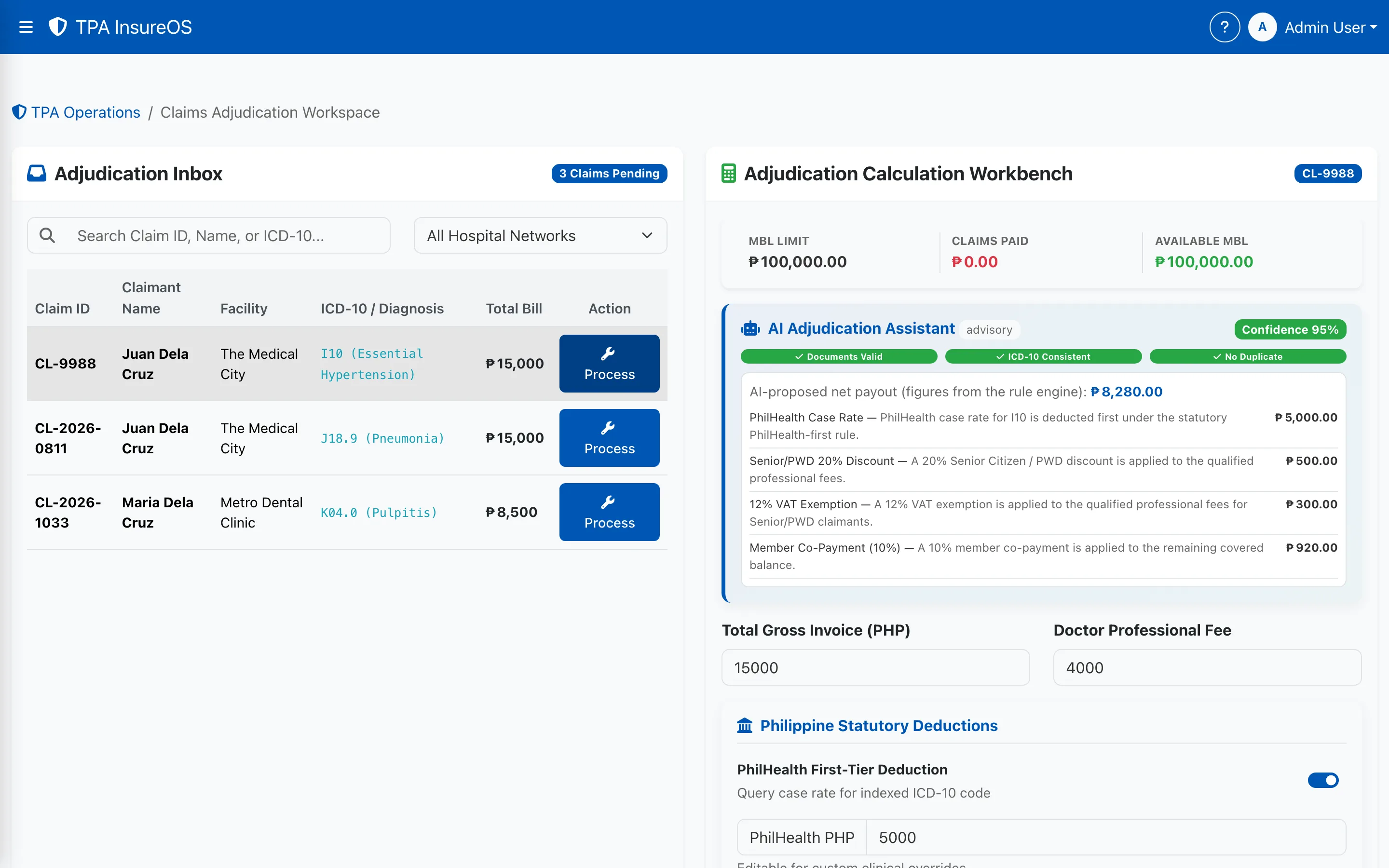
The workbench proposes a settlement — PhilHealth case rate, senior/PWD discount, VAT exemption and co-pay — while an AI assistant scores confidence, validates documents and checks ICD-10 consistency. The adjudicator decides; the math is done.
OCR intake & document audit
Claims arrive from web, mobile photo or partner API. OCR extracts fields with a confidence score, verifies BIR official receipts and indexes ICD-10 — low-confidence values flagged before adjudication.
Clinical pre-authorization
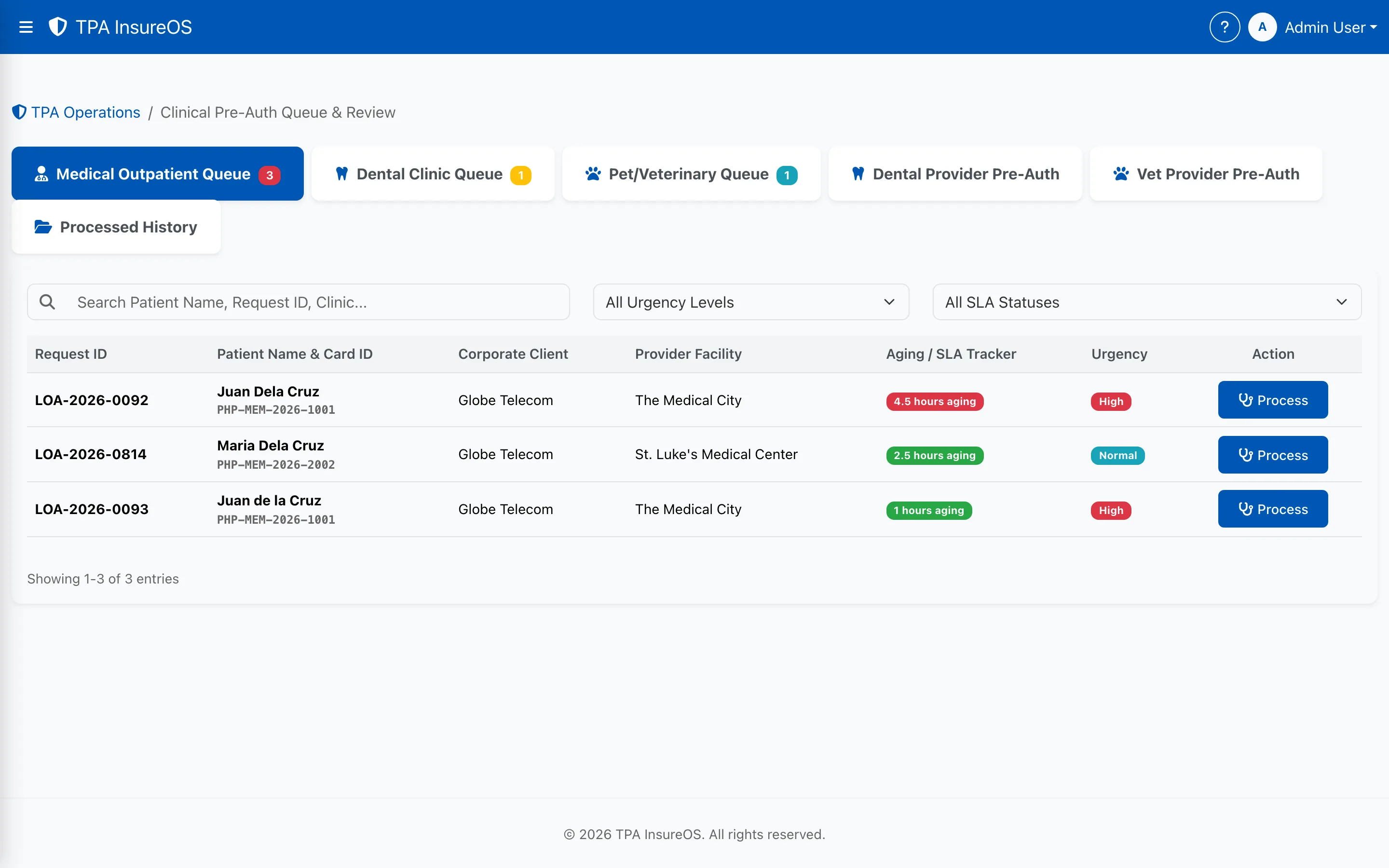
Medical, dental and veterinary LOA requests in one queue with urgency and aging trackers — plus pluggable clinical decision support, so reviewers approve the right cases first, on guideline.
Coordination of benefits
Determine payer sequencing, apply PhilHealth-first offsets and calculate residual member liability for multi-coverage claims — duplicate and secondary-payer logic built in.
Fraud, waste & abuse detection
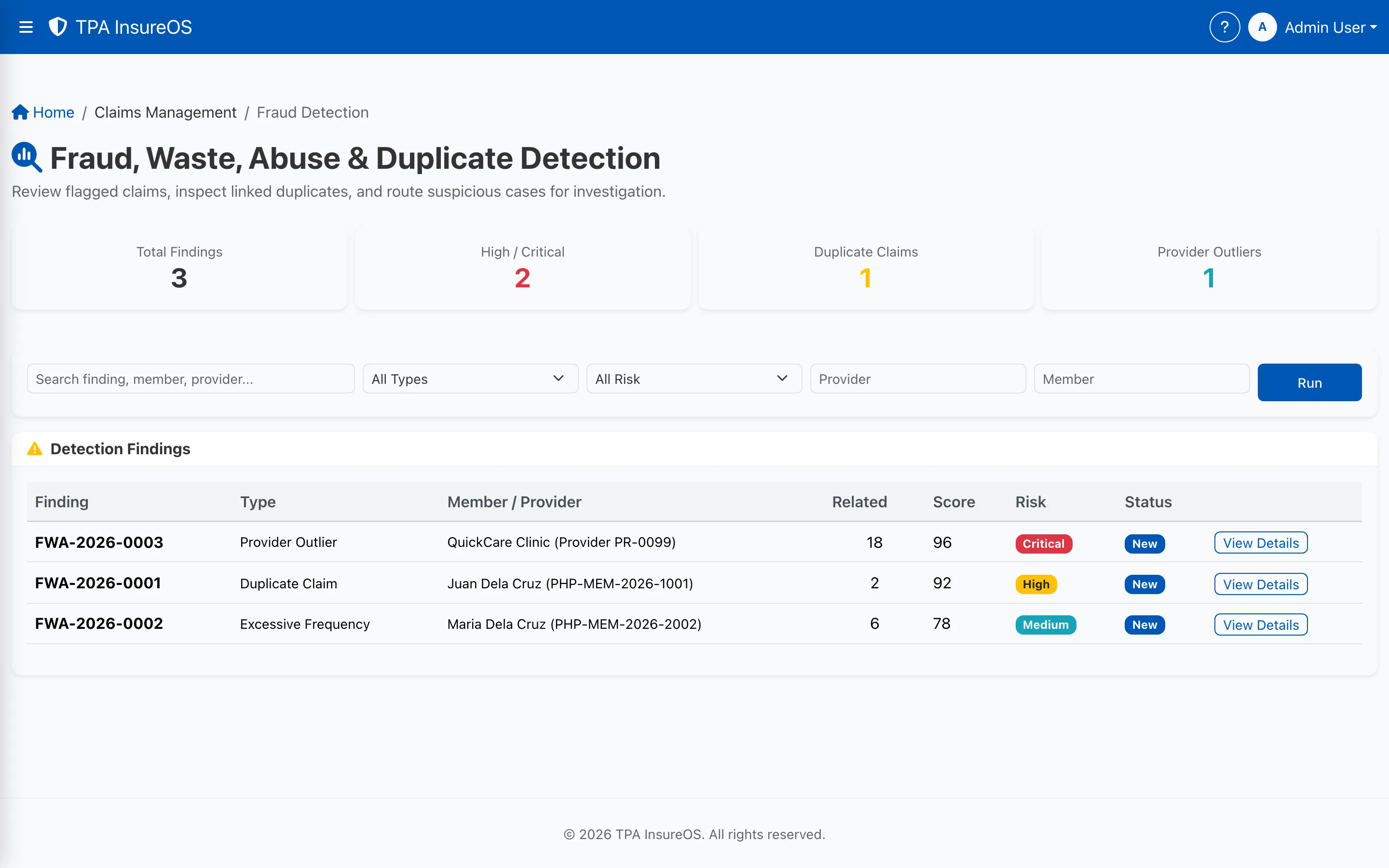
Every finding is scored — duplicate claims, excessive frequency, provider outliers — and routed for investigation before a single peso goes out the door.
Finance, WHT & reconciliation
Settle approved claims against the corporate escrow balance with BIR withholding tax per payee, bulk disbursement over PESONet, and carrier-funds reconciliation — every statement audit-ready.
Member self-service
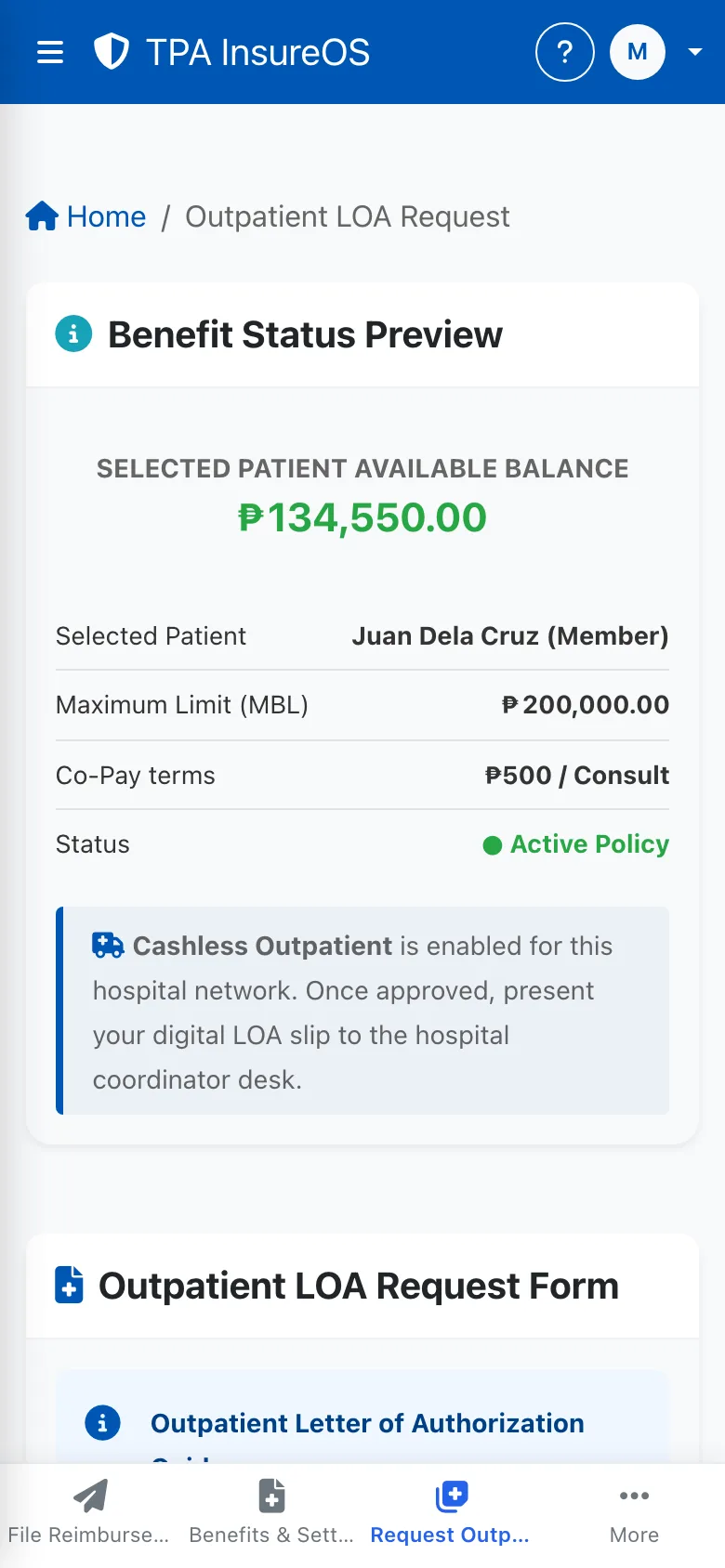
Members request cashless LOAs, file reimbursement claims with their receipts, and track every Explanation of Benefits — with appeals — from an installable web app, no app store needed.
Provider & corporate portals
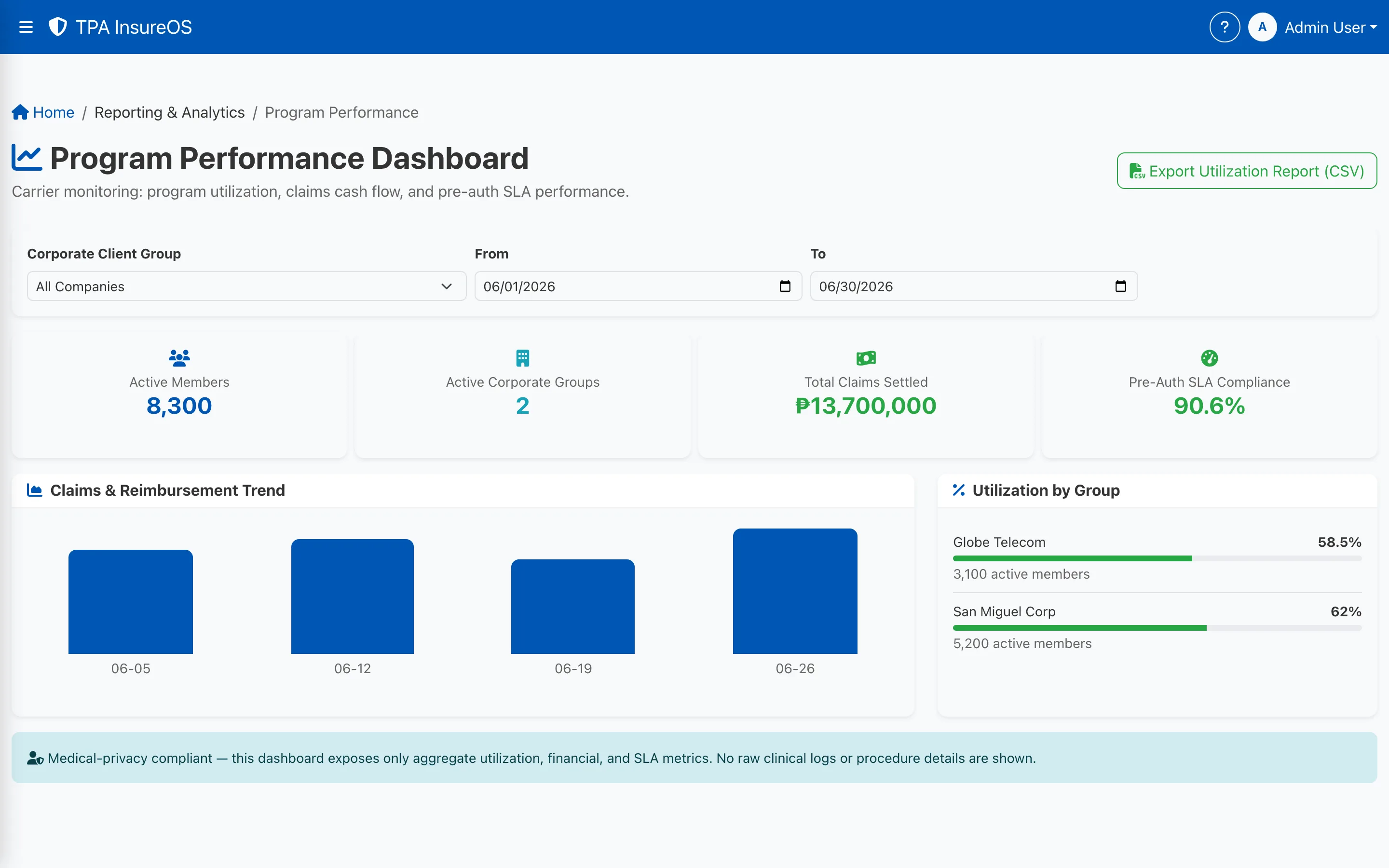
Providers submit direct billing, GOP and inpatient claims with WHT auto-calculated; corporate HR runs enrollment and roster; carriers watch program performance — each in its own workspace.
Workflow rules & SLA engine
Configure adjudication rules, auto-adjudication thresholds, escalations and SLA clocks without a developer — and watch turnaround and queue metrics in operational dashboards.
RBAC, MFA & audit reporting
Nineteen role-scoped workspaces, MFA enforcement and an access-control console — consolidating logs, overrides, exceptions and policy deviations into regulator-ready compliance reports.
What does InsureOS look like?
Real screens from the live demo you can open above. Your own deployment is a separate instance, branded and configured to your operation.
The winning balance of cost and capability
Stacked against the ways Philippine HMOs and TPAs run their claims today.
| Capability | InsureOS Purpose-built for PH | Global claims suite(international vendors) | Generic health SaaS(foreign platforms) | Spreadsheets / email |
|---|---|---|---|---|
| PhilHealth case-rate adjudication | ● Built-in | ✕ Custom build | ✕ Not localized | ✕ Manual |
| AI-assisted settlement & confidence scoring | ● Native | ◑ Add-on | ◑ Varies | ✕ None |
| BIR withholding tax & official-receipt audit | ● Built-in | ✕ Not localized | ✕ No | ◑ Manual |
| Clinical pre-auth: medical, dental & veterinary | ● One queue | ◑ Medical only | ◑ Varies | ✕ None |
| OCR intake & ICD-10 indexing | ● Built-in | ◑ Module | ◑ Generic | ✕ Manual |
| Fraud, waste & abuse detection | ● Risk-scored | ◑ Add-on | ◑ Varies | ✕ None |
| Coordination of benefits (PhilHealth-first) | ● Built-in | ◑ Configurable | ✕ Not localized | ✕ Manual |
| PESONet bulk disbursement & reconciliation | ● Native | ◑ Integration project | ◑ Custom | ✕ Manual |
| Member & provider self-service portals | ● Included | ✕ Separate project | ◑ Varies | ✕ None |
| SLA engine & audit-ready compliance reports | ● Built-in | ● Yes | ◑ Varies | ✕ Error-prone |
| Time to go live | ● Weeks | ✕ 12–24 months | ◑ Months | ● Immediate* |
| Source code ownership & white-label | ● You own & rebrand it | ✕ Vendor-locked | ✕ Vendor's product | ◑ Files only |
| Hosting & data residency control | ● Your infra, any region | ◑ Vendor-defined | ✕ Vendor cloud only | ◑ Your device |
How do you buy InsureOS?
As a licence, or under Outcome-as-a-Service with no upfront CAPEX. What you open above is a demo instance; what you buy is your own separate deployment — under your brand, source-available, and configured to how your operation actually works. UAE rollouts run on UAE-compliant hosting, in the UAE. Under Outcome-as-a-Service, Xamun invests the build, and you pay a per-transaction fee on what the system processes. A slow month is a small invoice; if it does not run, you do not pay.
Where InsureOS fits
See InsureOS on your own numbers
Bring us one workflow and we will show you InsureOS running it.