
BunkerOS — Makes every stem defensible.
The operating system for physical bunker-fuel suppliers and barge operators — AI-assisted nomination intake, live barge-fleet scheduling, an ISO 8217 quality auditor, and a claims-and-disputes workbench that seals a defensible evidence bundle before the dispute even starts. A two-minds design keeps every price, tax line, quality verdict and credit block on a deterministic, versioned rules-pack, with LLM features isolated to drafting and parsing and clearly labelled advisory; a tamper-proof ledger and one-click sealed exports make every stem traceable end to end.
What is BunkerOS?
The operating system for physical bunker-fuel suppliers and barge operators — AI-assisted nomination intake, live barge-fleet scheduling, an ISO 8217 quality auditor, and a claims-and-disputes workbench that seals a defensible evidence bundle before the dispute even starts. A two-minds design keeps every price, tax line, quality verdict and credit block on a deterministic, versioned rules-pack, with LLM features isolated to drafting and parsing and clearly labelled advisory; a tamper-proof ledger and one-click sealed exports make every stem traceable end to end.
Who is BunkerOS for?
BunkerOS is built for bunker supply & barge ops teams in logistics. It is delivered under Outcome-as-a-Service: Xamun invests the build, deploys it on your infrastructure, and you pay per transaction the system processes.
What MARPOL requires of a bunker supplier — and why a trading system cannot evidence it
Under MARPOL Annex VI Regulation 18, every delivery of fuel oil to a ship must be documented by a bunker delivery note declaring that the fuel conforms to Regulation 18.3 and that its sulphur content does not exceed the Regulation 14.1 limit — 0.50% m/m outside emission control areas since 1 January 2020 — together with a retained, sealed MARPOL sample. Since 1 March 2020 carrying non-compliant fuel for use on board has itself been prohibited. The supplier signs that declaration; the supplier is the party a port-state inspection or a quality claim comes back to.
A trading or logistics system records the nomination, the quantity and the price. It does not hold the ISO 8217 quality analysis against the batch that was actually delivered, the chain of custody of the sample, the barge’s tank and line history, or a dispute file assembled before the claim arrives. When a buyer alleges off-spec fuel six weeks later, the supplier who cannot produce that bundle in order is the supplier who settles.
BunkerOS treats the delivery note as the regulated document it is: every price, tax line and quality verdict is computed by a versioned rules-pack, the ISO 8217 auditor runs against the batch, and the claims workbench seals a defensible evidence bundle at delivery — before any dispute starts. In the UAE the supply contract and any vessel claim sit under Federal Decree-Law No. (43) of 2023, and invoices carry VAT at 5% under Federal Decree-Law No. (8) of 2017, applied by the pack rather than typed.
What regulation does BunkerOS handle?
BunkerOS treats the bunker delivery note as the regulated document it is. Under MARPOL Annex VI Regulation 18, every delivery must be documented by a bunker delivery note declaring that the fuel conforms to Regulation 18.3 and that its sulphur content does not exceed the Regulation 14.1 limit — 0.50% m/m outside emission control areas since 1 January 2020 — with a retained MARPOL sample. Fuel quality is audited against ISO 8217. In the UAE, supply contracts and vessel claims sit under Federal Decree-Law No. (43) of 2023 Concerning the Maritime Law, and invoices carry VAT at 5% under Federal Decree-Law No. (8) of 2017. Every price, tax line and quality verdict is computed by a versioned rules-pack, and the GraphIQ compliance layer keeps these rules current as they change.
- MARPOL Annex VI Reg. 18 (BDN)
- MARPOL Annex VI Reg. 14 (0.50% sulphur)
- ISO 8217
- Federal Decree-Law No. 43 of 2023 (Maritime Law)
- UAE VAT — Federal Decree-Law No. 8 of 2017
What can BunkerOS do?
Not a generic logistics platform with a fuel bolt-on. Every module is shaped around how physical bunkering actually works — nomination to cash.
AI-assisted nomination intake
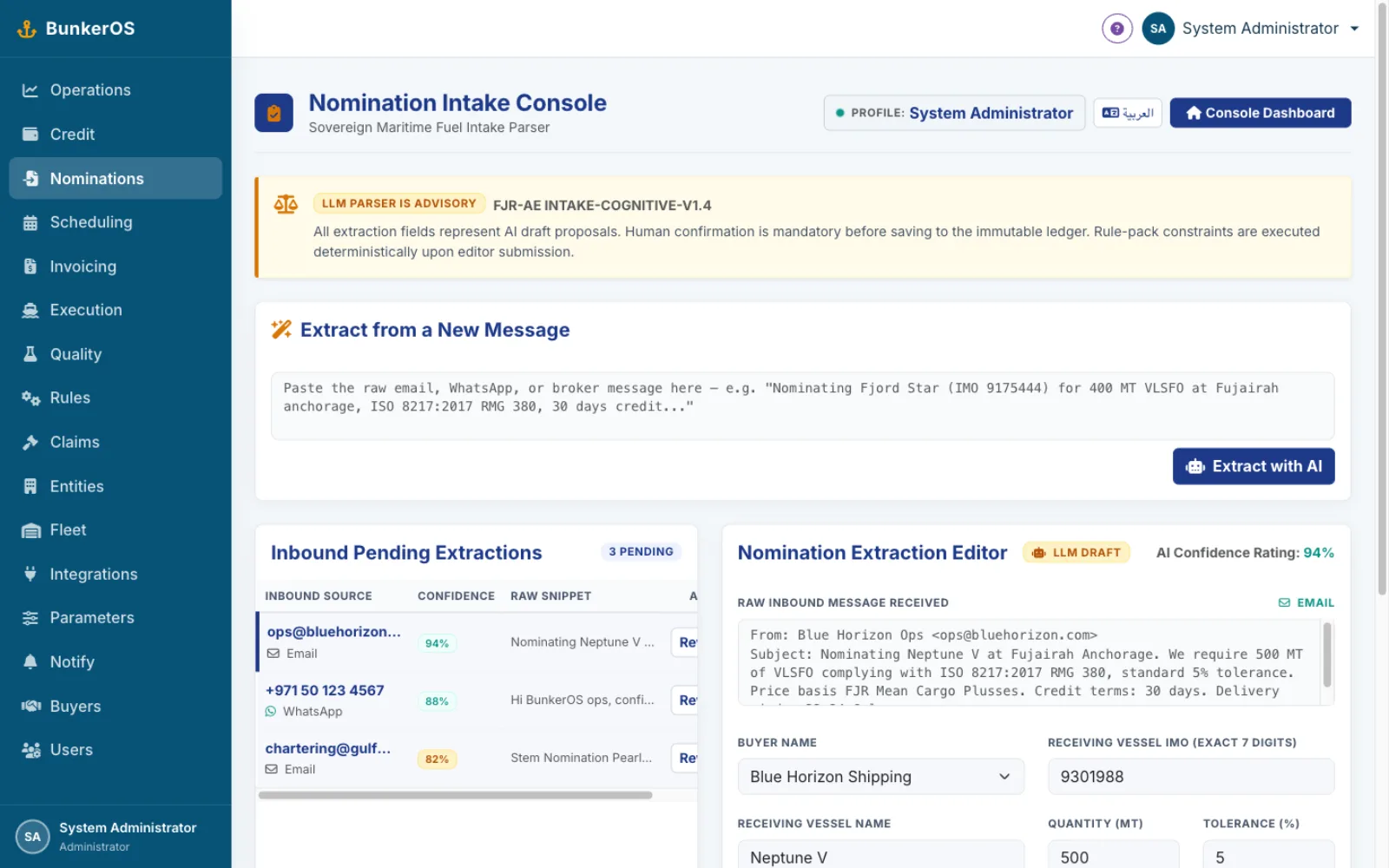
Raw email or WhatsApp messages are parsed into structured nominations — vessel, quantity, ISO grade. Advisory only; nothing touches the ledger until a human confirms it.
Live barge fleet scheduling
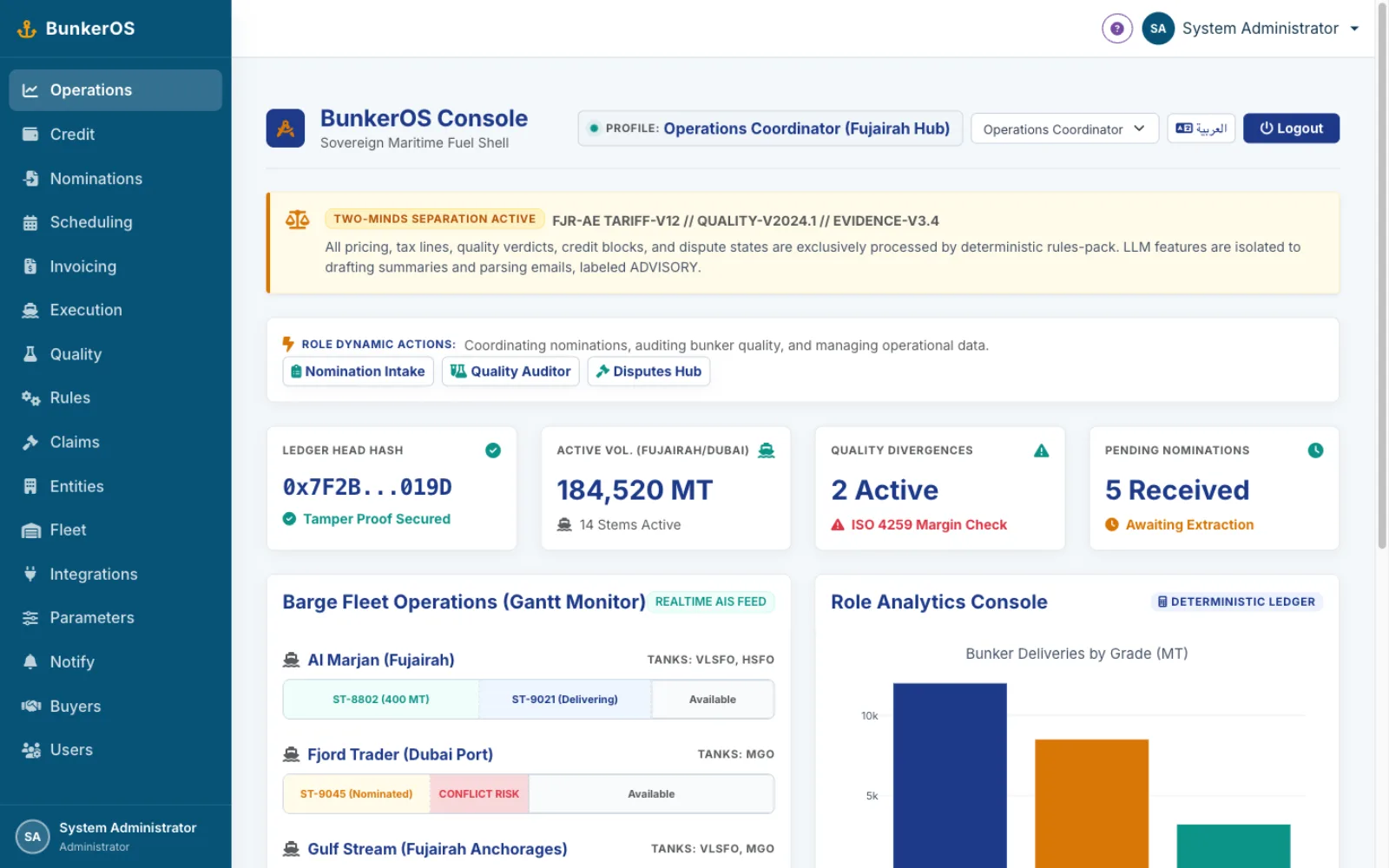
A real-time gantt across every barge and berth, with conflict detection before a nomination collides with an existing stem.
ISO 8217 quality auditor
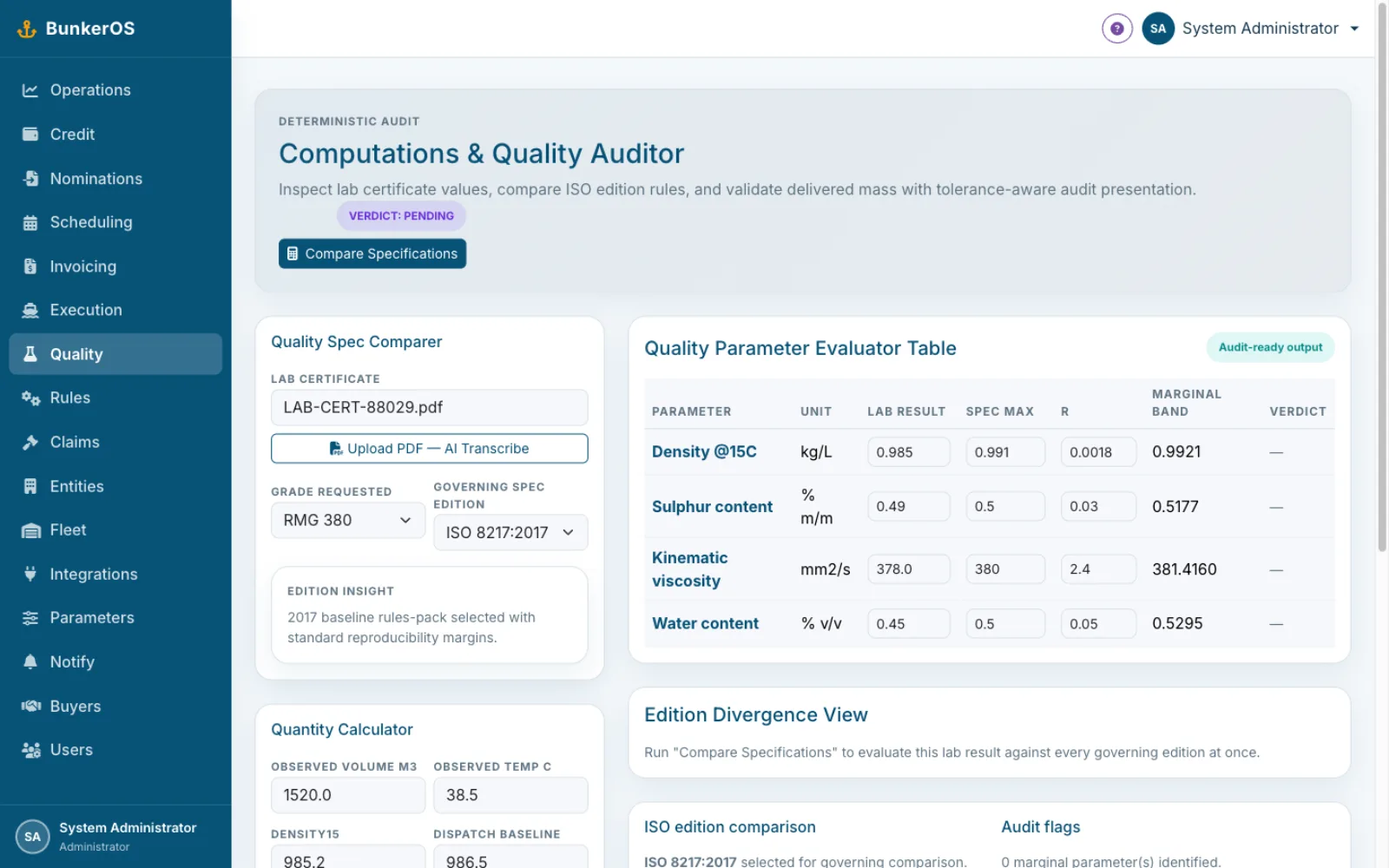
Lab certificate values audited against the governing edition and grade — density, sulphur, viscosity, water — with ISO 4259 reproducibility margins and an edition-divergence view.
Claims & disputes workbench
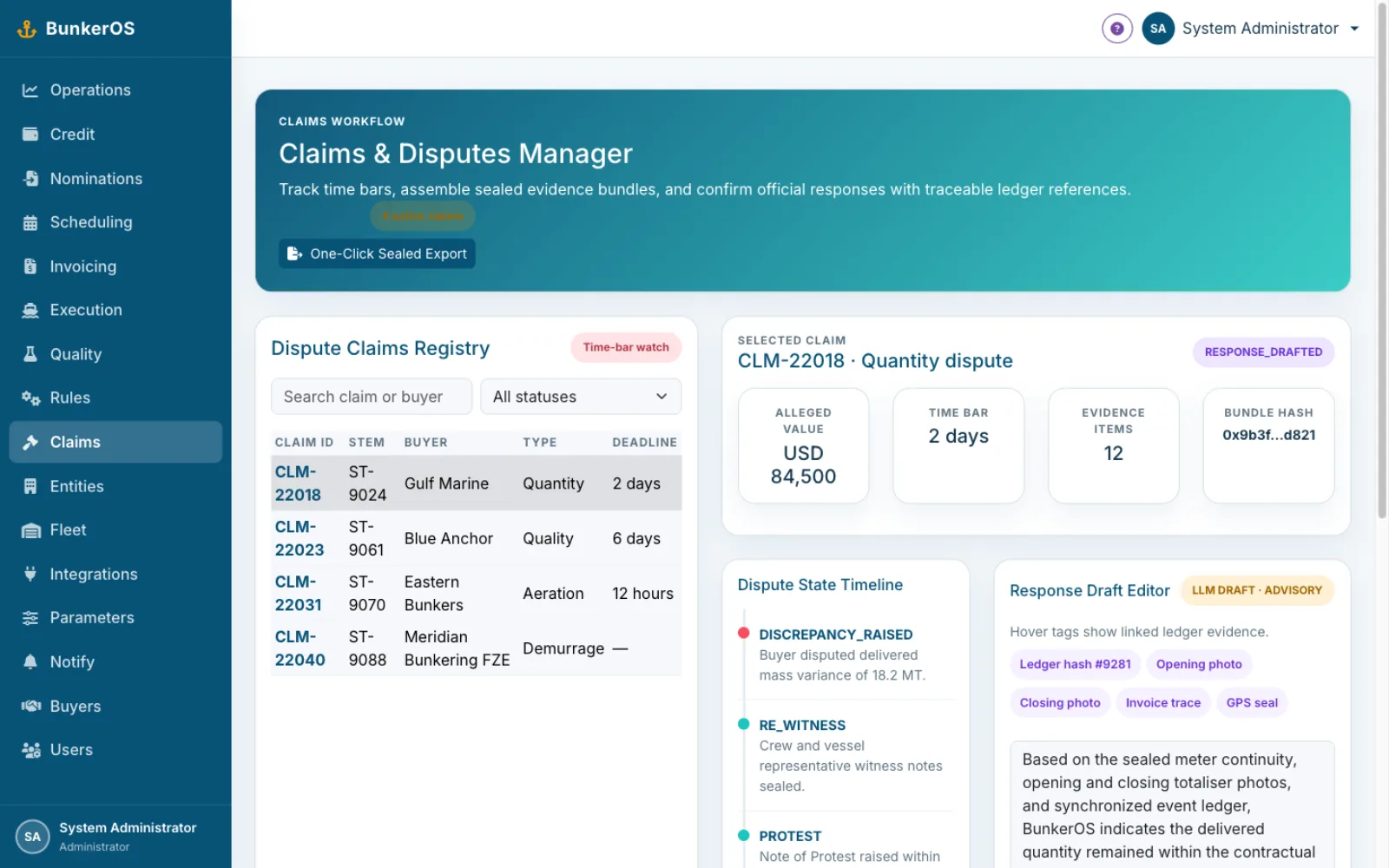
Time-bar tracking, sealed evidence bundles and an advisory response draft the moment a dispute is raised — never the final word, always defensible.
Dual-approved rules-pack governance
Every pricing, tariff and quality rule that governs a calculation is versioned, diffed against the active pack, and requires dual sign-off before it goes live.
Credit & compliance board
Counterparty exposure, credit blocks and compliance status computed deterministically — never left to a spreadsheet formula that silently breaks.
Invoicing & ERP console
Delivery-to-invoice in one flow, itemized and tied back to the ledger entry that created it — reconciles to the cent, on demand.
Buyer portal
Counterparties see their own orders, invoices and claims live, from a mobile-first portal — no phone calls to check delivery status.
Role-based operations
Distinct workspaces for operations, dispatch, credit, claims, finance, barge masters and administrators — each scoped to exactly its job.
What does BunkerOS look like?
Real screens from the live demo you can open above. Your own deployment is a separate instance, branded and configured to your operation.
The winning balance of cost and capability
Stacked against the three ways bunker suppliers run their operations today.
| Capability | BunkerOS Purpose-built for bunkering | Legacy maritime ERP(tanker-fleet suites) | Generic logistics SaaS(global vendors) | Spreadsheets / email |
|---|---|---|---|---|
| ISO 8217 quality auditing, edition-aware | ● Built-in, GraphIQ-backed | ◑ Custom module | ✕ Not localized | ✕ Manual, error-prone |
| AI-assisted nomination intake | ● Built-in, advisory-only | ✕ Not supported | ◑ Generic parsing | ✕ Manual re-typing |
| Claims time-bar & sealed evidence | ● Automatic, ledger-linked | ◑ Manual tracking | ✕ Not supported | ✕ Missed deadlines |
| Dual-approved rules-pack governance | ● Versioned, diffed, dual sign-off | ◑ Custom build | ✕ No | ✕ None |
| Live barge fleet gantt scheduling | ● Built-in, conflict detection | ● Yes | ◑ Generic scheduling | ✕ Manual |
| Mobile-first buyer portal | ● Included | ✕ Separate project | ◑ Varies | ✕ None |
| Deterministic, tamper-proof ledger | ● Immutable, hash-secured | ● Yes | ◑ Varies | ✕ Error-prone |
| Time to go live | ● Weeks | ✕ 12–24 months | ◑ Months | ● Immediate* |
| Source code ownership & white-label | ● You own & rebrand it | ✕ Vendor-locked | ✕ Vendor's product | ◑ Files only |
| Hosting & data residency control | ● Your infra, any region | ◑ Vendor-defined | ✕ Vendor cloud only | ◑ Your device |
How do you buy BunkerOS?
Under Outcome-as-a-Service, with no upfront CAPEX. What you open above is a demo instance; what you buy is your own separate deployment — on your infrastructure, under your brand, source-available, and configured to how your operation actually works. Xamun invests the build, and you pay a per-transaction fee on what the system processes. A slow month is a small invoice; if it does not run, you do not pay.
Where BunkerOS fits
See BunkerOS on your own numbers
Bring us one workflow and we will show you BunkerOS running it.