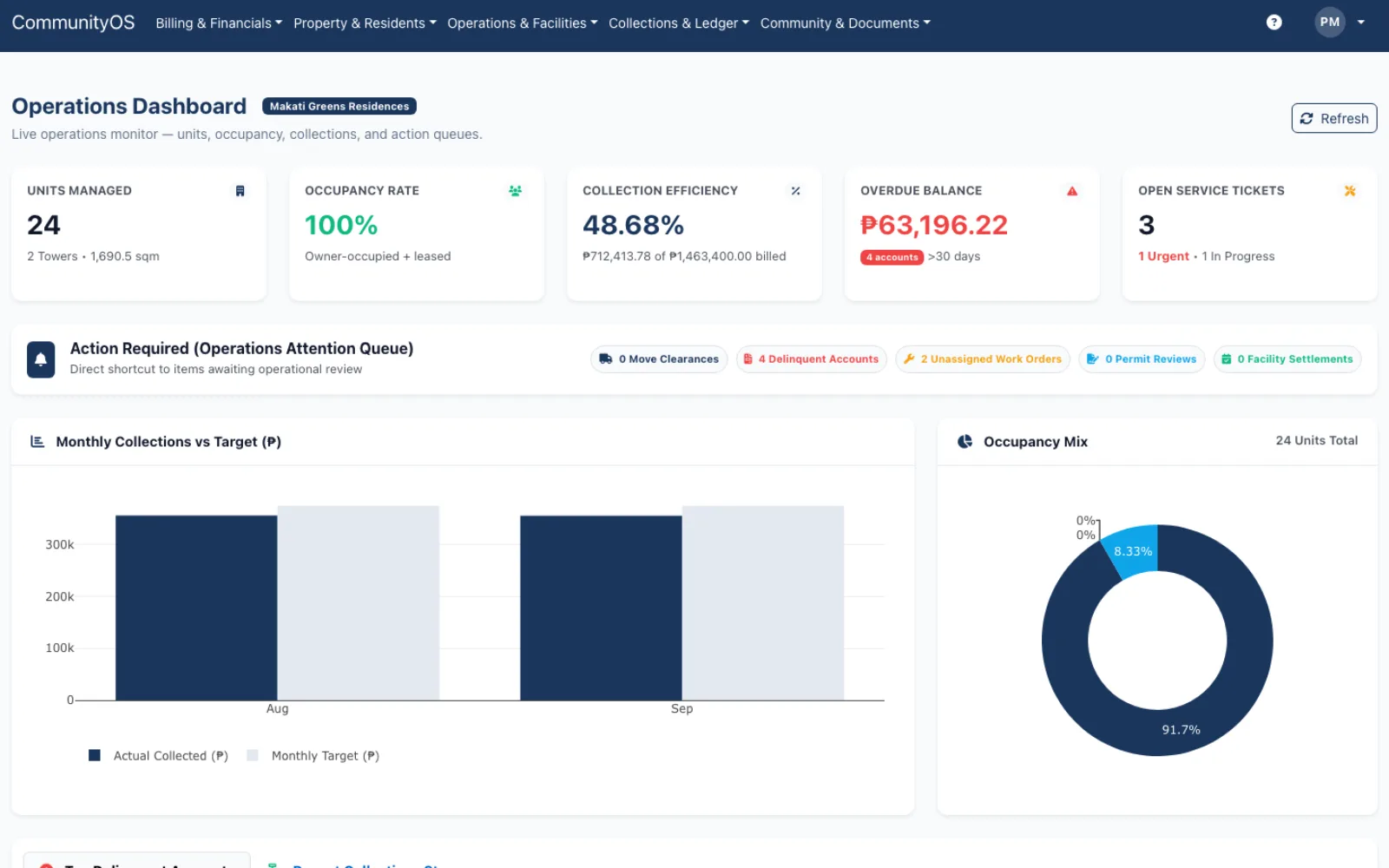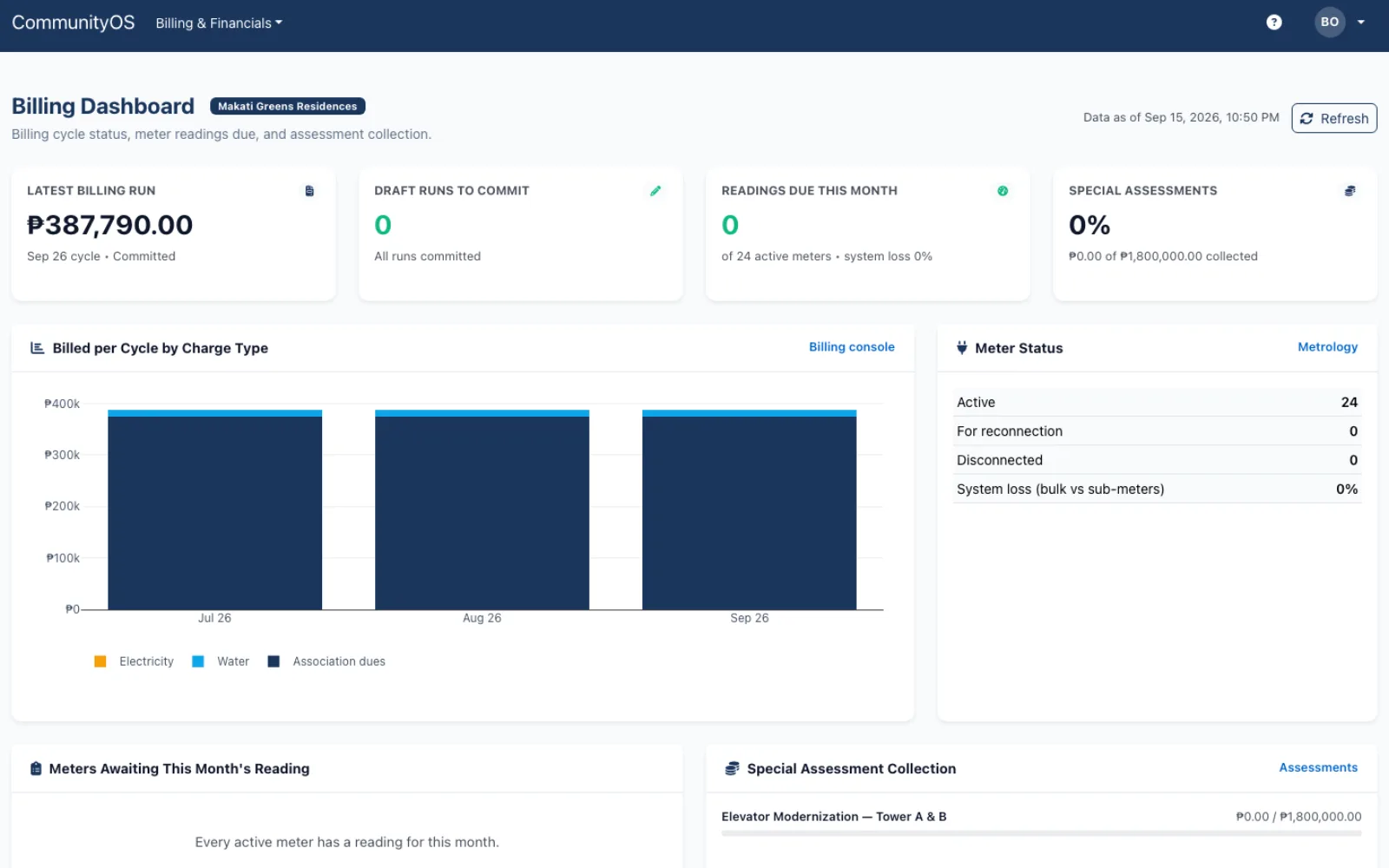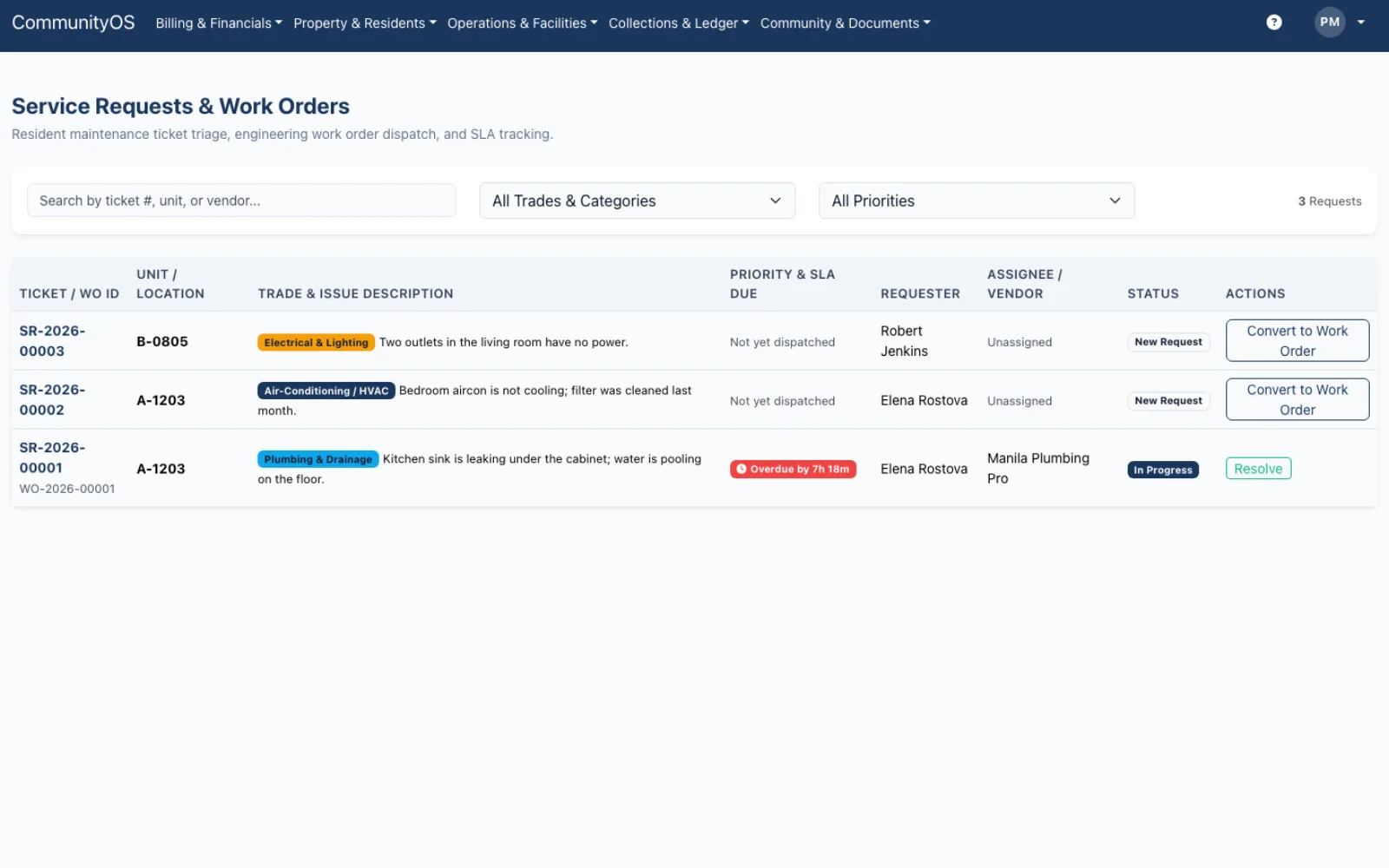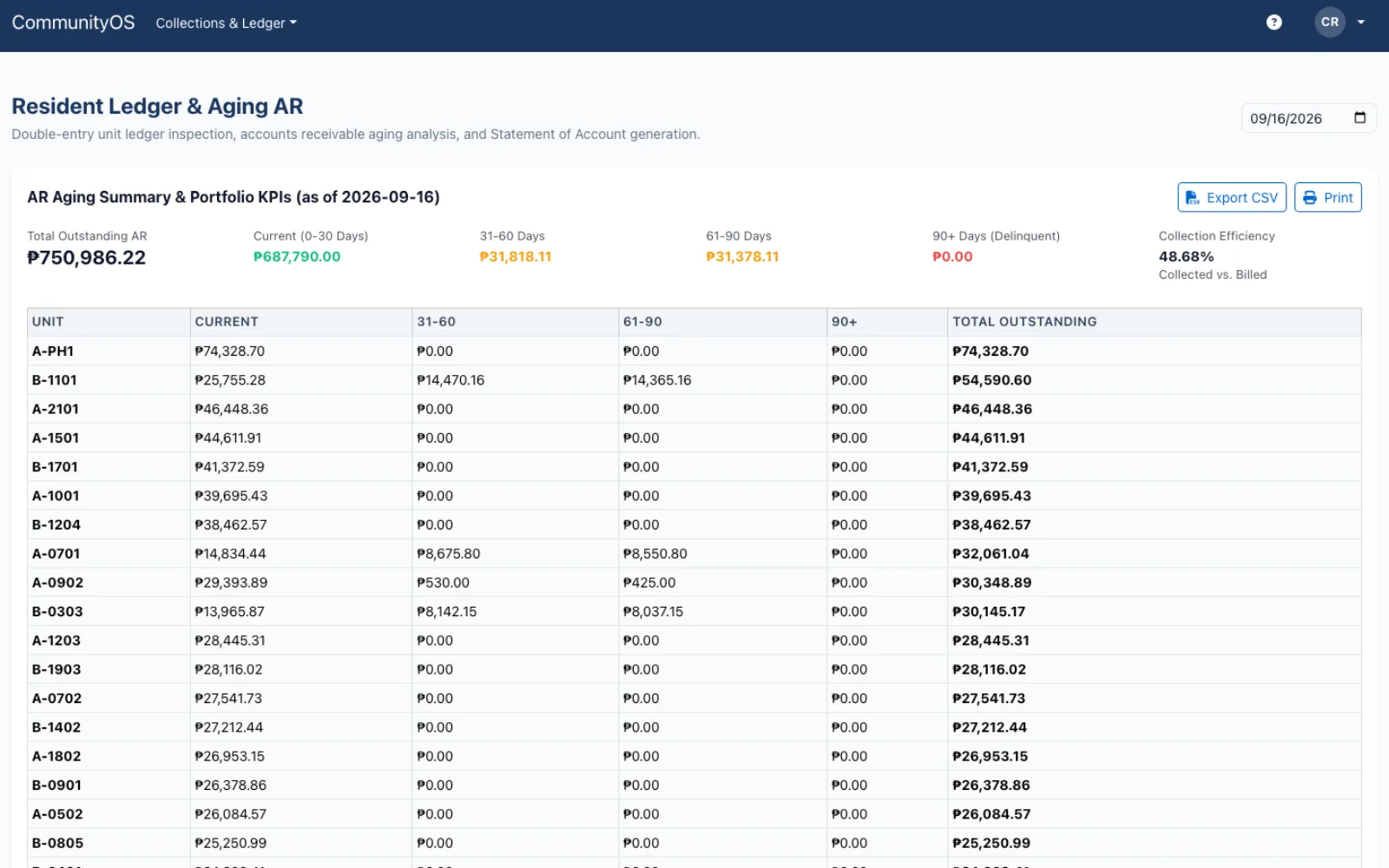
CommunityOS runs the whole association — dues and sub-metered utility billing, receipts, collections and delinquency, service requests, gate passes and the board’s books — for condominium corporations, homeowners and owners associations, and the property managers who serve them. It is built for what a community actually is: many owners, a board that answers to them, and a manager who runs it all under contract — not landlord-style rental software with an HOA bolt-on. The platform is country-neutral and each market’s rules arrive as a country pack. The Philippines pack runs in the live demo today, built around RA 4726 (the Condominium Act), RA 9904 (the Magna Carta for Homeowners), DHSUD HOA rules, BIR official receipts and RA 10173 (the Data Privacy Act); Dubai is the next pack.
CommunityOS runs the whole association — dues and sub-metered utility billing, receipts, collections and delinquency, service requests, gate passes and the board’s books — for condominium corporations, homeowners and owners associations, and the property managers who serve them. It is built for what a community actually is: many owners, a board that answers to them, and a manager who runs it all under contract — not landlord-style rental software with an HOA bolt-on. The platform is country-neutral and each market’s rules arrive as a country pack. The Philippines pack runs in the live demo today, built around RA 4726 (the Condominium Act), RA 9904 (the Magna Carta for Homeowners), DHSUD HOA rules, BIR official receipts and RA 10173 (the Data Privacy Act); Dubai is the next pack.
CommunityOS is built for community & association management teams in real estate, starting with the Philippines, with a Dubai pack next. It is delivered under Outcome-as-a-Service: Xamun invests the build, deploys it on your infrastructure, and you pay per transaction the system processes.
The platform is the same everywhere: units, owners, a board, a manager, billing, receipts, collections, operations and governance. What changes by country is the law those run under, so each market’s rules arrive as a country pack: declarative data, never a branch in the code. The Philippines pack below is what runs in the live demo today, enforced in the workflow rather than documented beside it.
Condominium corporations under RA 4726 and villages under RA 9904 and DHSUD HOA rules. Dues from the board-ratified budget and entitlement share, a controlled BIR official-receipt series, a delinquency ladder that follows the By-Laws, SEC corporate registers, RA 10173 data privacy, peso billing and ECPay-ready payments.
Jointly owned property in Dubai: owners committees and management companies under the Dubai Land Department and RERA. Service-charge budgets gain a regulator-approval step, service-charge monies sit in escrow through the DLD’s collection platform rather than operator-controlled accounts, costs are apportioned by area under the jointly owned property declaration, and billing is in dirhams with English and Arabic, right to left. No code changes for Dubai: only the pack does.
Another market is another pack. The GraphIQ compliance layer holds each pack and keeps it current as the rules change. How GraphIQ works →
Not a rental-management tool with an HOA bolt-on. The core follows how multi-owner communities actually work, and country packs carry the local statutes, receipts and governance rules.
Monthly billing runs with pre-billing validation and an atomic commit. Association dues come from the board-ratified budget and each unit's entitlement share.
Water and electricity meter readings with bulk-versus-sub-meter system-loss tracking, billed on the same statement as the dues.
Post payments against a controlled OR series, then run aging reports, bank deposit batches and void or NSF reversals so every peso reconciles.
Penalties follow your By-Laws. Accounts move from reminder to first notice, final demand, service restriction and legal referral, and every adjustment is audited.
Residents file tickets and staff convert them into work orders for engineering or vendors. SLA timers flag anything overdue before a complaint reaches the board.
Residents pre-register guests and get a QR pass. The guardhouse scans it on a phone, and move-in, move-out and delivery passes go through the same gate.
Owners and tenants see their balance, pay dues, book amenities and read circulars from an installable web app. There's no app store involved, and navigation sits at the bottom like a native app.
Send emergency advisories, water interruptions and AGM notices by in-app, push, email or SMS, track who has read them, and answer residents in two-way threads.
Run many condominium corporations and HOAs from a single console. Each keeps its own data, and a permission matrix gives each role exactly the access its job needs.
Real screens from the live demo you can open above. Your own deployment is a separate instance, branded and configured to your operation.
Property manager, billing officer, collections, board director, security and platform admin. See the operations dashboard, billing runs, delinquency tracking, gate control and the permission matrix working together. Recorded on the live demo you can open above.
Owners and tenants open CommunityOS and see their balance due, a pay button, today’s advisories and the four things they do most: guest passes, service tickets, amenity bookings and their statement of account. It installs to the home screen from the browser, so there is no app store involved.
Compared with the two ways associations run today.
| Capability | CommunityOS Philippines pack live | Generic property SaaS(landlord / rental tools) | Spreadsheets & manual ORs |
|---|---|---|---|
| Dues from a board-ratified budget & entitlement share | ● Built-in | ✕ Flat rent model | ◑ Manual formulas |
| Sub-metered water & electricity billing | ● With system-loss tracking | ◑ Add-on | ✕ Re-keyed readings |
| Controlled official receipt series | ● Built-in | ✕ Not localized | ✕ Paper booklets |
| Budgets by Operating & Reserve fund | ● Built-in | ◑ Single budget | ✕ Error-prone |
| Staged delinquency per By-Laws | ● Reminder → legal referral | ◑ Late-fee only | ✕ Manual letters |
| Service requests, work orders & SLAs | ● Built-in | ● Yes | ✕ Logbook & chat |
| Visitor QR passes & gate control | ● Built-in | ◑ Separate app | ✕ Guard logbook |
| Many corporations under one operator | ● Per-corporation data | ◑ Varies | ✕ One file each |
| Mobile-first resident app | ● Included | ◑ Varies | ✕ None |
| Time to go live | ● Weeks | ◑ Months of workarounds | ● Immediate* |
| Source code ownership & white-label | ● You own & rebrand it | ✕ Vendor's product | ◑ Files only |
| Hosting & data residency control | ● Your infra, any region | ✕ Vendor cloud only | ◑ Your device |
Under Outcome-as-a-Service, with no upfront CAPEX. What you open above is a demo instance; what you buy is your own separate deployment — on your infrastructure, under your brand, source-available, and configured to how your operation actually works. Xamun invests the build, and you pay a per-transaction fee on what the system processes. A slow month is a small invoice; if it does not run, you do not pay.
Bring us one workflow and we will show you CommunityOS running it.