
LoanOS — The lending platform that moves at the speed of life.
Manages the complete loan lifecycle from application to closure with built-in compliance for Philippine regulation — SEC rate caps, CIC credit-bureau integration and AMLA — at SME-appropriate pricing and implementation speed.
What is LoanOS?
Manages the complete loan lifecycle from application to closure with built-in compliance for Philippine regulation — SEC rate caps, CIC credit-bureau integration and AMLA — at SME-appropriate pricing and implementation speed.
Who is LoanOS for?
LoanOS is built for microfinance teams in lending. It is delivered under Outcome-as-a-Service: Xamun invests the build, deploys it on your infrastructure, and you pay per transaction the system processes.
What regulation does LoanOS handle?
LoanOS carries the following regulatory and compliance surface, enforced in the workflow rather than documented beside it. The GraphIQ compliance layer keeps these rules current as they change.
- BIR
- SEC
- PDC
- AMLA
What can LoanOS do?
Origination is the easy part. This is the rest of it — the ledger, the provisioning, the statutory filings and the collections floor — shaped around how regulated lending actually works here.
Term and revolving facilities
The flagship: a real revolving credit line — drawdowns under a hard headroom lock, daily interest on utilisation, commitment fee on the undrawn portion, cycle statements with a Minimum Amount Due, and limit re-availment that waits for the bank to clear. Term loans run alongside, untouched.
SEC rate caps, as data
Nominal, EIR, penalty and total-cost ceilings are effective-dated parameters under maker-checker — not constants in someone’s code. Tighten a cap and every product is re-audited; a non-compliant product cannot be saved or activated.
Decisioning with champion-challenger
Policy knock-outs, a versioned scorecard engine and auto-approve / refer / decline bands — plus live A/B traffic splits. Assignment is a deterministic hash, so a re-score never changes a decision, and a challenger cannot be promoted on a cohort too thin to mean anything.
PFRS 9 ECL provisioning
Stage 1/2/3 classification with SICR overlays, effective-dated PD/LGD/EAD tables, monthly provisioning runs that post reverse-and-repost journals, and a movement schedule that ties. Credit lines price EAD as outstanding + CCF × undrawn.
A real general ledger
Five-class chart of accounts, multi-line journal vouchers that cannot post out of balance, event-to-GL mapping with an execution log, period close, trial balance, and off-balance-sheet memorandum accounts for PDCs and pledged mortgages — held out of the statutory books by design.
BIR-ready books
CAS electronic books of accounts, borrower subsidiary ledgers, Form 2307 certificates and tax alphalists — each export hashed into an append-only register. Layouts still awaiting an official spec say so on the face of the file rather than pretending.
Collections that route themselves
PAR-banded worklists, a dialing workbench with promises-to-pay and automatic reminders, capacity-capped queue assignment rules, external agency endorsement with commission accounting, and BP 22 notices with the statutory five-banking-day clock.
PDC vault to clearing
Intake QC that rejects a defective cheque before the borrower leaves, barcode-sealed custody with dual control, banking-day presentment, clearing ingestion with return-reason classification, and a legal evidence pack for prosecution.
Compliance as plumbing
CIC and AMLA reporting, an immutable audit log, branch-scoped row-level access, per-role MFA policy, and a Data Privacy consent ledger whose erasure workflow masks PII while proving the money trail is byte-for-byte intact.
What does LoanOS look like?
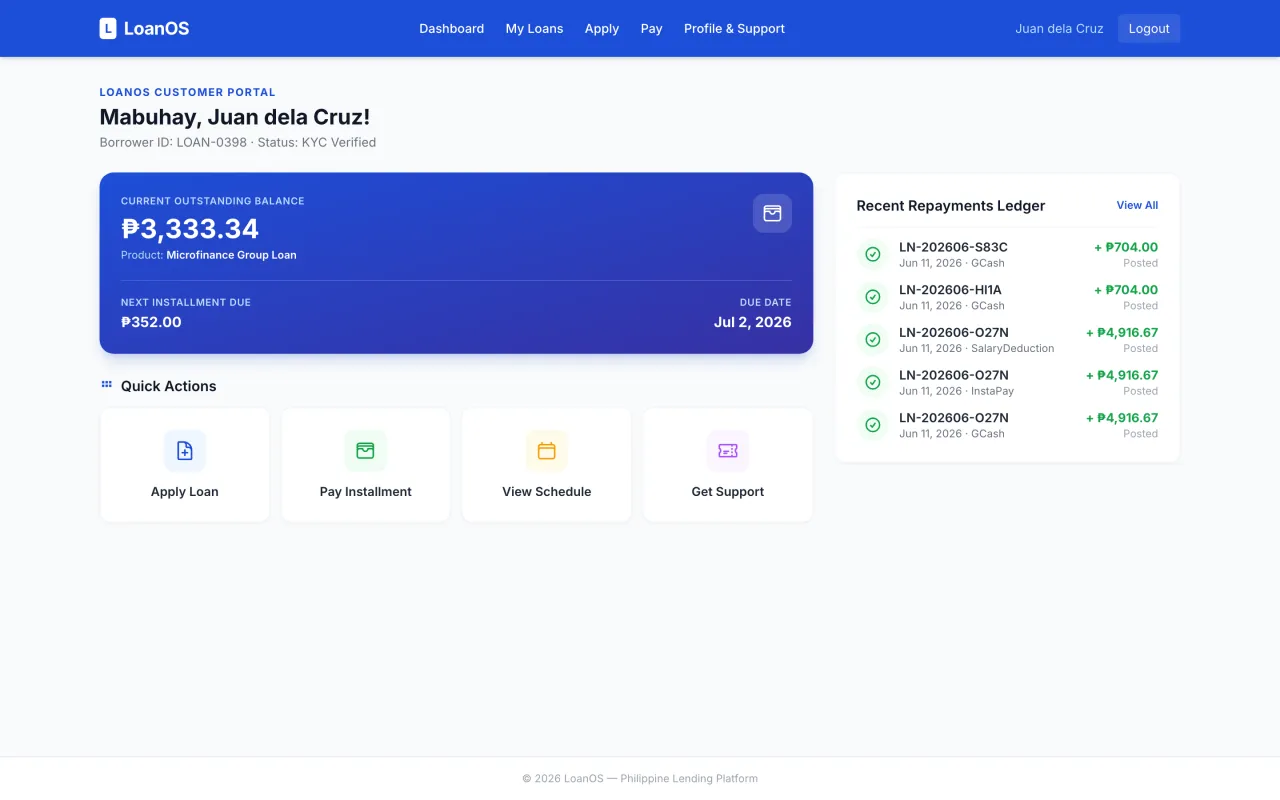
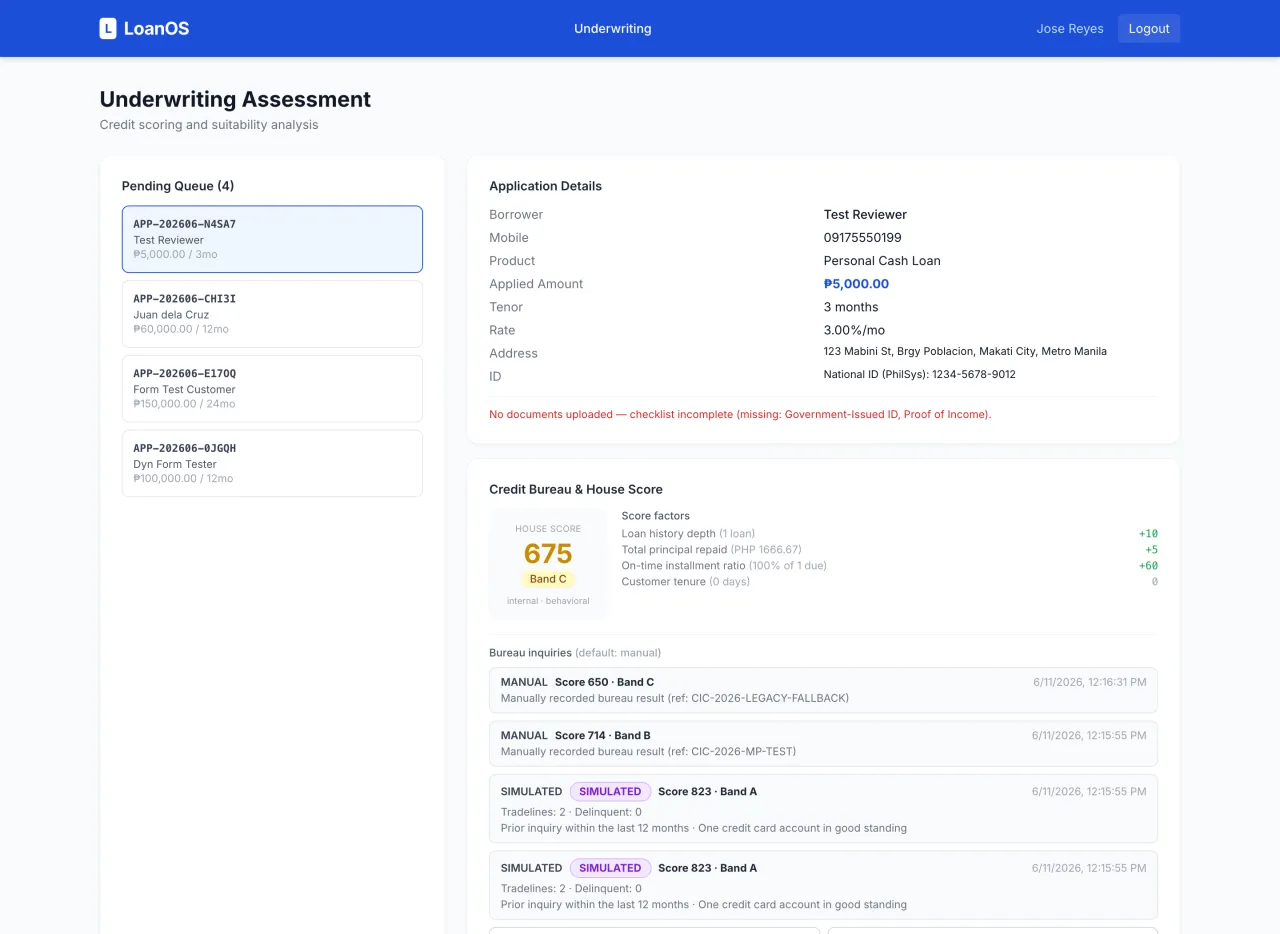
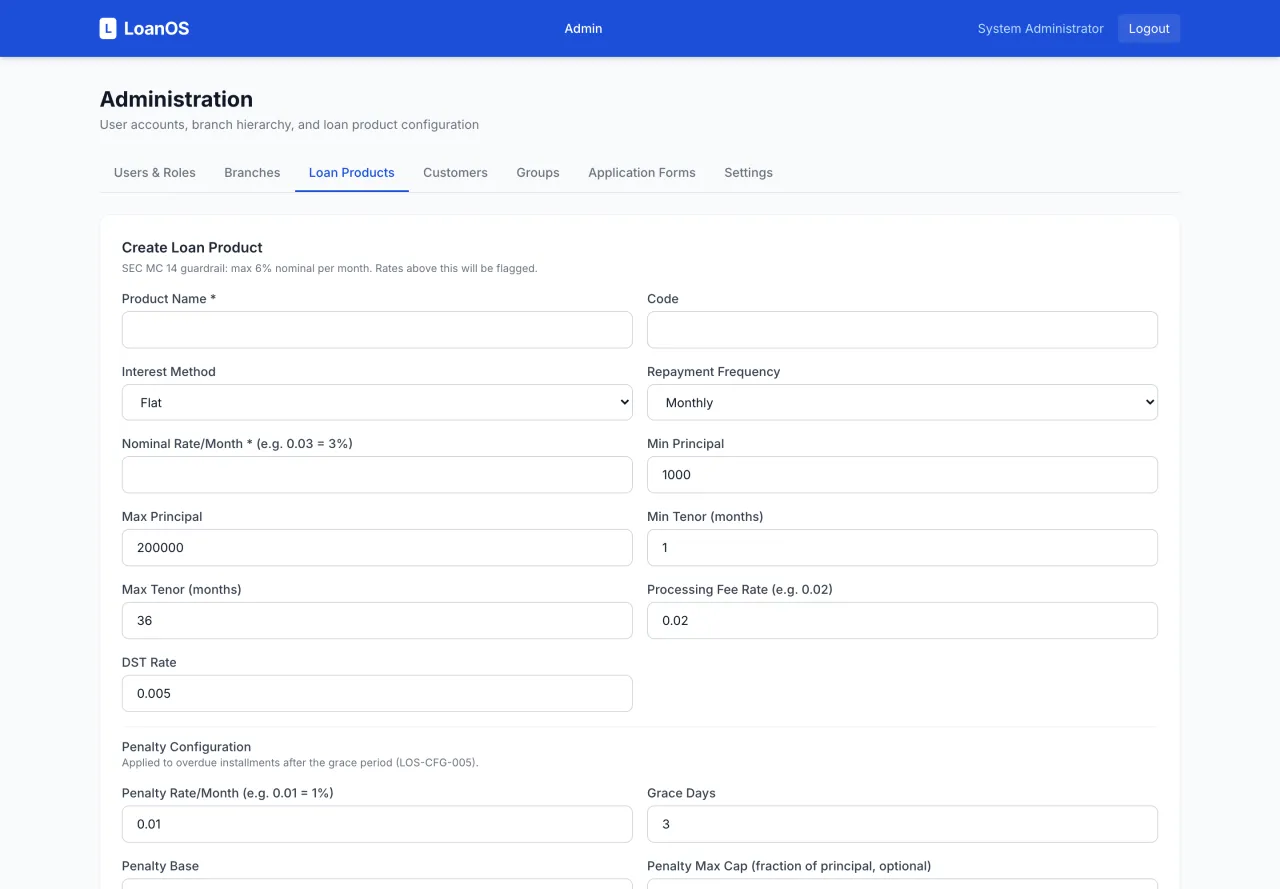
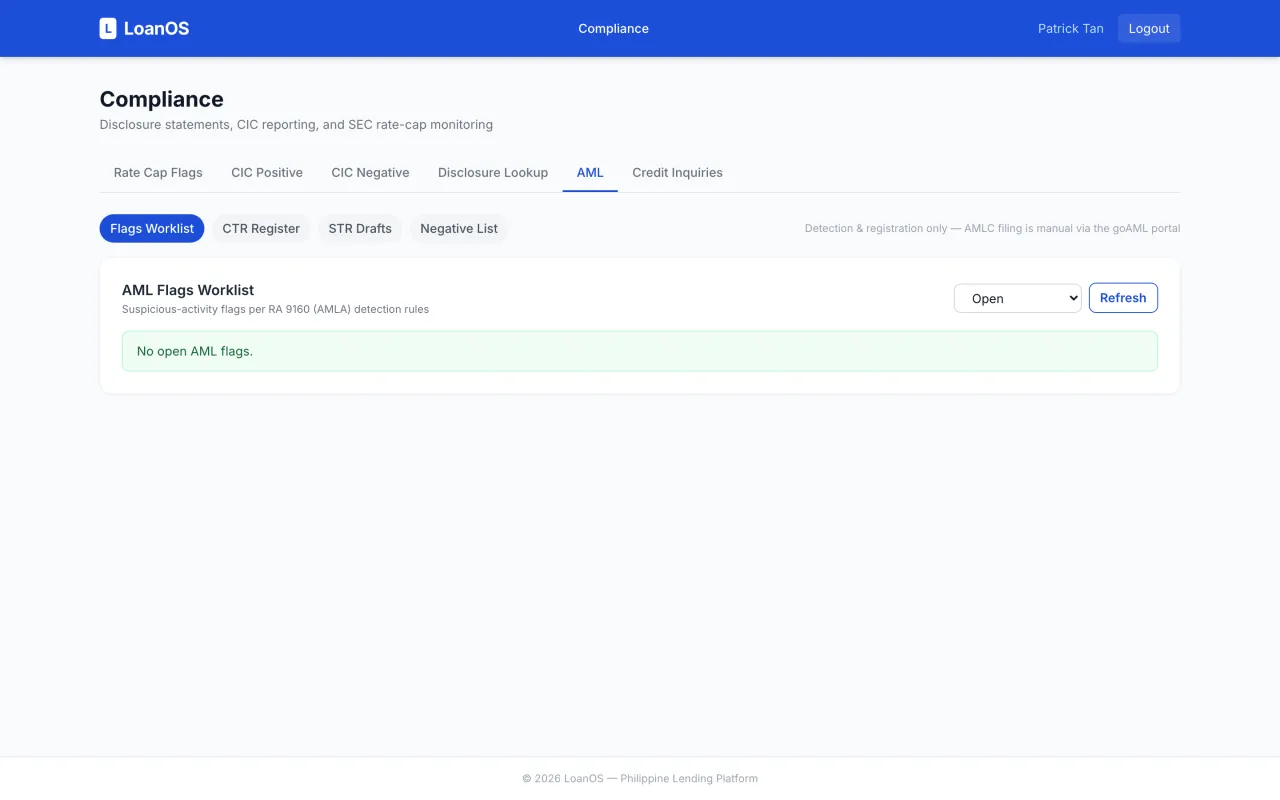
Real screens from the live demo you can open above. Your own deployment is a separate instance, branded and configured to your operation.
The winning balance of cost and capability
Stacked against the four ways Philippine lenders run their books today.
| Capability | LoanOS Purpose-built for PH | Core banking suite(Temenos / FLEXCUBE) | Foreign lending SaaS(global vendors) | Spreadsheets / in-house |
|---|---|---|---|---|
| SEC MC 14 rate-cap guardrails | ● Built-in | ✕ Custom build | ✕ Not localized | ✕ Manual |
| CIC credit-bureau integration | ● Native driver | ◑ Add-on | ✕ Not supported | ✕ None |
| AMLA / goAML & UN sanctions | ● Built-in | ◑ Module | ◑ Generic | ✕ Manual |
| Truth-in-Lending (RA 3765) disclosures | ● Auto-generated | ◑ Configurable | ✕ Not localized | ✕ Manual |
| BIR DST & PH fee handling | ● Configurable | ◑ Custom | ✕ No | ◑ Manual |
| Group / microfinance & field collection | ● Built-in | ◑ Limited | ◑ Varies | ✕ None |
| GCash / Maya / InstaPay & salary deduction | ● Native | ◑ Integration project | ◑ Custom | ✕ Manual |
| Double-entry GL ledger & audit trail | ● Immutable | ● Yes | ◑ Varies | ✕ Error-prone |
| Mobile-first borrower PWA | ● Included | ✕ Separate project | ◑ Varies | ✕ None |
| Time to go live | ● Weeks | ✕ 12–24 months | ◑ Months | ● Immediate* |
| Revolving credit lines & drawdowns | ● Flagship | ✕ Costly module | ✕ Term loans only | ✕ Impossible |
| PFRS 9 ECL staging & provisioning | ● Built-in | ● Enterprise tier | ✕ Not localized | ✕ Manual |
| Chart of accounts & journal vouchers | ● Built-in | ● Built-in | ✕ Export only | ✕ Manual |
| BIR CAS books & Form 2307 | ● Built-in | ✕ Custom build | ✕ Not localized | ✕ Manual |
| Champion-challenger decisioning | ● Built-in | ● Enterprise tier | ✕ Add-on | ✕ Impossible |
| Collector queues, PTP & agency endorsement | ● Built-in | ✕ Custom build | ✕ Add-on | ✕ Manual |
| PDC vault, clearing & BP 22 evidence | ● Built-in | ✕ Custom build | ✕ Not localized | ✕ Manual |
| Data Privacy consent ledger & erasure | ● Built-in | ✕ Custom build | ✕ Partial | ✕ Manual |
| Source code ownership & white-label | ● You own & rebrand it | ✕ Vendor-locked | ✕ Vendor's product | ◑ Files only |
| Hosting & data residency control | ● Your infra, any region | ◑ Vendor-defined | ✕ Vendor cloud only | ◑ Your device |
How do you buy LoanOS?
Under Outcome-as-a-Service, with no upfront CAPEX. What you open above is a demo instance; what you buy is your own separate deployment — on your infrastructure, under your brand, source-available, and configured to how your operation actually works. Xamun invests the build, and you pay a per-transaction fee on what the system processes. A slow month is a small invoice; if it does not run, you do not pay.
Where LoanOS fits
See LoanOS on your own numbers
Bring us one workflow and we will show you LoanOS running it.