

Can a recruitment agency charge Filipino nurses a placement fee, and how does an agency prove it didn’t?
For the UK, no. Philippine rules cap a placement fee at one month’s basic salary and ban it where the destination does not allow recruitment fees. The UK–Philippines agreement on healthcare recruitment bars any fee from nurses, and UAE law bars employers from passing recruitment costs to workers. The proof is a per-candidate cost ledger, kept as the work happens.
This explainer is for licensed Philippine recruitment agencies that deploy nurses and allied health professionals, and for the UK and UAE employers that hire through them. It sets out what each side’s rules actually say, with the document and its date, and then the records that let an agency show, candidate by candidate, that nobody paid for the job.
What does the Philippine rule say about placement fees?
The rule sits in the 2023 DMW Rules and Regulations Governing the Recruitment and Employment of Landbased Overseas Filipino Workers, issued by the Department of Migrant Workers as Department Circular No. 01 on 9 June 2023. The Department itself was created by Republic Act No. 11641, the Department of Migrant Workers Act, signed on 30 December 2021 and in effect from 3 February 2022. It took over the work of the Philippine Overseas Employment Administration (POEA).
Section 56 says a placement fee may be charged to the worker equal to one month’s basic salary in the DMW-approved contract, except for two groups:
- domestic workers; and
- workers deployed to countries where the prevailing system, by law, policy or practice, does not allow the charging and collection of recruitment or placement fees, directly or indirectly.
Where a fee is allowed, the worker pays it only after signing the DMW-approved contract, and the agency must issue a BIR-registered receipt stating the date, the purpose and the exact amount. The 2016 Revised POEA Rules, which the 2023 rules replaced, said the same in their Section 51.
What the nurse pays, and what the employer pays
The rules also split every other cost. Section 55 lists the only costs the worker pays: personal documentation (passport; NBI, police or barangay clearance; PSA birth certificate; school records certified by CHED and authenticated by the DFA; the PRC professional licence; a TESDA certificate where the job needs one; the DOH-prescribed medical) and membership of PhilHealth, Pag-IBIG and the SSS. Section 58 puts the costs of recruitment and placement on the employer: the visa and its stamping fee, the work and residence permits, round-trip airfare, transport from the airport to the jobsite, the DMW processing fee, OWWA membership, and any extra trade test the employer asks for. Section 59 says no other fee of any kind may be charged to the worker, and Section 60 says the agency’s service fees are charged to the employer.
What happens to an agency that charges anyway
Section 139 lists both “charging or collecting placement fees for deployment to countries where the prevailing system, as determined by the Department, does not allow” it, and passing to the worker costs that only the employer should bear, as serious offences, punishable by cancellation of the licence. Charging more than the allowable fee is a less serious offence, punished by suspension.
Note the phrase “as determined by the Department”. Which destinations count as no-fee countries is the DMW’s call, set out in its advisories. In September 2024, for example, it issued an advisory naming Qatar a non-placement-fee country. Check the current list with the DMW before you quote a corridor to a candidate.
Can a Filipino nurse be charged a fee for a UK job?
No. Two documents say so directly, and a UK statute sits behind them.
The government-to-government agreement. The Philippines and the UK signed a new memorandum of understanding on the recruitment of Filipino healthcare professionals in October 2021 (published on GOV.UK on 11 November 2021). Paragraph 4 says that no employer, recruitment or placement agency or any other entity shall collect any placement fee, the agency’s costs or other fees, directly or indirectly, from any nurse or healthcare professional to be deployed, where that contravenes either country’s laws. The same paragraph ties recruitment to each country’s published codes of practice for ethical recruitment. The MOU runs for three years and renews itself unless either side gives notice.
The Code of Practice. The Department of Health and Social Care’s Code of practice for the international recruitment of health and social care personnel in England (last updated 27 March 2025) sets a benchmark that international health and social care personnel will not be charged fees for recruitment services. Recruiters build their costs into the fee they charge employers, and employers and contracting bodies should not contract recruiters that charge candidates. The code applies to UK health and social care employers, public and independent, and to the agencies that supply them, which should be on the ethical recruiters list that NHS Employers keeps.
The statute. The code notes that it is illegal under section 6(1) of the Employment Agencies Act 1973 for a recruiter in Great Britain to charge work-finding fees to job seekers.
Is the Philippines on the red list?
No. The code grades countries red, amber or green. Red countries come from the WHO Health Workforce Support and Safeguards List 2023, and there must be no active recruitment from them. Amber countries may be recruited from only under the terms of a government-to-government agreement. The Philippines is listed in the code’s Annex B as a green country with a government-to-government agreement, and the code’s own case study describes the long-standing UK–Philippines bilateral arrangement and the October 2021 MOU.
What a UK employer can and cannot claw back
The code allows a repayment clause in the employment contract, set out clearly in writing, to recover some upfront costs if the recruit leaves early. Only proportionate, evidenced costs the employer actually paid can be reclaimed, such as relocation, visa and regulatory exam fees, and the amount should taper: the code’s example is up to 100% in the first 12 months, 50% in months 13 to 24, 25% in months 25 to 36, and nothing after 36 months. Costs the employer is liable for as part of recruitment, such as the agency fee and the sponsor licence fee, must not be reclaimed. A clawback of the agency fee is a placement fee by another name.
What does UAE law say about recruitment fees?
The UAE’s private-sector labour law is Federal Decree-Law No. 33 of 2021 Regarding the Regulation of Employment Relationships, in force since 2 February 2022 and administered by the Ministry of Human Resources and Emiratisation (MOHRE). Article 6(4) prohibits the employer from charging the worker the fees and costs of recruitment and employment, or collecting them from the worker, directly or indirectly. Article 6(3) says only a MOHRE-licensed business may recruit or place workers in the UAE.
Two limits matter for nurses. First, Article 3 applies the law to the private sector and excludes employees of federal and local government entities, so a nurse hired by a government hospital sits under that employer’s own rules. Second, the article binds the employer; the Philippine side binds the agency. An agency deploying to the UAE answers to both: Section 58 of the DMW Rules puts the visa, permits, airfare and processing costs on the employer in every corridor, and whether the UAE is on the DMW’s current no-placement-fee list is a question for the DMW.
The rules side by side
| Question | Philippines (DMW) | UK | UAE |
|---|---|---|---|
| Placement fee from the nurse? | Up to one month’s basic salary, except domestic workers and no-fee destinations (Section 56) | None (MOU para 4; Code of Practice; Employment Agencies Act 1973 s6(1)) | Employer may not charge or collect recruitment costs (Decree-Law 33/2021, Art. 6(4)) |
| Who pays the agency? | The employer, as service fees (Section 60) | The employer; recruiter costs sit in the employer fee (Code) | The employer bears recruitment costs (Art. 6(4)) |
| Visa, permits, airfare | Employer (Section 58) | Employer may pay; may sit in a tapered repayment clause (Code) | Part of recruitment and employment costs |
| Nurse’s own costs | Personal documents, medical, PhilHealth, Pag-IBIG, SSS (Section 55) | Not set out for the candidate; agency and sponsor fees never reclaimable | Not set out in Art. 6 |
| Penalty | Licence cancellation (Section 139, serious offences) | Report to the Employment Agency Standards Inspectorate; removal from the ethical recruiters list | Fines under the Decree-Law |
Summarised in our words from the documents listed under Sources. The documents are the authority.
What evidence should an agency keep?
Every one of these rules is about money that should never move from the candidate to the agency or the employer. A sworn statement at the end proves very little on its own. What holds up is a record built while the work is done, that an employer’s compliance team or the DMW can trace back to a receipt or a contract. Five records do most of the work.
1. A fee ledger per candidate
One line for every cost in the candidate’s deployment: what it was, the step it belongs to, the amount, the date, and who paid it, whether agency, employer or candidate. Lines the candidate paid should map to a category Section 55 allows, with the receipt attached. A placement-fee line for a UK nurse should not exist, and the ledger should show it as zero rather than leave it blank.
2. The signed declarations
A declaration signed by the candidate that they paid no placement fee and no other charge to the agency, its staff or anyone acting for it, and the employer’s matching confirmation that it pays the agency’s fee. Keep them, but treat them as the summary of the ledger, not a replacement for it.
3. The employer-pays contract
The service agreement between the agency and the employer, showing that the employer pays the agency’s service fee and the costs Section 58 assigns to it. For UK hires, keep the employment contract’s repayment clause too, so anyone can check that it only covers costs the code allows and that it tapers.
4. Receipts for what the candidate did pay
Where a candidate pays for their own documents or medical, keep the receipt from the issuing body or clinic. Where any fee is allowed and paid to the agency in a fee-charging corridor, the BIR-registered receipt Section 56 requires, dated after the contract was signed.
5. An audit trail
Who recorded each cost, who changed it, when, and why. An unexplained edit to a payer field is exactly what an auditor will ask about. Status changes on the deployment itself belong in the same trail.
Where DeployOS Health fits
DeployOS Health is Xamun’s deployment system for licensed agencies placing nurses and allied health professionals from the Philippines in the UK, the UAE and Saudi Arabia. On the no-fee question, its product page describes three things:
- Every cost has a payer. Each step’s cost is recorded with who bears it (agency, employer or candidate) as the corridor pack for that destination declares, and any override is recorded and explained.
- The attestation comes from the ledger. The no-fee attestation is generated from the cost ledger itself, rather than written afterwards, and the candidate sees the same cost statement on their phone, with a zero candidate share shown rather than asserted.
- An audit trail for every change. Status changes, overrides and corridor-pack migrations are logged with who made them and when.
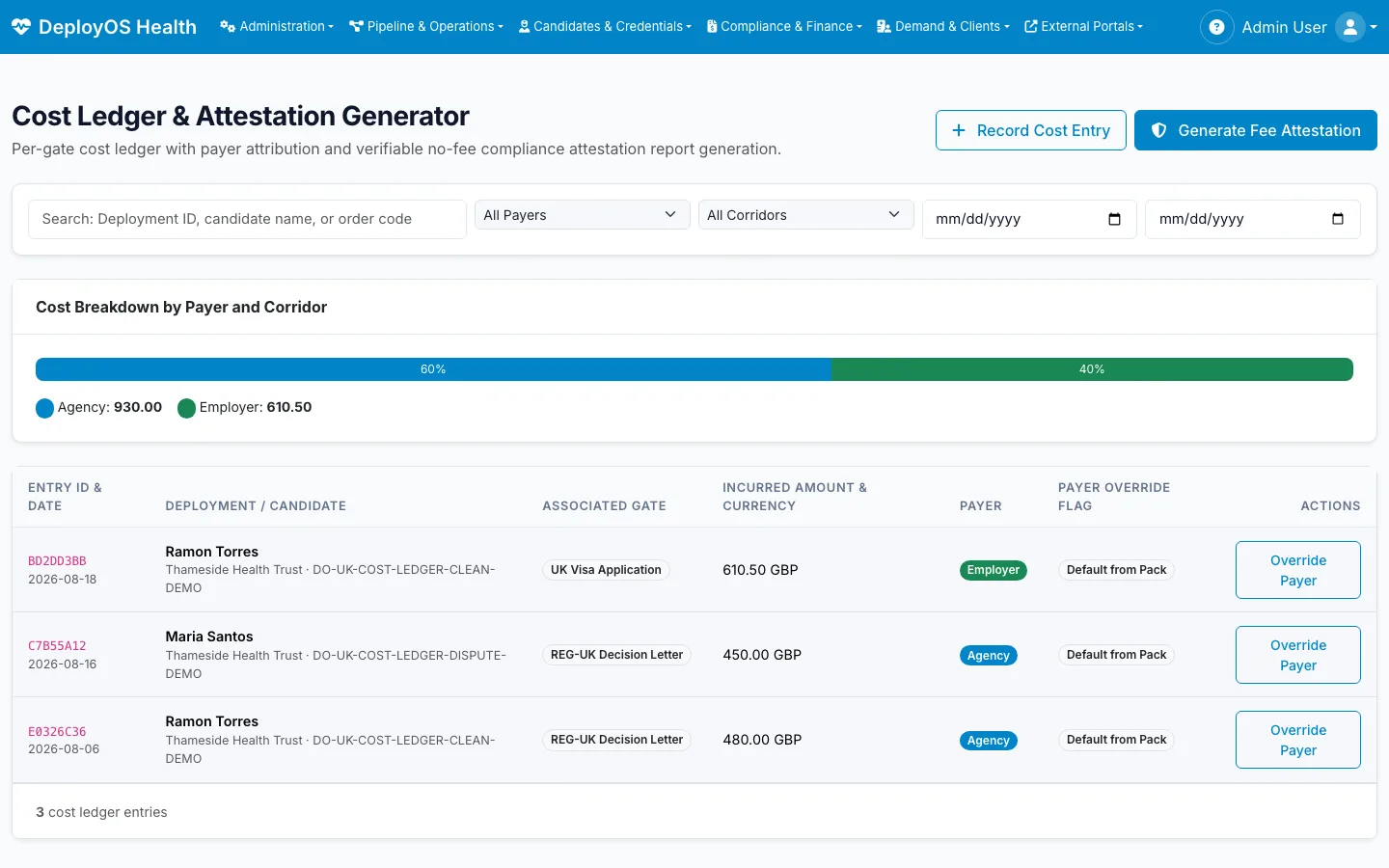
A live demo with invented employers and candidates runs at deployos.xamun.ai. It is bought as a licence for your own instance or as Outcome-as-a-Service. The system records what your team enters; it does not decide for you which corridor is a no-fee corridor. That stays with the DMW and your compliance lead.
Questions agencies ask
Can a Philippine recruitment agency charge a nurse a placement fee?
Only up to one month’s basic salary in the DMW-approved contract, and only where it is allowed. Section 56 of the 2023 DMW Rules bars any placement fee for domestic workers and for workers going to countries whose law, policy or practice does not allow recruitment fees to be charged. Where a fee is allowed, it is paid only after the worker signs the DMW-approved contract, against a BIR-registered receipt.
Can a Filipino nurse be charged a placement fee for a job in the UK?
No. The 2021 UK–Philippines memorandum of understanding on the recruitment of Filipino healthcare professionals says no employer, recruitment or placement agency may collect a placement fee or the agency’s costs from a nurse or healthcare professional to be deployed, directly or indirectly. The UK Code of Practice for international recruitment also says international health and social care staff will not be charged fees for recruitment services.
Is the Philippines on the UK red list for health worker recruitment?
No. The Code of Practice for international recruitment in England (updated 27 March 2025) lists the Philippines as a green country with a government-to-government agreement. The red list is drawn from the WHO Health Workforce Support and Safeguards List 2023, and active recruitment from red-list countries is not allowed.
Can a UAE employer make a nurse pay recruitment costs?
Not under the UAE’s private-sector labour law. Article 6(4) of Federal Decree-Law No. 33 of 2021 prohibits the employer from charging the worker the fees and costs of recruitment and employment, or collecting them, directly or indirectly. The law covers the private sector; employees of federal and local government entities are outside it, so check which rules the employer sits under.
What may a Filipino nurse still pay for?
Section 55 of the 2023 DMW Rules lists the only costs the worker pays: personal documentation such as the passport, NBI, police or barangay clearance, PSA birth certificate, authenticated school records and PRC licence, a TESDA certificate where needed, the DOH-prescribed medical, and PhilHealth, Pag-IBIG and SSS membership. Section 58 puts the visa, work and residence permits, round-trip airfare, airport-to-jobsite transport, the DMW processing fee, OWWA membership and any extra trade test on the employer.
How does a recruitment agency prove a nurse paid no placement fee?
With records made while the work happens, not a statement written afterwards: a cost ledger per candidate that names who paid each cost, the signed service agreement showing the employer pays the agency, receipts for anything the candidate paid that the rules allow, a signed candidate declaration, the repayment terms in the employment contract, and an audit trail of who recorded or changed each entry and when.
Sources
- Department of Migrant Workers, Department Circular No. 01, series of 2023: 2023 DMW Rules and Regulations Governing the Recruitment and Employment of Landbased Overseas Filipino Workers, signed 9 June 2023. Sections 55, 56, 58, 59, 60, 129–134 and 139. The circular’s preamble records RA 11641’s signing (30 December 2021) and effect (3 February 2022).
- Philippine Overseas Employment Administration, 2016 Revised POEA Rules and Regulations Governing the Recruitment and Employment of Landbased Overseas Filipino Workers, Section 51 (copy hosted by ASEAN).
- Republic Act No. 11641, the Department of Migrant Workers Act, signed 30 December 2021.
- Department of Health and Social Care, Code of practice for the international recruitment of health and social care personnel in England, updated 27 March 2025. Fees benchmark, repayment clauses, red/amber/green grading, Annex B and case study 1.
- Governments of the Philippines and the United Kingdom, Memorandum of Understanding on the Recruitment of Filipino Healthcare Professionals, signed October 2021, published 11 November 2021. Paragraphs 4, 9 and 10.
- Employment Agencies Act 1973, section 6(1), as cited in the Code of Practice.
- UAE, Federal Decree-Law No. 33 of 2021 Regarding the Regulation of Employment Relationships, English text published on the UAE government portal (marked by the publisher as not an official translation). Articles 3, 6 and 74; in force 2 February 2022.
- Department of Migrant Workers advisory of September 2024 naming Qatar a non-placement-fee country, as reported by GMA News and the Gulf Times, September 2024.
Before you rely on this: rules and no-fee country lists change. Confirm the current position with the DMW, the employer’s regulator (in the UK, DHSC and NHS Employers; in the UAE, MOHRE) or a lawyer before you act on it.
Related reading: DeployOS Health: nurse deployment software for recruitment agencies → RosterOS: rosters, credentials and timesheets once workers are placed → Healthcare at Xamun →